Letters on Photography by Kim Beil and Annebella Pollen
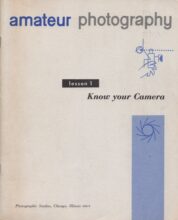
Correspondence Course began as a creative adventure during the confinement of Covid lockdowns. While the doors to many museums and archives were still locked, two historians of visual culture, Annebella Pollen and Kim Beil, sent each other, by post, photographic curiosities and ephemera as gifts and as writing prompts. The resulting eight essays are written as personal letters. They are informal, reflective takes on photographic history and collecting, with research folded into autobiographical stories. The project takes its name from the first item sent out across the sea: a guide for a 1960s educational course on camera technique taught remotely, via post. Below, Pollen and Beil present the first of these Correspondences as an evolving series of Photomonitor Experiments.
__________
Correspondence Course 1
From Annebella Pollen to Kim Beil:
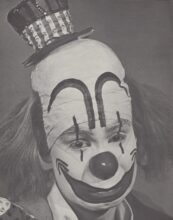
“Welcome to an exciting adventure in photography!” So declares the opening page of 1965’s Amateur Photography series of instruction manuals. It is a fitting start too, to this Correspondence Course of scholarly pen pal writing. Lesson One, the manual states, is to know your camera, but what unites the two of us, perhaps, is our interest in the structures around that knowledge; what you have called ‘the rules’. Here they are in joyless abundance, across didactic text, diagram and recap quiz, including exemplar photographs. You too could take this grotesque clown portrait, the message goes, if you follow the dry guidance closely enough!
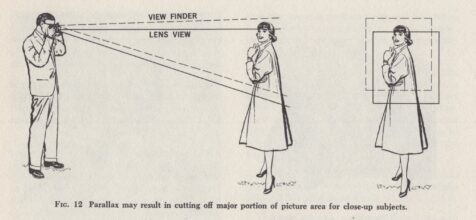
Just this morning, I was browsing at a car boot sale (where, in fact, I found the object that I am about to send to you for Correspondence Course, Edition 2). I marvelled at a How to Swim manual from the 1950s, where via a series of mathematical tables, numbered manoeuvres and line drawings, a trusting pupil might risk their life by attempting to traverse deep water. The stakes are not so high in learning photographic skills by booklet, but the publication shares some of the same character. Is it really necessary to know about the concept of parallax before one even begins to photograph? The original owner of the manual thought so; they added a summary on the topic – “a difference in view from viewfinder and lens” – in capital letters in the Notes section at the rear of the guide.
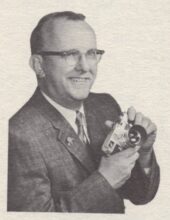
Once the first Lesson has been absorbed, the first photographic assignment may begin. Six pictures must be taken, for postal evaluation, across six categories: Portrait, Landscape, Interior, Still Life, Animal and Action. Judging by the line drawings used to demonstrate the science of lenses, a dog on its hind legs and a woman in fashionable swing coat and heels might be suitable subjects for the (male) photographer depicted. For those unclear about what Still Life might comprise, a suggestion of “a vase of flowers, a book and a candle” is given, which seems curiously archaic for 1965. Nonetheless, some historical interest is assumed, as Lesson 1 also includes a quick potted history of photography’s invention. Interestingly, from a British historian’s point of view, Daguerre is given the sole honours in this Chicago account. Fox Talbot is nowhere mentioned. A British equivalent summary in the period would put the Englishman at the centre.
Lesson 2 is heavier on the science and lighter on the clowns, with “chromatic aberration” and “curvilinear distortions” deemed essential next-step knowledge. I would surely fail this course. In the final quiz, without revision, I got most of the questions wrong. The original correspondent, however, is gaining in confidence. Key aspects of the text are now highlighted assertively with neon pen; the only annotations in Lesson 1 were tentatively in pencil. By the end of the booklet, they are ready to take on the second assignment, which requires an engagement with the principles of depth of field; the subject can be either a rural scene of “rolling prairies” or “a long main street shot”. I enjoy the American particularities of these instructions from my reading position on the other side of the Atlantic (5,370 miles from you, Kim, as you pointed out in your accompanying postcard).
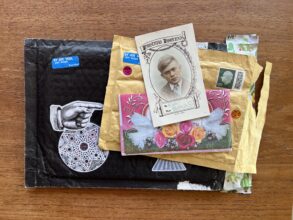
I’m on firmer territory in Lesson 3, as the final booklet in the elegant envelope you sent, which I opened very carefully, with scissors, on the kitchen counter, so as not to spoil the taped and looped closure, but then unwittingly rested it on the remains of my evening meal. The final lesson is about taking sufficient care and preparation and I stumbled in this task in opening your letter. In reading composition and in seeing photographic rules, however, I have a better, if instinctive, track record. I can boast the “trained eye” that is the outcome of Lesson 3, by dint of simply looking at a lot of photographs over very many years.
The manual’s author, Martin J. Schmidt, a besuited white man in JFK spectacles, emphasises that one must see as a camera sees, and organise composition around three key principles for good results: simplicity, a strong “center of interest” and leading lines of movement. These might not apply when one is taking a photograph, he says, of a laughing baby (interesting “to most”) but are essential with subject matter “not in itself very interesting” (a coiled rope).
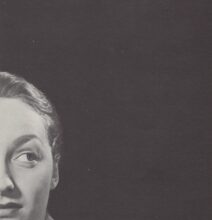
Two examples stand out to me in the illustrations: a striking photograph of a woman’s face, trapped in the bottom left corner of the frame, but whose eyes look upwards into the black space that fills more than three-quarters of the remaining image. After the previous pictorialist and historicist prescriptions of prairie and candle, this portrait seems remarkably fresh, and full of imaginative openness in its blank space.
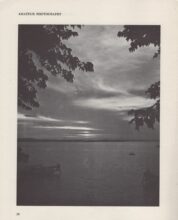
My second favourite belongs to a curious genre that I collect wherever I find it in flea markets: the monochrome sunset photograph. Here, it is used to model ideal composition with lines, but in a manual of guidance printed only in black and white, the key aspect of what is attractive about the setting sun in the sky needs to be passed over for such an image to be deemed a success.
At the end of the first entry of this Correspondence Course, then, what have I learned? That I love receiving things in the post, and that you and I share an enthusiasm for viewing and dismantling photographic constructs. The original pupil of the 1965 course of study seems to have dropped out by Part 3: their final quiz goes unanswered. For us, however, let’s continue the lesson.
__________
With thanks to Annebella Pollen and Kim Beil for their text and images.
Annebella Pollen has been writing about photographic archives and lesser-known visual histories for over twenty years. She is the author of five books: Mass Photography (2015); The Kindred of the Kibbo Kift (2015); Nudism in a Cold Climate (2021); More Than a Snapshot (2023) and Art without Frontiers (2023). She is Professor of Visual and Material Culture at University of Brighton.
Kim Beil is an art historian who teaches at Stanford University. She is the author of two books: Good Pictures: A History of Popular Photography (Stanford, 2020) and Anonymous Objects: Inscrutable Photographs and the Unknown (MACK, 2023). Her writing on photography and visual culture also appears in the New York Times, the Atlantic, the Believer, and Cabinet magazines, among many other publications.