

What counts when we are talking about an image? “[..] what counts, faced with an image, is not “what we are talking about”. What counts is the dance itself – of my gaze and my sentences – with the image. It is a question of rhythm”, writes Georges Didi-Huberman[1]. It is through this rather poetic position that it might be interesting to initially approach French photographer Sarah Ritter’s work and tap into the rhythm not of her own projects, but of the ‘Collecte’ (Collection) of images and quotes curated and hosted on her site.
This de-fracted, as it were, move is adopted, because I consider her presentation in ‘Collecte’ as a meta-thinking/seeing access point: from there we can observe the process of her thinking/seeing. We can see, and ideally listen, to the rhythm with which a photographer with a philosophical background has an affinity, by assembling images with sentences from philosophers, artists and writers.
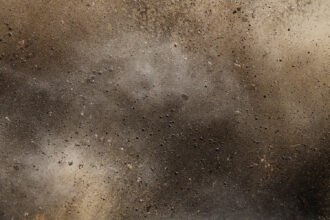
Playing in that framework, the beat she chooses, in the sense of the underlying pulse permeating her selecting process, stems from the invisible zone or from where there is darkness until it is cracked by light. In ‘Collecte’ the visual cues for this beat are the abstract grey scale scans, the scientific image, the almost impenetrable black photograph of her grandmother in Paris coupled with numerous quotes, from Melville, to Lucian, to László Moholy-Nagy. As for the speed of the movement, the tempo, so to speak, that would be slow, pensive and often silent. She quotes Rilke to refer directly to silence, yet it is also found in the five women’s images presented with only one of them looking back at the viewer. Almost all of them belong to epochs long gone, yet nonetheless achieving in shifting in a zone hovering in time, as we are directed more towards their act of looking. And of course there are pitches in the rhythm, created by repetition in content, with two very different photographs of hands, repetition of a detail of an image on a different scale and a quote by Balzac. And still the above description of the rhythm in ‘Collecte’ is far from representative, as there are more in-depth pulses that may be heard if we open up the ‘invisible’ zone, linked with Allan Sekula and Annie Ernaux.
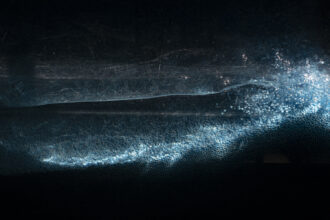
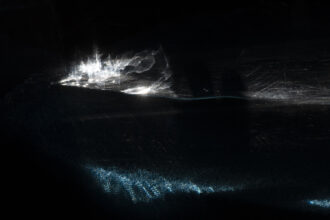
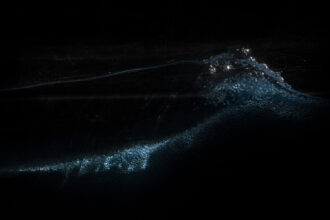
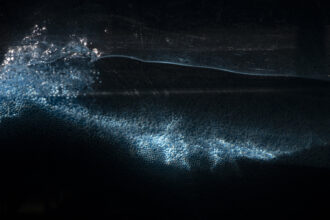
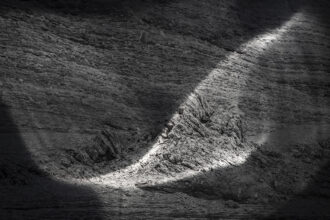
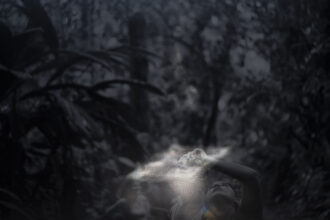
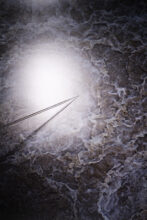
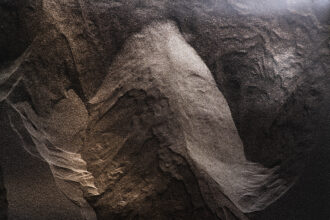
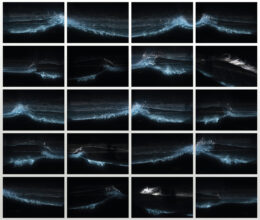
This is a very ‘present’ and yet elusive rhythm, leading the viewer/listener/reader to the heart of materials, objects and experiences. And it is with this in the background that one can ‘hear’ the rhythm reflect on Ritter’s most recent projects: in the staged photographs in her studio, ‘Soleils Fantômes’ (Phantom Suns) (2021-2022) where there are images in which she uses light to transform rock into fabric or where she creates a white/’black hole’ from the water movements during sand dredging, ‘shot with the arrow’ of an optic fiber. In the ‘Vagues Scélérates’ (Rogue Vagues) (2022), playing along the parallel between light and aquatic waves to re-create the flow of an artificially made sea, making us listen to the sound of each wave at a time, just like Leibniz talked about in his ‘minute perceptions’. And of course, in the series ‘Ors’ (Gold) (2022-2023) listening to the pitch of those tiny nuggets of gold being unearthed through the intense processes used.
So what counts when we are talking about an image? It is the dance. But nothing tops a good dance, not just for the thrill of experimentation, but right in the heart of a Golden Sea of Rocks, in the heart of the grave reality.
_
[1] Didi-Huberman, Georges (2016).“Glimpses. Between Appearance and Disappearance”. Zeitschrift Fuer Medien Und Kulturforschung 2016 (7):109-124.
__________
About the artist
Sarah Ritter became an artist after studying philosophy with Jean-Luc Nancy and photography at the National School of Photography in Arles. Her artistic practice is process oriented and for each project she aims at developing the proper way of making and showing images according to each topic. Her first monograph “La nuit craque sous nos doigts,” was published with Loco editions in 2019. She also edited the book “Wild Rumors, Moby-Dick, Detroit and autres récits” in 2023, which was the outcome of an art research project based on Melville’s book, in collaboration with writers, artists, philosophers and sociologists. Her work is part of several public and private collections in Europe and is regularly exhibited in France, (solo and collective) and in other countries, (collective shows in Finland, Germany, Slovakia, Mexico, Argentina). Ritter received several major grants, like the Institut pour la Photographie des Hauts de France research program, BNF’s “Radioscopie de la France” major commission, the Schneider Foundation prize, and has been also supported by the Fondation des Artistes.
About the author
Alexandra Athanasiadou, PhD, is the founder and director of the PHLSPH – Philosophy & Photography Lab, an online international platform connecting philosophers with visual artists using the photographic medium through workshops, discussions, mentorship and tailor-made activities designed for knowledge sharing. She has been working with artists for the past fifteen years by exploring different positions in the photography world through various collaborations with institutions, organizations, festivals and galleries. She holds a PhD in philosophy (Aesthetics) from the National and Kapodistrian University of Athens, a Master of Arts from the Courtauld Art Institute in London, and is a graduate of Oxford University (St. Hilda’s College) and of the Panteion University of Social and Political Sciences (Athens).
About Philosophy & Photography Lab
The online independent platform PHLSPH – Philosophy & Photography Lab, was founded in order to bridge existing gaps between the communities of photography and philosophy and to encourage collaboration between people interested in photography for different reasons who might otherwise not encounter each other’s work and ideas. The platform invites artists to collaborate with philosophers and researchers in an ongoing series of workshop events; it designs critical tools which may be applied to creative process; it develops theoretical and critical commentaries on artistic work in order to bring those with different interests in photography closer together; and it organizes virtual and live encounters in the form of pop-up discussions and interviews. Details of past and future events and activities can be found on the lab’s website