Photographs: Sam Laughlin
Words: Emma Jones
An attempt
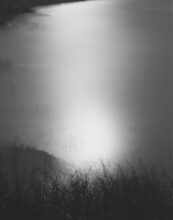
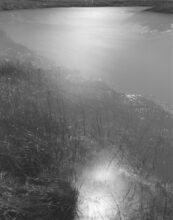
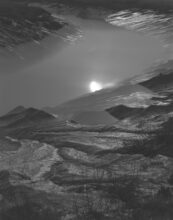
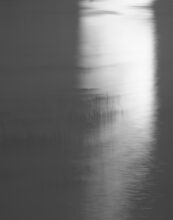
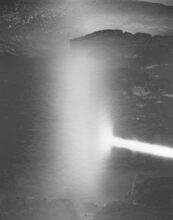
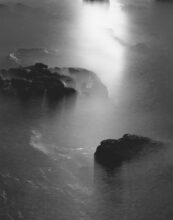
He checked the charts fastidiously and, for one year, ran to a lunar clock. Tide watcher, moon’s lover, photographer. It became, by his own admission, something of a compulsive habit. Traipsing down to various riverbanks across the Southwest of England with a heavy camera and mud-caked shoes. These are the results of his patience.
At first, when I saw the prints, I was not sure what I was looking at. Only that I knew it.
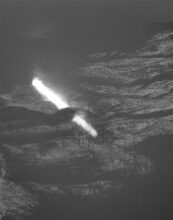
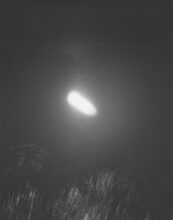
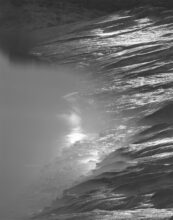
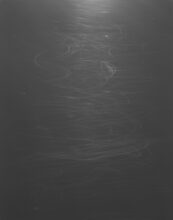
The ground is thrumming. The world hovers between states and, somehow, both are there on the paper. These are unsteady landscapes. In-between places. Ecotones. The water, pulled back, reveals curving slopes of mud. Grasses left stranded on their sticky banks. The moon extended, no longer a circle but a rod of bright light, the mirror of its journey across the sky.
Thin veil pulled over it all. Fishscale silver. A shimmering.
I’m reminded of Virginia Woolf
– the essay must lap us about and draw its curtains across the world –
To write in a way that embraces the same language of flux. An estuary shifts and moves, and is hard to pin down with definition. Physical changes are visible in its tidal flow but it is never fully realised. How to visualise or give language to this process, the movement of one thing to another while still existing as both.
A trip
We went to the river together last year, in early December. Me with my notebook. Him with his camera. I couldn’t write. My gloves were too thick to hold my pen. Everything was still. I was impatient, but scared too. Hyper-aware of some potential danger lurking in the darkness. We weren’t trespassing, but it still felt wrong to be there so late. If we’d been able to cross the huge width of the Wye at the point where we stood, on the edge of England, as the river curved in a crescent only visible on the map, then we would have met the shore of Wales. When we arrived the cusp of the moon was just starting to rise above the tops of the bare trees. We waited.
When I crouched down close to the riverbank, I could hear the mud pushing and pulling, a slight sucking sound, a laboured breath. I peered at the reeds at the water’s edge, and tried to figure out whether the water had risen or fallen around their spindly bundles. When it happens it starts slowly, there is no sudden change, it is impossible to pinpoint the exact moment when the water begins its counterflow.
It feels a bit mad, he’d muttered, as he extended the tripod and pushed its legs into the clagging mud, now that there is someone else here watching me.
I asked to look through the viewfinder of his camera. The scene was flipped. The moon rippled, unable to hold its shape. At that size it seemed vulnerable, ready to be swallowed up. As if it could be dissolved on the tip of the tongue. On the water it didn’t seem to be on the surface at all but rising from beneath, pushing up its needles. After he loads the film and begins the exposure, he may wait minutes, or hours, before closing the shutter.
Selective history
In the seventeenth century, Johannes Kepler saw the relation between moon and tide as inflected with a type of desire. He suggested that the seas wanted to take flight.
– If the earth ceased to attract (to itself) the waters of the sea, they would rise and pour themselves over the body of the moon –
It’s a seductive image.
The thought of the water rising because it wants to flow over the moon’s body, to push its tongues over lunar rock, to fill the craters. The water wanting to understand what it means to be solid, just as the moon in his photographs is seeking a less stable form.
An echo
What I had thought was a haze or mist sitting just above the water was actually a sheeny covering. It split and multiplied and formed into eddies. We stood together and watched as the water picked up speed, and became a rapid flow. Huge pieces of driftwood sailed past as if they were weightless. I was reminded of seeing something similar in the city, not too far from where we stood, but a different river. A white fridge, its top door busted open and hanging toothily at the hinge, carried downstream.
Collaborators
A few weeks after our trip to the river he sent me the photos he took there.
Exposed by the moon, and flowed into being by the tidal shift.
In the past the words time and tide were used interchangeably, the water’s rising and falling used to track the minutes and hours instead of a clock. We think of the photograph as something fixed, of holding a moment perfectly still. Here, time unfolds in front of the lens and shows the world in a state of constant becoming.
I thought that the river where I saw the fridge had flooded once. It was early, a leaking watercolour morning inverted and sweeping high and threatening to overtake the path. It crept over the tree roots. There was a man who stood close to me by the edge who was also looking out, a small dog tucked behind his legs like a shy child. High tide, the man said to me. High tide, I said back. As if our recognition of the water were a type of greeting.
__________
Emma Jones:
Emma Jones (ekj.ink) is an art writer and essayist. Her published work encompasses criticism, travel writing, and blended memoir. Recent writings are found in Photography: A Feminist History (2021), the Italian magazine L’Essenziale Studio Journal V.4 (2022) and Scottish indie press Gutter (2023). In 2024 Jones was longlisted for the Anthony Burgess/Observer prize for art writing, and was a writer in residence with the Jan Michalski Foundation. ekj.ink
Sam Laughlin:
Born 1990 in Cambridge, UK. Sam Laughlin is a British visual artist whose recent practice is primarily concerned with intricate natural processes quietly unfolding through time in patterns and cycles. Mainly utilising large format black and white photography, his work is characterised by sustained and informed engagement with the natural world.
Laughlin has exhibited widely both in the UK and internationally, including at Jerwood Space, Impressions Gallery and Towner Art Gallery. In 2017 he was awarded the Jerwood/Photoworks award. He works mainly on personal projects and commissions and has worked with GRAIN Projects and John Hansard Gallery amongst others. His most recent series Spinning Away was awarded Juror’s Choice at the Hariban Awards. In 2024 he was the inaugural artist in residence with Borders Forest Trust. He is currently based in Somerset, where alongside his practice, he lectures on Photography. samlaughlin.co.uk