A few days into the breakdown of my first long-term, committed relationship I went to The Garden Cinema with my mum. In the hallowed, art deco style walls, we sat in silence and watched All the Beauty and the Bloodshed, the expansive documentary on the activist and photographer Nan Goldin. The life I’d once imagined for myself promised certain things. Security, stability, family. Now I was walking away from all of those promises into the unknown. But it wasn’t the break-up that had destabilised my relationship to the expectations of traditional heteronormativity; it was getting sick(er).
I’d long had to fight within my relationship to justify my disabled body. My partner wanted me to get out of bed, to wash regularly, to participate in the rituals of domesticity. But my DNA was made up of refusal in a way I couldn’t override. And with him as my primary witness, his continual invalidation probing me to feel guilt over my involuntary deviance, I ceased to exist at all. I’ve always loved the cinema as a space to reflect and affirm our own experiences, or simply get lost in the life of someone else for a while. Looking up as Goldin unapologetically documented her reality, during a time when this wasn’t the norm, I felt galvanised to stop apologising for all the ways I’m different.
Though not the primary focus of Goldin’s photographs – which take place across interchanging scenes of bars, clubs, the street, and homes of the queer community in which she was firmly rooted – the bed resurfaces again and again. Training her lens as witness for the parts of life often unseen and hidden behind closed doors, Goldin and her friends appear in bed relaxing, having sex and deep in the throes of addiction. For me, bed had become a recurring character, spending extended periods of time bedbound as a result of my disability. Seeing how Goldin’s addiction placed her into orbit with medical paraphernalia and outside of linear, capitalist time, I found myself drawing links with my own shrouded world.
The ways we construct our identities in public versus in private are fused within Goldin’s images; Goldin and her friends strived to live authentically whilst amongst kin regardless of location. Meanwhile, I was experiencing a continual fracturing of the self. When I was at my most sick, I was predominantly alone. Only my mum and my partner had perceived me wholly in relation to my disability. To be amongst peers, I had to be well enough, and thus the majority of people observed a construction based on me masking my more debilitating symptoms. I began to feel frustrated at the discrepancy between how I was understood by others, versus the actuality of my quotidian existence. Entering periods where sickness dominated my every waking and sleeping hours, I became hyper aware of the fact that no one knew the real me.
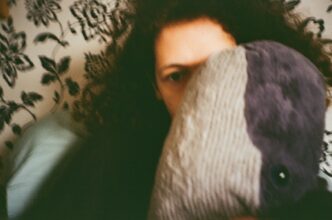
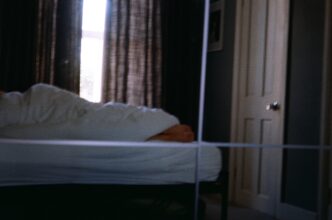
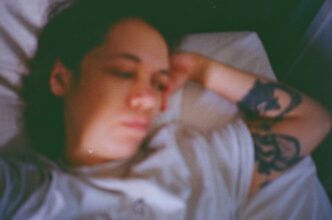
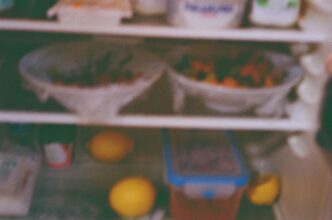
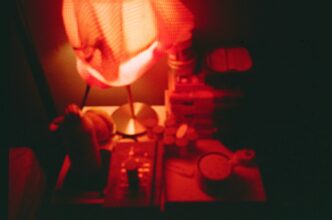
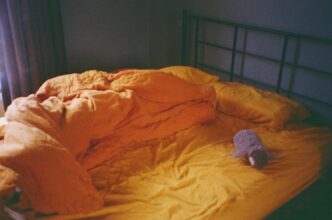
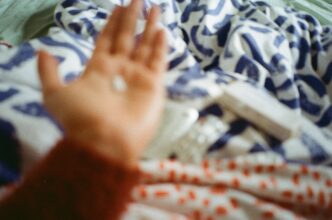
Returning home that evening, I picked up my simple point and shoot camera, and began trying to dissolve the separation between my public and private selves. I couldn’t have anticipated that my health would soon deteriorate further, leaving me bedbound and completely cut off from the world for an entire year. With new physical symptoms making my artistic practice largely inaccessible to me, the camera became my one method of articulation. My bed became my studio. My camera, my sole witness to the everyday of being disabled. The resulting series, Flare, is still ongoing. Named for flare-ups that occur in fluctuating disabilities, and the camera flare of light that might overtake and distort a film photograph. There is an instability in the quality of the images. Taken in low lit bedrooms and hospital rooms, they are often blurred, linking the precariousness of both film photography and health. Across my year in bed, my number of friends dwindled. Finding I could never leave the house, invitations and messages quickly dried up. For the most part the only company I kept was my mum, as she resumed the role of my full-time carer. Taking photographs, then, became an act of witnessing, of proving my own being, immortalising the outline of my unobserved days. All the while Goldin’s words echoed in my head:
‘I mean that’s the problem, you grow up being told, “That didn’t happen. You didn’t see that. You didn’t hear that.” And what do you do? How do you believe yourself? How do you trust yourself? How do you continue to trust yourself? And then how do you show the world that you did experience that, that you did hear that? So that’s the reason I take pictures.’
__________
Jamila Prowse
Jamila Prowse is an artist and writer, propelled by curiosity and a desire to understand herself through making. Informed by her lived experience of disability, mixed race ancestry and the loss of her father at a young age; her work is research driven and indebted to Black feminist and crip scholars. She is an active participant in a rich and growing contemporary disabled artistic community and has been researching, programming and creating around cripping the art world since 2018. Self taught, Jamila is drawn to experimenting with a multitude of mediums in order to process her grief and radical hope.
Viewing her practice as grief work, Jamila uses visual art making as a way to process complex family histories, loss, trauma and the isolation of being a bedbound, disabled, autistic person. Often incorporating oral histories into the conception of her works; the location of voice is vital in her explorations. She embeds creative access adjustments from the outset of each project – seeing access as a method of artistic articulation.
She is currently articulating through moving image, painting, photography, textiles and performance. Previous exhibitions and talks include TULCA Visual Arts Festival, (Galway Ireland), Ormston House Gallery, (Limerick, Ireland), Somerset House, South London Gallery, Studio Voltaire (London, UK) and Hordaland Kunstsenter (Bergen, Norway). Her writing has appeared in Frieze, Art Monthly, British Journal of Photography and elsewhere.
Instagram: @jamilaprowse
Website: jamilaprowse.com