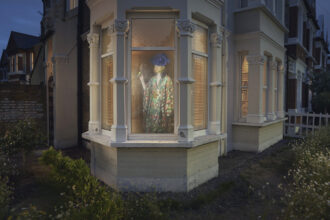
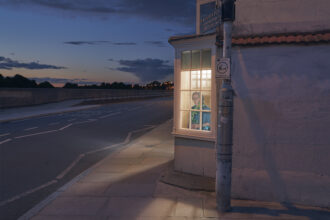
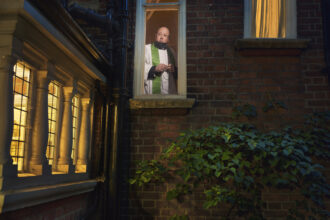
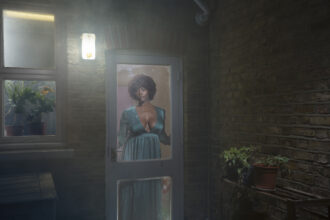
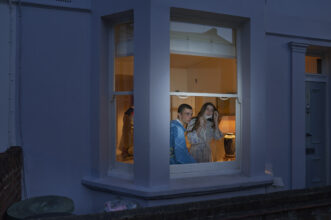
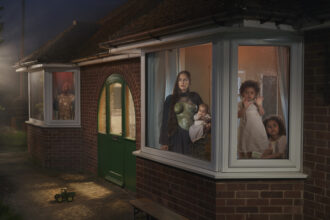
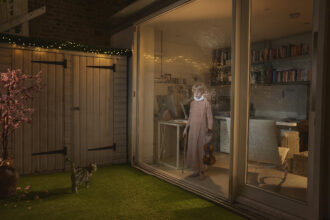
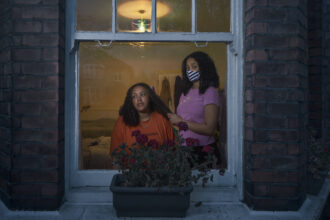
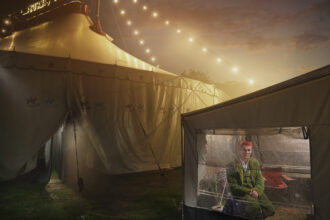
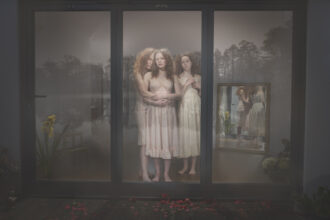

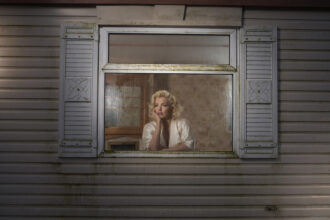
When news of the first UK lockdown circulated in March 2020, many of us prepared for our life indoors and months of limited engagement with the outside. Some, however, were intrigued by what they saw from the outside through the windows separating us. Julia Fullerton-Batten hit the streets to photograph dozens of compelling compositions in her recent series, ‘Looking Out From Within’, and has just launched a crowdfunding campaign to create a hardback publication of her works. Below, Christiane Monarchi recently asked Julia about the background to these images and her artistic process.
__________
CM: As we are speaking now in June 2021, hopefully nearing the end of lockdown in the UK, I am enjoying looking again at the works that you have made during the pandemic and the different lockdown periods here. The immediacy, the searing memory of containment, has been rendered so beautifully in your compositions, that I can now detach myself from my own Pavlovian response and see these images in a new light. ‘Looking out from Within’ contains so many interesting subjects, I’d love to know more about how you gained the confidence and trust to photograph these people in such a difficult time, and indeed, how you found them?
JFB: Nothing had prepared us mentally for the first nation-wide Covid 19 Lockdown imposed on March 23, 2020. It was a bleak encounter with a new negative factor on our lives and heightened even more the fear of the pandemic.
Everything ground to a halt. The usual hum of activities in our neighbourhood ceased, streets were empty of vehicles and pedestrians. Two assignments were postponed then cancelled, I had to call off a personal shoot at short notice. I had no work; the future was uncertain. I was numb from a combination of the fear, the inactivity and the uncertainty. I realised that I needed to do something to break this deadlock.
I took hourly walks in my neighbourhood as permitted exercise and noticed people looking lost out of their front windows. I had found my idea for a project that, as it turned out, would preoccupy me for over a year. I would document this time of the soullessness of lockdown for posterity, of people imprisoned within their homes. Of necessity it would be small scale, restricted to my neighbourhood in West London.
CM: How did you work out the process for engaging with your subjects in this time when it was so difficult to see people?
JFB: I formulated my idea and posted it online and in the local newspaper. The response was truly amazing, even some people from outside London responded. I realised that I had to select my choice of setting to avoid sameness. Later on, word-of-mouth and prepared letters dropped through the letterbox of interesting houses enabled me to become even more selective. In hindsight it was amazing that people were so receptive to the idea of a complete stranger entering into their lives, above all a photographer who believed in meticulous planning for a shoot and then took a long time to consummate the shoot itself. It was a wonderful experience to find out how people reacted to their involvement in this project, all of them with pleasure and exuberance. I think they welcomed the break in the monotony of life under lockdown.
I shot during the twilight hour capturing the most magical combination of lighting setup – then later on in the evening available ambient indoor lighting mixed with flash, using the sitter as an assistant to rearrange the indoor lighting, often asking them to bring additional lighting from other rooms in their home. On several occasions in the later months the shoot extended into the early hours of the next day.
CM: How did lockdown change your working practice?
JFB: My equipment and cinematic approach remained true to my photographic style with the use of flash and bringing in props and vintage clothing. On occasions my 12-year old son Finn assisted me. It was only during the third lockdown that I was able to use one of my usual assistants.
The project awoke recollections of my start in my career when I used very little artificial lighting and street-cast models. To a certain extent, it was refreshing but I’m not sure that I will carry on shooting this way as my lighting technique has developed over years and is a major feature of my photographic style.
CM: What is the next stage for this project?
JFB: By end of this year, I will have published my third book which I am at present in the process of self-publishing. Titled Looking out from Within it will contain the images and answers by the sitters to questions I asked them as to how they were coping with life under a lockdown.
__________
Julia Fullerton-Batten is a fine-art photographer renowned for her highly cinematic visual story-telling. Her large-scale projects are based around specific themes. Each image in the project embellishes her subject matter in a series of thought-provoking narrative ‘stories’ using staged tableaux and sophisticated lighting techniques.
Julia’s use of unusual locations, highly creative settings, street-cast models, accented with cinematic lighting are hallmarks of her style. She insinuates visual tensions in her images and imbues them with a mystique that teases the viewer into continually re-examining the picture; something new coming to the fore each time.
Her fine-art work is globally renowned and exhibited. She has won many awards worldwide, is frequently portrayed in photographic journals, has published two books, is a Hasselblad Ambassador and a frequent speaker at international workshops and a juror of international competitions. She has a permanent collection at the National Portrait Gallery, Musee de l’Elysee, Lausanne and the Parliamentary Art Collection, Houses of Parliament.
A crowdfunding campaign has been launched today to publish Looking Out From Within, more details can be found here: Looking Out From Within