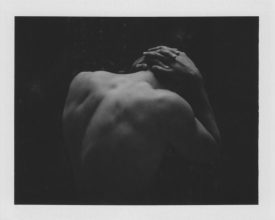
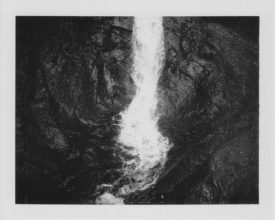
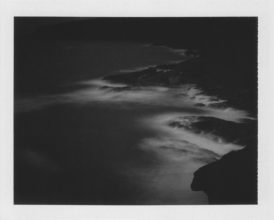
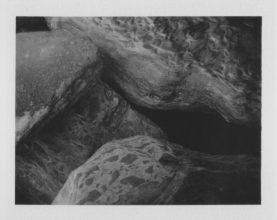
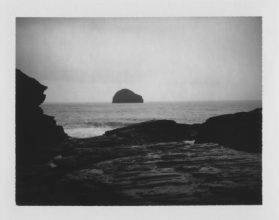
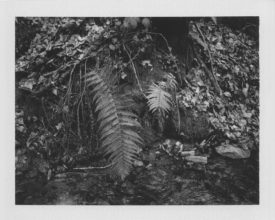
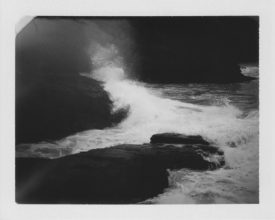
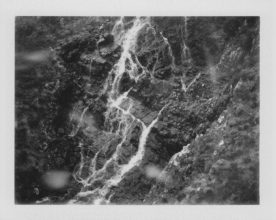
Cyrus Mahboubian (b. 1986, London) is a British-Iranian artist known for his contemplative approach to photography and his use of analogue materials, especially polaroid. He has stated that his intentionally slow process is a response to the increasing influence of technology in modern life. Mahboubian’s debut photo-book VISCERA was published in May 2019; below, Nico Epstein recently asked the artist about the background to this project.
__________
NE: It is so important today to have something tangible. We live in a world where we are constantly bombarded by digital experiences. Of course, photography itself often comes across now as being more digital than analogue. What I have always admired about your practice is the use of traditional photographic techniques and your eye for underused and underexposed (pun intended) film and its physical outcomes. The idea to make a photobook seemed like a natural progression for you. When did you come up with the idea and why did you decide on making it now?
CM: Books are a wonderful way to experience photography. Commercial art galleries can sometimes feel cold and impersonal, but you can sit with a book and take your time with it. You have this intimate one-on-one encounter with the work. I got into photo-books back when I was a student and first started to develop my practice. I would browse the books at The Photographers’ Gallery in London – and started collecting the classics, like Robert Frank’s The Americans – it was an important part of my education. I knew I didn’t want to rush making one, that it had to be the right body of work.
NE: When did you decide to start work on VISCERA?
CM: Last year, once I realised I had a body of work that felt representative of this early stage of my career. For the last five years, I’ve been predominantly working with a particular type of instant analogue film that is, sadly, no longer in production. Having found my voice as an artist using this film and drawing close to the end of my supply, it felt like a natural moment to publish the images
NE: Speaking about the film — tell me about this type of film that you’ve used specifically for this book… How did you discover it and what drew you to it originally?
CM: I’ve been shooting polaroids since I first got into photography in 2006 while at university. The pleasure I felt watching the small-scale pictures manifest before my eyes – as if by magic – is something that has never left me. While I’ve refined my practice and trained my eye, I’m still smitten with polaroids because of their singularity, intimate scale and the tangible nature of the print.
The type of film I used for the body of work published in VISCERA is a professional-standard black-and-white instant film that was first developed by Polaroid in the 1960s and later produced by Fujifilm. It’s commonly referred to as “peel-apart” film. Sadly, like so many analogue films, it was discontinued in the 2000s. I discovered it at a moment when original Polaroid stock was too far past expiry to be reliable and new film being produced by The Impossible Project (now rebranded Polaroid Originals) was not stable enough to use for professional purposes, and this opened up new possibilities for my work.
The quality of the film is superior to other instant films – it was designed to be suitable for industrial uses, such as photomicrography, ultrasonography and oscillography. I found that because of its fine grain I could make portraits with very smooth flesh tones, and I achieved better tone reproduction in my landscape work thanks to its improved highlights.
In terms of the physical print, these photographs are rectangular – not the iconic square polaroids people are most familiar with. They resemble high-quality traditional darkroom prints, but are made with all the convenience and joy that comes with instant photography.
NE: The material in the book comes from three pivotal years in your career: 2016, 2017, 2018. What made these years special enough to be included in this first photobook of yours?
CM: I’d say those years are when I hit my stride. A decade on from when I first started using photography with the intention of making art, by 2016 I had found my voice and photography had started to feel effortless, instinctive and flowing. I was free of hesitations I had in earlier years, knew what subject matter interested me and was successful in portraying it as I saw it in my mind’s eye.
NE: I think this notion of flow which you mention is very integral to your practice, and what I’ve noticed looking at the book is that when the works are being catalogued and referenced there’s no mention of the location or the date. I feel like this allows the material within VISCERA to encapsulate an overarching emotive drive — a feeling, a texture or a modality. What was the motivation behind this lack of captioning and what is it that you were trying to evoke or convey by not providing any information outside of the works themselves?
CM: It was a conscious decision to not include information about the photographs, such as dates or the locations where the images were made. I’m not one of those photographers who gets caught up in the technical side of things, f-stops etc. That isn’t what interests me. My main concern is that the images evoke a feeling, an atmosphere. I still enjoy photography most when it communicates on a basic – i.e. visual – level, and have never wanted the strength of my work to rely on language. Thus I hope the work in VISCERA evokes truths that are universal. The images were shot in different locations over three years, but what links the work is a certain energy, a sense of mortality, of time and of quiet
NE: It was part of the design too, an aesthetic quality, was that something you were going for?
CM: It wasn’t so much a design choice because one could, for example, include a list of dates/locations discreetly at the back of a book. But I wanted these details to remain ambiguous so as not to tie the images to a particular place. I wanted for people to view them without preconceptions and to maintain a level of wonder. My idea for VISCERA is that the places and the few figures we see inhabit a world that exists only in the book. I think ambiguity is a powerful tool in image-making. For example, I’m a big lover of cinema and enjoy losing myself in film. I try to watch without reading up too much beforehand – for example, with a film that takes you on a visual journey, I find researching the filming locations will somewhat ruin the magic.
NE: So was there a certain narrative that you were trying to convey through the sequence of the photographs? Is it chronological, thematic, or was it simply this flow of energy that you were producing for the book?
CM: The sequence isn’t chronological. When laying out the book with its designer, fellow photographer Yoshi Kametani, we were interested in finding a rhythm within the body of work. I think of it like breath that speeds up and slows down. We wanted the images to be harmonious at times, then intriguing, and to build a sense of intensity. The images depict different subjects – we see landscapes, seascapes, a portrait and several figures – but I wanted to avoid a rigid thematic approach. Instead, I wanted to interlace them, blend them together. I wanted the book to feel alive.
NE: So many of your shots are drawn from nature, are taken from nature, and are created with an insight from the natural landscape … and even your nude models have abstracted curves that appear like landmasses in their own right. What is it that has drawn you over the years to work in/with/around nature and how is this reflected in VISCERA?
CM: Having taken up photography more than a decade ago, my development has coincided with the emergence of high-speed internet. The increasing influence of technology in our lives – e.g. the constant connectivity that comes with smartphones – is something that’s profoundly on my mind. At some point over the years I discovered that walking and making photographs in quiet, remote landscapes was deeply fulfilling and provided an escape from the fast pace of life in a big city.
This was enhanced by working with a material that’s limited. Knowing you have a finite number of exposures remaining before you can never use your preferred film stock again makes you think carefully about each click of the shutter. Working in this way – with extreme focus and close observation of your subject – photography becomes a kind of meditation, and I think the images in VISCERA reflect this.
NE: Right now you’re based in Oxfordshire for half the time. How has the countryside and spending even more time in nature affected your practice, after the publication of the book?
CM: Basing myself away from the city has given me more time alone, which is probably the most important thing for me creatively. Time to catch up with reading, to reflect and to develop ideas.
NE: Let’s talk about inspiration. Who are some of the photographers who have had an impact on you? Secondly, for readers who feel inspired by someone who is still using an antique 1960s camera in 2019, how should they start taking things a step further in their own practice?
CM: I do love the nostalgia present in Wim Wenders’ polaroid photographs. Nostalgia is a powerful emotion and polaroids are inherently nostalgic because there’s a kind of mystery around them – the fact that there’s no negative or digital backup means they’re completely singular images.
My most formative years were those early ones spent browsing and collecting photo-books. One artist who made a big impression on me during that time is Andrei Tarkovsky – I was struck by the feeling of melancholy in his polaroids published in Bright, Bright Day, 2007. Another book that’s important to me is Arno Fischer’s Der Garten, 2007, which like Bright, Bright Day is deeply poetic. I also revere Sally Mann – the body of work published in Immediate Family, 1992, is among the most beautiful and moving in the history of photography.
To answer your second question, I think the point about my use of an antique camera today is that you have to find the tools – and a process – that inspire you. Feeling inspired is the lifeblood of an artist. For me, in recent years I have found the combination of my 1960s camera and the defunct film it takes very stimulating – it forces me to slow down and scrutinise my subject, and that’s when I make my best work. So I’d say experimentation is important for those wishing to take their practice further. I found the tools that work for me by buying (and then selling on) lots of old cameras on eBay, which is a wonderful resource, and trying out many different film stocks. Photography is an expensive pursuit and you’ll need to invest in your practice, but it isn’t a necessity to use the most expensive cutting-edge technology. The key is to find the materials that motivate you to keep making work all the time.
NE: What’s on the horizon for you after this book?
CM: I will actually be busy promoting the book for a little while longer – I’ll be at the London Art Book Fair at the Whitechapel Gallery, 5-8 September. Beyond this book, however, I will probably take some time-off from exhibiting in order to undertake a period of experimentation and begin making new work.
NE: Any closing thoughts?
CM: I suppose it’s bittersweet – the fact that this book represents a chapter of my work that’s approaching an endpoint. My supply of peel-apart instant film is running low and I won’t be able to shoot this format for very much longer, but at the same time, I know it’s good to evolve as an artist. I don’t want to be doing the same thing forever.
__________
Notes:
Cyrus Mahboubian will be signing copies of his new book VISCERA at the London Art Book Fair at Whitechapel Gallery: 4-5pm on Saturday 7 September 2019.
Featuring 37 black-and-white polaroid photographs, VISCERA was published in a limited edition of 250 copies in May 2019. More details via the artist’s website: www.mahboubian.com
With thanks to the artist and Nico Epstein for this interview.