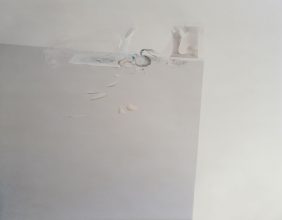
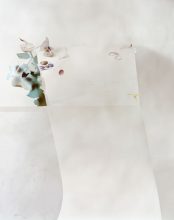
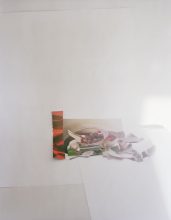
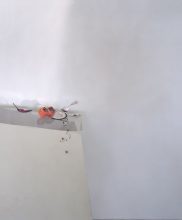
Laura Letinsky has developed her practice since the late 1990s through meticulously composed still life photographs that draw influence from Renaissance painting. Letinsky lives and works in Chicago, Illinois where she is Professor at University of Chicago in the Department of Visual Arts. Her works have been exhibited at the Museum of Modern Art, New York, The Netherlands Foto Institute and the San Francisco Museum of Modern Art, among others, and feature in numerous public and private collections. In a long-distance interview, Photomonitor editor Christiane Monarchi asks Letinsky about the background and inspiration behind the works about to go on view at The Photographers’ Gallery, where her solo exhibition Ill Form and Void Full runs from 18 Jan to 7 April 2013.
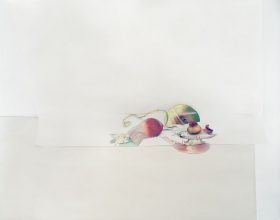
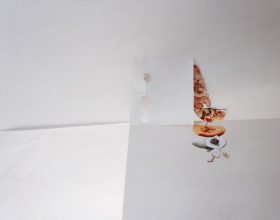
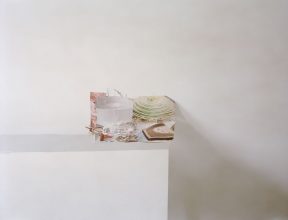
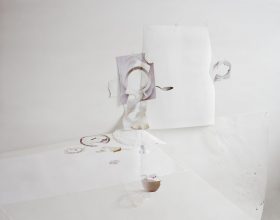
Christiane Monarchi: Seeing works from your recent series Ill Form and Void Full in person, I am keen to discover the genesis to your departure from using real food and the aftermath of dinner parties, as in previous series including To Say It Isn’t So and Hardly More Than Ever. Your new compositions defy classification, as these two-dimensional still life images contain pictures of other two dimensional images, while still representing food, eating and post- celebration, albeit in a visually distilled way. When did you first decide to include a picture within your picture?
Laura Letinsky: A few years ago, in 2009, for various personal and art-related reasons, I had reached an end point. As I’ve discussed in other interviews, my understanding of photography was very much one of ambivalence, complete infatuation and complete frustration. As Barthes has articulated, the photograph portends a relationship to what it describes that is always after, never in the present. Christian Metz describes the photograph as a fetish both in the psychoanalytic sense, instilling desire for what is always absent, outside of reach, but also, relatedly within capitalism, as a perfect vehicle for unrequited want that necessitates an endless cycle of unfulfilled consumption and production. My point of entry was more on the emotional side of this discussion in terms of investigating melancholy, the way the photograph holds on to that which is not there. This aspect of photography, the pleasure of want, is of great interest and annoyance, seemingly unavoidable if one wants to hold on to the promise it perpetuates.
Finally, in 2009, I came to understand that the melancholia that is inextricable from the promise–I mean here, romance, love, fulfillment–is not a formulation that I want to inhabit–there has got to be another way. Through a year of intense reading, thinking, looking, listening, I felt that I had to make work that better explored another option, not one that I necessarily already knew but a different way of feeling, thinking, making, and finding some modicum of joy. This position might be seen as nihilistic, but instead it feels expansive and freeing. More tentative, less finite, a bit of floundering that I think is productive.
Artists such as Richard Tuttle, Jessica Stockholder, Daniel Gordon, Mona Hatoum, Giorgio Morandi, these became my guides, as well as writers including Gertrude Stein, Lydia Davis, Ann Carson, Yasunari Kawabata, Wisława Szymborska, Diane Williams, Colm Tóibín, David Foster Wallace, and theorists like Gilles Deleuze, Jean-Luc Nancy, Lauren Berlant, and Roland Barthes…not to mention lots of musicians who accompanied me in my studio!
CM: Have you included real objects in these compositions? Some objects I can’t make out if they are round, flat, suspended, sitting…?
LL: Yes, the compositions are amalgams of flat, three dimensional aka “real” objects, and sometimes even digitally incorporated images either from my scanner or downloaded. The promiscuity of images means exactly that they are interchangeable, no one source more truthful, or deceitful that another.
The term “collage” isn’t really applicable both for ideological reasons with which the collage was associated, and that my pieces are made in my studio NOT as flat scenes. Signs of tape, props, etc. are left in the final images to cue the viewer in to their constructedness.
CM: Are the images of fruit, utensils, plates, cakes etc including pictures that you have taken or are they made using found images?
LL: Most of the pictures come from mass media i.e. magazines or the web, but many come from my old prints as well as those of others. I did a trade with Jeanne Dunning to whom I lent objects for her still life work and she gave me prints to cannibalize.
CM: Do the subjects have a history or significance beyond their visual representation? (e.g. whose apple is that, and whose cake?)
LL: Yes, they do, at least to me and maybe one or two others who are in on that part of the production. That’s always been the case with my work. But for others I hope that the objects in their composition, so old fashioned but for me, true, in their form they acquire meaning. That is, the context of the objects in relation to one another and in relation to where and how they are seen, this is where signification happens.
CM: Compositionally, your new works defy gravity in so many ways, from the perilous perches of cakes on the edge of a table, to vexing shadows falling on divergent planes. Or is there even a table? How do you approach the visual arrangement of your subject; are you working in your studio, on a table, on the floor, in three dimensions?
LL: This work is very much a studio practice, one I could not, would not have arrived at if I did not have this space. When I acquired a studio in 2006, a real studio not just a large room in my home, the question of what, or what not to photograph given the medium’s voracity became even more urgent. That is, what does a picture mean? What it describes? Where? How? Why this and not that? Over the years this question of the relativity of value and meaning of the photograph in relation to what is in the photograph has troubled me.
Working before an everything or nothing possibility–I can picture everything, nothing…what is the difference–choosing what to depict, and how and where, and of course why is the question. Sooooo, starting with that which already permeates our visual field, images from an array of sources, at the intersection of domesticity (the private) and mass society (mechanical, no, make that digital! reproduction), I begin by considering the problem of space, its appearance within the two dimensional plane, and build from there.
CM: Does the subject matter or composition have inspiration from life?
LL: Yes, unavoidably. Where else can anything come from? I remember my favorite undergrad professor, David McMillan describing to me that he photographed because he didn’t have that good an imagination–not true to be sure, but the idea being that one cannot refer to anything else but what one already knows. We are all products of that which surrounds us.
CM: Are the works printed to lifesize scale?
LL: Yes although in this series, much trickier as scale is, as you know, relative. I try to find a balance, a compromise. Here again, a gentler, more “real” world view.
CM: You have spoken of the works of Gertrude Stein, in particular with reference to the title Ill Form and Void Full. Could you elaborate on the inspiration of Stein’s work to your recent series?
LL: Gertrude Stein, among many of the other authors I referred to above, uses language in a way that I aim to use photography. The concreteness and the malleability of the material of language is simply amazing. What words can do! She explores what language can do, as sound, its meaning made fluid, relative in that its placement rocks, unsettles, and soothes expectations. Her writing makes me pay attention, reminds me of the difference between knowledge as a kind of closure vs. knowledge as experience, alive, uncertain, unfixed…
——–
Laura Letinsky will be speaking at a panel discussion as part of the Photography Focus Day at the London Art Fair, 1.30 pm on 16 January.