




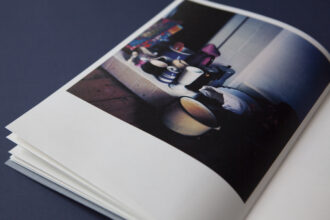
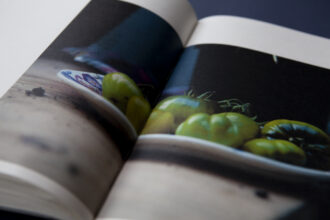

Photomonitor: I’ve really enjoyed perusing your exquisitely designed book ‘A Stranger in my Mother’s Kitchen’ and would love to know, how did you decide to start this photographic project? It looks like it has taken you back in time and around several continents in researching and working through your ideas.
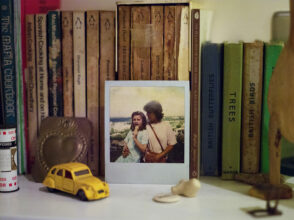
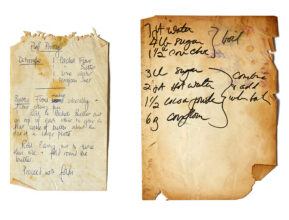
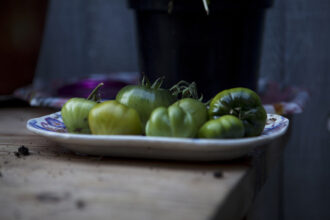
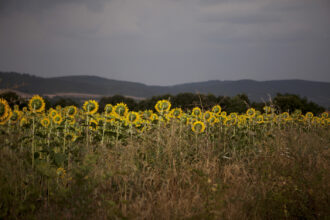
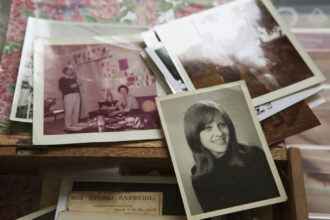
Celine Marchbank: This work came directly after my previous body of work Tulip I made in 2019-2010, during the year my mother was diagnosed with and died from cancer. This work was about the last year we had left together, where I photographed mainly within her home, her things, herself and other things happening within her home. After she died the urge to photograph, to document, remained and perhaps was even stronger. I made images of my mother’s home changing, the warm feeling that had been there for all my life had faded, it was a very different place. I was photographing feelings or a mood rather than things. It was during this process of clearing her house in preparation for leaving it I started to find her recipes, and that’s when I decided to start cooking them and document the process. I also found old photographs, many from her up-growing in America and this made me want to visit these places and others that had significant meanings to us. Alongside all these different strands I was also writing about my grief, something that had started too during making my Tulip work, I found writing an incredibly helpful process for me so I continued it for around 5 years after my mother died.
So there were all these different strands happening concurrently, and at the beginning I didn’t see them all as one project, but at some point, I don’t remember when, perhaps a few years down the line that it just became apparent they were all part of the same thing; they were my progress through my grieving. They were for me all about exploring feelings, remembering, but also about discovering and marking the legacy of my mother’s life.
PM: When did you know you would like to present this project in book form?
CM: I have always loved books, and had planned to make one with this work from early on, but when it was a quite different iteration; more of a book about my mother’s recipes and food only. When that realisation happened that all the things I was making were the same work that’s when I started to make book dummies, as this process helped me realise what the work was actually about. It forced me to properly edit the work, to look through all the different elements together to try to work out what it was about and how it all worked together. I admit I struggled, I could not get the book right. I made many different versions, some with just the photographs, some with recipes in a booklet, some with the writing, some without, but I didn’t find a solution for all of them I liked. The only solution that I was ever happy with was in an exhibition form as this was where there was freedom for all the elements to work together.
I always knew it should be a book; what I love about books is that that they are permanent objects that will be around forever. The book took a long time to get right, but I was never in a hurry. I felt a burden and a protective feeling over it to get it right, so this took time.
PM: Could you tell me about some of this inspired design with page inserts and recipes, an unexpected twist for the photobook shelf?
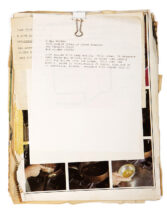
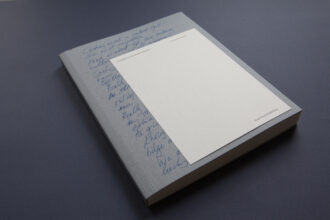
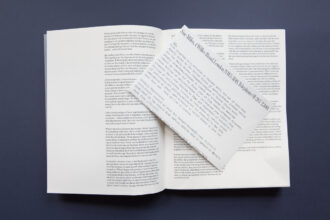
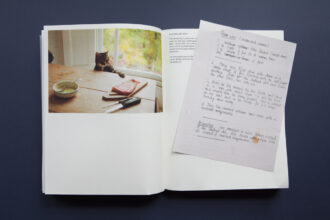
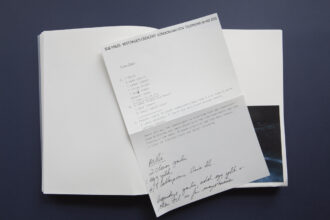
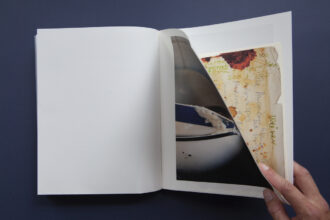
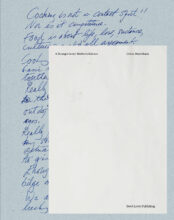
CM: After making many book dummies and showing the work in exhibitions I decided I wanted to find a designer to work on the book with. Before I became a photographer I was a designer, I had designed my previous book Tulip but I could not get this book how I wanted it, I felt stuck. Perhaps because it was so close to me, I couldn’t look at it objectively, I needed fresh eyes and ideas. I spent a lot of time researching books, and the designer Lewis Chaplin’s name kept popping up so I contacted him, he was now running Loose Joints (with his wife Sarah Piegay Espenon) which is both a publisher and book designer. In my first meeting with Lewis he seemed to really get the work and understand what I was asking for it. Early on he came up with the great idea to have pockets all the way through the book that would house the recipes. For me this was the perfect solution for them, I had always wanted the recipes to be a main part of the book and to be tactile, but my previous dummies were missing this. The pockets are made by not trimming the bottom edge of the book, which means every other spread becomes a pocket. This could have become gimmicky if over used, such as putting images inside the pockets and making it annoying to view the book, but we were strict that their main function was to house the recipes, this allowed the reader to pick them out to touch, hold them and cook from if they wish, or they can simply be ignored and left in the pocket as they do not disturb the pace of the book. Through the book there are a few correspondences I had with my mother’s friends where they shared stories of her life, these are the only other element that uses the pockets, they are printed within them and again are there to interact with or not.
The book can be enjoyed by many different people for different reasons, someone could view it purely for the photographic content, or for the food and recipes element treating it more like a cookbook, or someone may look at it for the writings on grief. The design allows these different uses to happen easily.
PM: I see a planned website for the project too, could you tell me what kind of content you envision for this in future?
CM: The idea behind the website is to have a space to share more. A book should be a well-edited selection normally from a much larger body of work. This work had many different strands, so more of these elements will be shared on the website along with more on my mother’s life as a chef and her recipes. The recipes in the book are just a small selection of the ones she wrote down, the website is a place to share more of these, along with more of my memories of her food.
At present it is still under construction, as in the final stages of the book production I discovered I was pregnant with my first child. I pushed to get the book done in time, including travelling to Amsterdam heavily pregnant to oversee the printing. The week I completed the book was the week I gave birth. There is a beautiful symmetry in the making of a book about my connection to my mother at the same time as becoming a mother myself, and it and my own son both emerged into the world at the same time.
This did mean however, that not everything could be done such as the website, so watch this space as it will be soon.
__________
A Stranger in my Mother’s Kitchen by Celine Marchbank was published by Dewi Lewis in September 2022.