
Interviewed by Daniel Pateman
Wen-Hang Lin (b.1971) was born and raised in Taipei, Taiwan, but moved to the United States in his early twenties to study photography. He graduated from Arizona State University with honors before earning an M.F.A at The Ohio State University and has worked and lived in the city of Mesa, Arizona for nearly 30 years. He’s been exhibited both nationally and internationally, and in 2018 he won the Praxis Gallery’s Director’s Choice Award for his series The Riff of Silence.
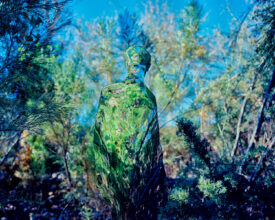
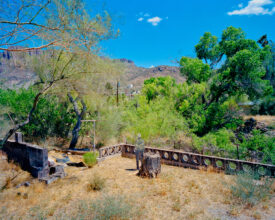
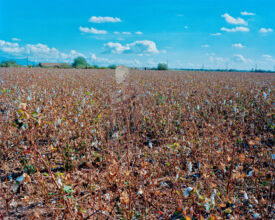
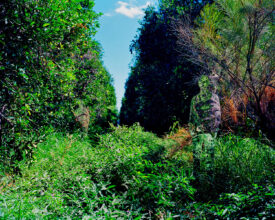
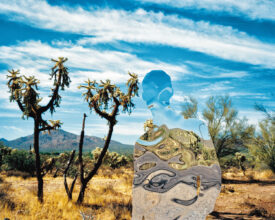
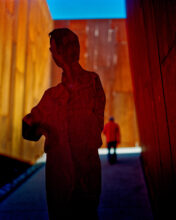
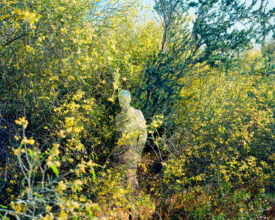
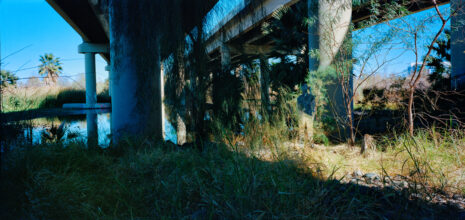
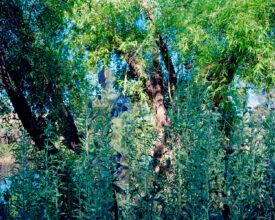
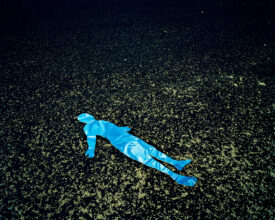
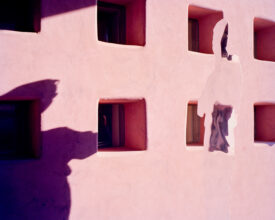
Lin visualizes subjective experience through analogue experimentation, interrogating overlapping themes of memory, identity, time and place. His ongoing project And I Wander, described by the artist as a “metaphorical self-portrait”, will be featured as part of a group exhibition I Hear America Singing: Contemporary Photography from America in Amman, Jordan, later this year. In it, Lin’s reflective silhouette is variously dispersed within the landscape of the American Southwest, blending in with varying degrees of efficacy. It’s a surreal meditation on identity that powerfully evokes Lin’s lived experience of cultural duality and alienation.
__________
Daniel Pateman: How would you describe your ongoing series, And I Wander, in a sentence?
Wen-Hang Lin: An immigrant photographer’s quest of searching for self-identity and a sense of belonging while encouraging conversations that help us learn about our commonalities.
DP: Personal identity and belonging are enigmatically and beautifully visualized in this series. What compelled you to explore these themes?
WL: People often ask me if I’m a Taiwanese or American photographer. I find this is a hard question to answer. I was born in Taiwan but have lived in the United States for almost three decades. One has a sentimental connection, yet, the other is legally bound. I still have no answer. This struggle compelled me to start this project.
DP: You moved to the USA in your early twenties. What were your reasons for relocating to America?
WL: The main reason was to study photography. There are schools teaching painting or sculpture [in Taiwan], but not photography. The only option was to study abroad. Nowadays, with the advance in technology, people can study photography via the internet. However, I still believe that there is value in formal education. Photography is more than the camera. I have learned the history of art, influenced by peer photographers, and inspired by artists in other practices. I’m glad that I have had the opportunity to study in the United States.
DP: Whom or what do you draw inspiration from, and how does this manifest itself in your practice?
WL: I meditate often. It helps to clear the mind and allows me to see things from different perspectives. Because I’m also a graphic designer, I pay attention to the surroundings more than other people. For example, the color, typography, rhythm of the sound, even a simple coffee stain pattern. Sometimes, when I saw an interesting scene, I’d make up a story in my head. When two people are laughing in a coffee shop, I may not hear what they said, but I’ll create an imaginary plot. All of those practices help me to develop future photo projects.
DP: Would you describe yourself as having a particular photographic style? Your projects illustrate an engaging combination of realist and abstract approaches, blending recognisable physical realities with our subjective experience of them.
WL: That is a great observation. I do love the combination of realism and abstraction. Like Salvador Dalí’s surrealist paintings, this style creates images that escape mere simple analysis of logical intuition and opens up room for imagination.
DP: Despite their fantastical appearance, the mirror-figures among your American landscapes aren’t digitally edited but shot on analogue cameras. Do you have a preference for analogue photography?
WL: I don’t have a preference for the tool I use. I use a film camera because that is what I have. I do think about the switch to the digital camera because the film is getting more expensive. However, I love the simplicity of the film camera. There is no gizmo or complicated function to remember. “The single most important component of a camera is the twelve inches behind it”, said Ansel Adams. The process of photography is very Zen-like to me. I don’t think I will change my camera any time soon.
DP: I feel like there’s a complex interplay of visual codes in your work that suggest identity as something continually in flux. In each image your reflective silhouette blends into the landscape with varying degrees of success. And, while complete invisibility implies successful assimilation, it also suggests a loss of individual identity. As a transplant in America for 30 years, is this something you intentionally wanted to explore – an ongoing negotiation between your native and adoptive cultures?
WL: There are many groceries within 10 minutes distance of my home, yet, I still drive 80km to an Asian market and get the produce I’m familiar with. Despite the effort, I always buy the same vegetables I can easily get from the western stores near my home. However, it doesn’t mean I prepare them the same way as the Americans do. Have you ever tried stir-frying chard with garlic or steaming kale? When I cook, I mix the Chinese cooking method with western ingredients. I love grilled salmon and congee for breakfast, and I haven’t tried cereal or grilled cheese sandwiches all of these years.
The point is, I’m constantly negotiating between two cultures. Even if I try to live in an American way, I cannot sever my Asian DNA. I overlooked this situation in the beginning when I started to settle down in this country. And now, I want to find out what I have become and what my new identity might be.
DP: Beyond your own personal search for a sense of belonging in America, do you feel your work has broader applications to the Asian American population generally, given their marginalization throughout the nation’s history? In a recent The New York Times article, Dr Lok Siu noted that the question of “Are they American enough? […] Can they assimilate?” drives xenophobic sentiment at times of national crisis, which has arisen once again during the current pandemic.
WL: Asian immigrants arrived in America in the late 19th century, seeking jobs and fresh opportunities. But people considered them as perpetual foreigners that needed to be managed and tamed. They were barred from owning land and receiving legal protections guaranteed by the U.S. Constitution. A few centuries later and the spread of COVID-19 has fuelled anti-Asian sentiment across the country once again.
Although this project is a quest to search for my Asian identity, I believe it can also apply to our current racial crisis in the Asian community and beyond. When viewing my photo project, we can interpret the hidden human figure as a symbol of any racial and minority group. They are waiting to be recognized and acknowledged. I hope that the process of seeking out the concealed figure in my photographs can inspire people to engage those who are overlooked in our society.
DP: What kind of an impact has the Coronavirus pandemic had on the direction and development of your own work?
WL: Before the pandemic, this project mainly focused on my identity. However, the idea evolved during the health crisis. What if I didn’t make it? Where would my remains go after I died? That question made me realize I don’t know where I belong. Taiwan, my birthplace, has changed a lot. The house I grew up in has been torn down and redeveloped. America, the country I’ve spent more time in than Taiwan, does not carry the emotional attachment of my birthplace. Searching for a sense of belonging becomes part of the mission. And I plan to travel to different places and take another look at the place I call home.
Also, I’m thinking about a different version of And I Wander. I’ve already made a mirror suit that covers my entire body. I want to achieve an abstract look through slow shutter speed. But summer in Arizona is brutal, around 45 to 50 Celsius. So, I will try it out during the fall or wintertime.
DP: You’re involved in an upcoming group show in Amman, Jordan, called I Hear America Singing, about American photographers and national identity. How does your series And I Wander engage with ideas around what it means to be an American citizen?
WL: To answer this question, we must ask ourselves what is American and who is American. When I first arrived in this country, I was in an American Language and Culture Program. Some of my classmates from Latin America disapproved of making America a synonym for the United States of America. “America is a region, not a country” they said.
I’m still looking for the meaning of being American. However, we must embrace the difference of each other so that we can be united. Just like my project shows. The mirror and the landscape are two different things, yet they can still merge together.
__________
And I Wander will be part of the group show I Hear America Singing: Contemporary Photography from America, taking place at the Jordan National Gallery of Fine Arts later this year, curated by Ashley Lumb.
For further viewing: Wen-Hang Lin website
Interviewed by Daniel Pateman for Photomonitor, May 2021.