



For Ian Howorth’s first monograph, he has chosen the title Arcadia, conjuring up a fictional utopia, an idyllic promised land, simple and untroubled. Photographs in and around British seaside towns conflate personal and collective memory and constantly question the viewer’s preconceived ideas of beauty. Below, Christiane Monarchi recently asked Howorth more background to Arcadia, recently published by Setanta Books.
__________
Christiane Monarchi: When I first handle your book, I am looking at a beautiful object which exudes nostalgia, as I think I’m looking at an arrangement of flowers through some sort of pebbled glass, the kind that we don’t see very often in modern homes. It may be sunset, or at least on the way to twilight. The format of your lap-friendly landscape photobook reminds me of my favourite family albums and their emotions. How did you decide that this series would work well as a book, in your mind, and what lead to your design choices?
Ian Howorth: The wonderful thing about any place is that it has stories to tell – sometimes these stories are more obvious than others – they may require a person to tell them if it’s something that happened there. The beginning of this book started very much with the immediate visual aspects and what stories they could tell on their own. I like the idea that an image can have so many variables in terms of what they say, and I like the idea of these being a bit ambiguous. However, the more I shot for the book, I realised that what interested me was the cultural landscape of the UK – England in particular – and what made up the fabric of a place through the choices that were made by people. In terms of the design of the book, I very much wanted a book that was easy to enjoy; I didn’t want the experience of leafing through it to be laborious or annoying. I wanted it to naturally lay flat so you could read the images whilst holding a cup of coffee in the other hand.
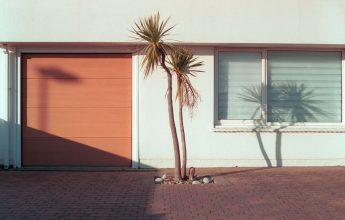
CM: I’ll start with the first image, as we don’t have an introductory text, and here is a lovely palm tree in the setting sun, casting a shadow on a tidy white house and paved garden. But the third palm tree has been clipped at its trunk. The symbolism is so inviting here, I must pause before I turn the page, and find out – where are we? When are we? Are these new works, or are you looking back to found images?
IH: This image is one that never screamed “Britain!” at me, but that’s what made it interesting. This exploration of the British culture made me realise just how much foreign influence we have had – at a time when sovereignty is very much on everyone’s mind. I thought it was fascinating to find just how much of our perception of what is British, is actually not. This one, titled “Palm Sprigs” the omission of the ’n’ was deliberate – screamed Palm Springs to me, albeit in a scaled down way to suit British tastes a little bit better.
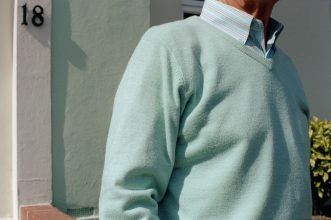
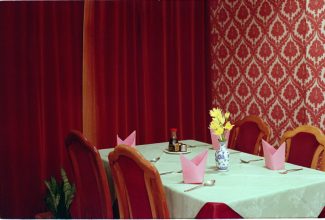
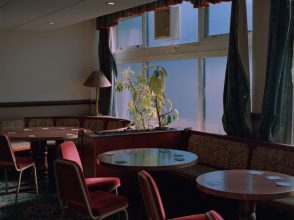
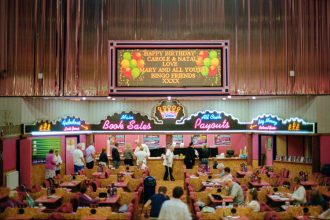
CM: It’s interesting, I had a hard time seeing ‘England’ at first, as the sun is so often present and in fact foregrounded in many of your very still images I was already wandering around Spain in my mind. Your lens focuses on stealthy crops to look at a bingo card on a pink table, a mint-green-merino-clad man and many empty tables at pubs and social halls, waiting for the fun to begin – perhaps the dinner rush is yet to come? Are these places you have revisited after holiday memories from long ago?
IH: I think as photographers we make choices and many of these could be considered part of the editing process – one that we put in a little of ourselves. Some people prefer the cold drabness of winter – which would also be a correct representation of Britain. I felt with my images I wanted a sense of hope amidst the mundanity of some of scenes I shot which is why I chose to largely shoot with bit of warmth.
I think in many ways they are reminders of my time in England as a tourist that has resonated with me. Not being native to a country or culture means that your mind almost automatically picks up on the things that are different to what you’re used to. For me it was always in the everyday things. A landscape or building being different is automatically accepted as being unique, but people’s everyday leisure activities, what they eat, the patterns of the carpets they walk on, their choice of jewellery and attire, present as more memorable.
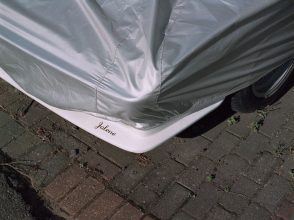
CM: Now the camper van is secured in place, a dune buggy caught in an overgrown grassy verge, stillness has a fading smile – until we get to the most intense red room since Eggleston’s ceiling, the clouds move in and we see some graffiti. Your edit plays with a tender embrace of age and also holds a mirror to loneliness and an aftermath. Could you tell me a little bit more about the emotionally charged vignettes that have taken place?
IH: The majority of the book is devoid of photographs of people, yet it’s very much about people and the choices they make. I did want a stillness, either a moment prior or a moment just after, to show people passing through without really being there. I liked the idea of creating this world that people would understand as familiar, yet at the same time find slightly unsettling due to the emptiness.
CM: Towards the middle, a sizzling ‘punctum’ – two young people in a hallway kissing in front of a poster advertising a Valentine’s day gathering promising ping pong and dancing (“10pm – 4 am”) at Canavan’s in Peckham – but quite in which decade I’m not sure. Is this at all autobiographic?
IH: It’s only after shooting for a while for the book that I realised how reactive the process had become for me. I’d gone into such a swing that there was hardly ever a though process anymore, it was very much look and fire. However, some moments were much more personal than others, and ones that resonated with me in a much more personal way.
The image at Canavans, or “Slow Bounce” as we affectionately refer to it, is in many ways an accurate representation not just of adolescent lust but also of my own understanding of courtship in the UK. When I first arrived, I was very much taken aback by how young people of school-age courted. A friend told you that their friend fancied you, you’d then arrange a meeting place, usually in town, on a Friday and involving a few cheap ciders – and then instinct would just take over I guess. Usually against the wall of the local Bowls clubhouse on a cold and rainy evening. It was just the way it was, I guess, for me and many others growing up, “up north’. At the time however, being 16 and inexperienced, I didn’t know any better, so over time, my memory has made this a very unique British experience, even though it is likely the same in many other cultures.
CM: Where had you arrived from when you came to the UK? Have you lived in many other countries? I’m curious if your memories from other places influence what you see and look for in this country.
IH: I was born in Peru where I lived until I was 12; I then moved to Miami, Florida where I lived for four years. I came to live in Britain at the age of 16. Ever since moving to Miami I’d been very curious about my surroundings even though I had visited Miami many times prior, nothing really prepares you for the different vibe of actually living somewhere. It was there that I really began to explore my surroundings and the mundanity of the everyday, because everything was so new and fresh I just wanted to see everything. This carried on to a degree when I moved to the UK, although adolescence did make my aimless meanderings somewhat secondary. Becoming a photographer in later life kind of completed the puzzle for me in many ways; in essence I’m doing now what I’ve always done, except armed with a camera. Trying to discover the fabric of somewhere, not just trying to figure out the differences but also the similarities in terms of how people live and what choices they make.
CM: What are you working on and looking at now?
IH: One project is a continuation of Arcadia, but a bit more focused on a specific story. The other is much closer to my past and in many ways a much more personal project.
CM: I will be interested to see these, and also to consider the narrative in these new works. I was intrigued that Arcadia didn’t have a text per se, rather a poem in Spanish and a dedication. How will you interact with the written word in your future projects?
IH: We made a decision that we wanted the images to stand alone and be consumed and enjoyed as photographs not aided by or somehow influenced by text. Granted, an introduction could have given the work more context, but ultimately it was decided that the images should speak for themselves. I see a lot of work that I’ve enjoyed over the years and have sometimes felt that it is often unnecessarily bolstered by text, either to explain or otherwise give context to missing parts in the puzzle. Obviously, some work needs it whilst other less so; yet still, text was used. I think it can be perceived as an overly bold decision, especially for a first monograph, but I often see that photographers stop being perceived as such and should be more story tellers, yet many of them have a balance towards one more than the other. I feel like I’m more a photographer – I still feel that my images should be the best they can be – and if they need anything else, then they shouldn’t be included. Maybe not for my future work, but certainly for this book.
__________
For further viewing:
Ian Howorth: ihoworth.com
Setanta Books: www.setantabooks.com