‘Digital Wonderings’ are a series of online speculations around the idea of ‘trust’, which was chosen as the curatorial theme for the f/stop 9: Festival für Fotografie 2021 taking place this summer in Leipzig, Germany. These interactions can take any form, from a conversation, a short statement, a film or a photographic series. Invited contributors come from a wide range of disciplines and can respond and react to the theme and the format as they wish.
Below, we are pleased to share a conversation between Susan Bright and Nina Strand, co-curators of f/stop 9 and the first international curators to be working with this renowned German photographic festival. The topic of ‘trust’ is very timely, and relates well to the challenges and opportunities working with photography for a festival which will invite physical and virtual presentations.
__________
Susan Bright: Welcome to our first Digital Wondering. We devised this element for f/stop 9: Festival für Fotografie 2021 in direct response to the time we are living in. We were invited to be curators of the newly re-launched f/stop festival in June 2020. At this time we were all living in a somewhat ‘high alert’ environment in regards to the pandemic, and it was shortly after the death of George Floyd in May. These events made us turn to the theme of TRUST for our curatorial investigation. The events of the past year have meant that all cultural institutions have had to rethink, reimagine and rebuild. Nobody is immune to these changes, and nor should they be. The most obvious change we have all witnessed in terms of outward facing events from arts institutions is the vital increase in online programming.
Nina Strand: Yes, we are responding to a current topic – our new future. We believe that trust is the currency of the 21st Century. We don’t know what the art scene – or the photography scene – will look like after a vaccine is found and confinement is over. Trust lies at the core of the Covid 19 crisis, and also the #metoo movement, fake news, national elections, relationships with technology as well as our personal lives. We want to build a program around this including art that can help us make better sense of our world, our place in it and where we are heading. The timeliness, topicality and relevance to this theme is clear. Trust is no longer what happens if we look eye to eye – it also needs to be generated and maintained for the digital space. Despite all advances, challenges and risks, trust issues will become increasingly critical for human and technological interaction as the century develops.
SB: Trust is the basis around which all of our human relationships revolve and when trust is high, our interactions flow with sensitivity, efficiency and ease. Social trust is about transparency of actions, continuity of values, and a belief in community. When promises go unfulfilled, a sense of betrayal seeps in and undermines social cohesion. We will be exploring all the different ways in which trust can be considered. It initially feels simple, but is in fact it’s an incredibly complex theme.
NS: It is a tumultuous time, also with the BLM movement in the midst of the pandemic. I hope this will develop into a revolution for people of colour as #metoo was for women. The Digital Wonderings is an idea taken from Visual Wanderings instigated on the Objektiv site where photographers and artist from many different countries are invited to create art that responds to our new situation: what does the lock-down mean for their work, what is important for them to convey, and what are their reflections on the time to come? Each photographer picks another artist to create a work, and in this way we hope to create a visual dialogue that runs across many different countries, in order to get a bigger picture of how this crisis, and its aftermath, are playing out for photographers all over the world.
SB: I’m looking forward to intersecting online and on-site contexts. We want to get away from that idea of a festival being a series of exhibitions; a catalogue and a symposium, and we really want f/stop to be different from past editions. It is about the balance of globalism and locality. A festival that that exists like an ‘iceberg’ on the calendar in a set space and time doesn’t feel appropriate now that travel is restricted. In addition, with the pandemic, environmental concerns have reconsidered more than ever. So with that in mind we have an ambitious programme with not only an exhibition, but also a publisher’s event, a long table event (which will be both digital and in person), a series of zines and a film programme. These will sit alongside, and compliment, other elements of the festival devised locally. Of course we have to be flexible. Who really knows what the landscape will be in the months running up to June next year?
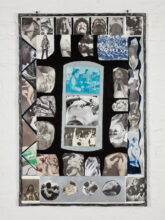
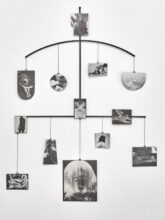
NS: For f/stop we will be looking more closely into the local situation as well as internationally when considering the display and dissemination of images. One of the artists we are working with addresses this directly. Carmen Winant often describes herself as a photographer who doesn’t make her own pictures, and has always been attracted to photography that rejects photography. She explained in a previous issue of Objektiv that she moved into working in collage, installation and found images because she is distrustful of how seductive photography can be. She started to use other people’s pictures, often from books, because she wants to test the limits of photography. We want Winant to show work at the main location of the Spinnerei but equally important to the festival is her presence at a location in the centre of Leipzig in order to communicate the festival’s theme directly to the inhabitants of the city.
SB: We are committed to trying new processes and experimenting with other ways of imagining and building a common space. In order to do this we aim to see our tenure as curators for f/stop a ‘work in progress’ in many ways. We will embrace curating in its most expanded form, and I hope we will extend the possibilities and reach of a festival. By treating the festival as an on-going discourse, and mode of reflection, we hope to reach outwards whilst also allowing the festival and ourselves to be challenged by the complex situation of our time.
NS: In this on-going discourse we will also make numerous zines from now until the festival is up instead of a fixed catalogue. I love the history of the zine that means they were easy to produce and distribute quickly, often containing political statements. In addition, I also read a new explanation of the name, calling the fanzine a contraction of fanatic magazine. Zines are made in a very DIY fashion, containing a political or passionate message. I believe that the immediacy of the zine makes a space for “backstage” thoughts and reflection on how to make a festival in these times. We will interview the artists on their work and present their thoughts on the festival’s theme and overall idea.
SB: We want our curatorial process to be as transparent as possible. This allows us to possibly make public mistakes, learn from them and show that the most creative part of curating is not dissimilar from the making of an artwork. It also allows us to be quick on our feet, adaptable and respond to any significant changes that may be occurring in the world. The zines are an important part of this intention. Curating is often thought of as quite a static endeavor, we want to challenge that with these smaller moving parts that will resonate on different registers.
NS: What is interesting is, as you say, who will see this festival in June? How can we open a discourse and involve the people of Leipzig and also the international field of photography. These Wonderings might be a good first step towards creating a larger, mutual dialogue that begins now, and even reaches beyond the ten days of f/stop 9 in June this year.
__________
About:
f/stop 9: Festival für Fotografie was established in 2007 and is now organized in conjunction with D21 in Leipzig. f/stop is committed to presenting international and national photographers as well as artists and to expanding its curatorial vision with rigour and curiosity. The upcoming ninth festival edition, f/stop 9, curated by Susan Bright and Nina Strand, will be held in Leipzig, Germany from June 25 to July 4, 2021.
Susan Bright is a curator based in London. She has a specialization in lens-based arts and contemporary visual culture with an emphasis on cross-disciplinary and international programming. She was a curator at the National Portrait Gallery in London before deciding to work independently in the early 2000s. Significant exhibitions that Bright has curated and co-curated include How we Are, Tate Britain (2007), Face of Fashion, National Portrait Gallery, London (2007), Home Truths, The Photographers’ Gallery and The Foundling Museum, London (2014) and Playground at Serlachius Museum, Finland (2018). She was Guest Curator for PHotoESPAÑA in 2019 curating five exhibitions across museums in Madrid. She has taught curatorial practice and visual culture at institutions including Parsons and the School of Visual Arts in New York and Sotheby’s Institute and University of the Arts, London. She has authored and co-authored seven books on photography and holds a PhD in Curating from Goldsmiths, University of London.
Nina Strand works as an artist, writer and is the founder and editor in chief of the art journal Objektiv. Founded in 2009 by Nina Strand, Ida Kierulf and Susanne Østby Sæther, the journal is a biannual publication with a focus on photography and film. Publications by Strand include: Residency (working title) 2019, Dr. Strand, (Journal) 2015, So, how do you think you’re doing? (Journal, 2008), and Gutta på Gølvet (Cappelen 2004). Strand is a co-editor of STAFETT (RELAY), a Scandinavian fanzine on photography. Strand holds a work grant from 2012 – 2020 from the Art Council in Norway. She was also a recipient of the Art Critic Grant from Fritt Ord in 2017. Strand is a regular contributor with essays on photography for several Norwegian and international publications, and has participated and arranged several exhibitions all over Scandinavia – the latest being the exhibition Le Book Club at Fotogalleriet in Oslo from January to February 2020. She has been involved in the Paris Photo-Aperture Foundation PhotoBook Awards and the Camera Austria Award Photography Prize. She was part of the expert panel of the seminar Photobook Reset at c/o Berlin and a Fellow at the MFA Image Text Ithaca summer workshop.
__________
With thanks to Susan Bright, Nina Strand and f/stop for sharing this interview with Photomonitor’s readers. For future updates visit f/stop and follow @fstop_leipzig