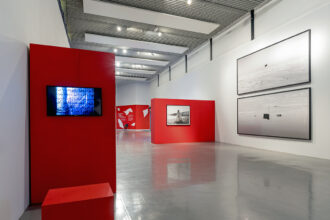
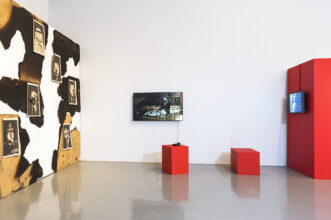
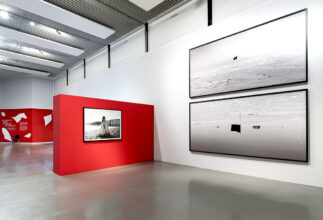
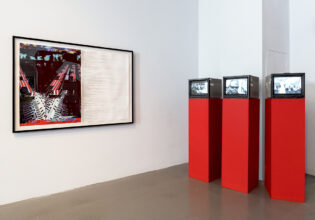
As the world wakes up from Covid and teeters on the edge of war in several continents just now, Jean Wainwright and Steffi Klenz have curated ‘Documents from the Edges of Conflict’, a group exhibition of lens-based work, engaged with the idea of contemporary conflict and its traces. Below we speak to the curators about the relationships between works from these thirteen artists in this very timely show, which is now in its final weeks at the James Hockey Gallery, UCA Farnham, Surrey.
__________
Photomonitor: I’m interested in the genesis of your exhibition, how have you decided to focus on lens-based works which engage with conflict and tension, at the present time?
SK: Conflict and war is embedded in almost every aspect of the world we are living in and I have explored ideas surrounding the photographic representation of traumatic events and catastrophes in my own work. Jean and I also discussed that documentary or reportage photography has undergone one of the biggest transitions in the last years.
I remember images like the iconic Joe Rosenthal’s “Raising the Flag on Iwo Jima” portraying six US Marines raising the U.S. flag atop Mount Suribachi in the final stages of the Pacific War on February 23, 1945. Then, photography still ‘functioned’ in its evidential form and the marks and traces became clues in this condensed scenario. The camera made this action of raising the flag outlive its moment. Or who does not remember Don McCullin’s “Shell-shocked Soldier, Battle for Hue Vietnam” (1970)? That photograph made me aware of the psychological terrors of war but it also made me understand my own need to use photography to connect to the world.
The probing of the photograph as evidence stipulates maybe the biggest change in the photographic representation of war and conflict. One of the most significant tropes in photography has been the turning of the documentary photograph into an image made after something has happened. One of the most beautiful illustrations of this for me was Sophie Ristelhueber’s work “Fait (Fact)”, 1992. Her aerial photographs of the traces of bombings and troop movement represented the war away from reportage photography. The reality of the conflict lies outside the time and frame of her images, and we are left with the scars and traces this conflict left behind in Kuwait.
This form of photography was well examined in the Tate Modern Show Conflict, Time, and Photography in 2015 but it seemed to both Jean and I that this ‘aftermath photography’ needs reinvestigating as well. Photography is now a secondary medium of evidence in the wake of television and social media and almost everyone has a camera nowadays. I remember the Arab Spring in the early 2010s and android phones being used by civilians in Egypt and Tunisia to report and document from the streets. Social media particularly Facebook played a significant role facilitating communication and interaction among participants of political protests. Protesters used social media to organize demonstrations disseminate information about their activities and raise local and global awareness of ongoing events.
I think it is fair to say that in the 21st century war, conflict and dispute is documented and reported differently: it is likely to be tweeted, blogged, texted, and organized on Facebook, YouTube and Twitter.
I don’t think Jean and I are claiming to present an overview of lens-based works of conflict nor do we claim to hastily define works and its practioners into a new genre. I think we are just trying to open-up questions and present works that offer themselves up to a slower penetrative understanding of the complexity of the representation of conflict. In the face of global uncertainty, intolerance and polarization our exhibition presents artists seeking other ways of approaching conflict and dispute, to provide alternative and contemplative visual reactions and provocations.
PM: The works included address experiences and histories in areas of the world which have borne witness to conflict including East Germany, Mexico, UK, US, Palestine, Beirut and even the North and South poles, across many points in the recent past. How have dialogues become apparent amongst the readings of these works seen together, now?
JW: Yes that is an interesting point: When the works were selected by both Steffi and myself for the exhibition, there were a number of underpinning decisions affecting our choices: We were really guided by how we envisioned visitors navigating the space, from the anticipated sightlines, to the way the often complex historical and contemporary narratives, in the wish list of artists we had drawn up, would intersect with each other. There is always that moment when you begin the hang and wonder if it’s all going to make sense, will the relationships between the works be obvious? Will the narratives we envisaged be preserved?
I also asked myself how older works such as Mona Hatoum’s “Measures of Distance” (1988), which I so loved when I first viewed it in the early 1990’s, would be perceived thirty-three years later in the context of this exhibition. And yes, the war in Beirut, Mona’s separation from her family, her exchange of letters with her mother and her mother’s nakedness in the shower, all retain so much potency and relevance. But there are other works that seem very pertinent
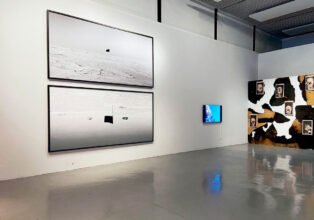
Santiago Sierra’s huge diptych “Black Flag, North Pole, 14 April 2015”, and “Black Flag, South Pole, 14 December 2015”, displays the anarchist symbol of the black flag planted at the two poles. The claiming of territories, the flag as a national symbol, the declarations of ownership, the fact that you have an absolutely gigantic photograph hung upside down intrigues gallery visitors, and leads to conversations.
But your initial point about the witnessing of conflict, it always fascinates me how artists can condense huge histories or events onto a photographic print or a screen each finding a different visual way in.
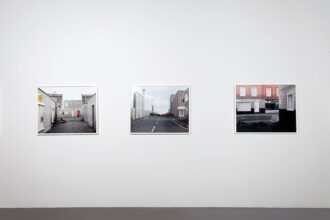
Paolo Pellegrin’s “Tijuana – A Girl celebrating her Quinceañera along the US- Mexico Border Tijuana Mexico” (2019) or Alfredo Jaar’s, 16mm film “The Cloud” (2001) both seem as case in point and show the Mexican border but in different media and with contrasting emphasis even though they are shot at the same location. Or indeed Catherine Yass’ “Wall/Abu Dis” (2004) with her glowing lightbox showing the barrier dividing Palestine and Israel and then seeing Ori Gersht’s quiet work on the other side of the gallery addressing the same subject.
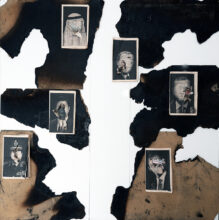
I also wanted to mention smell when I unwrapped the work by kennardphillipp; the smell of the burnt pinboard that acts the background and support for their work in the installation at the back of the gallery still retains its faint odour which seems to add to the insights about the work where politician and world leaders are printed onto copies of the Financial Times share indexes.
My last thought on this question though would be how do we talk about the holocaust or the Iraq war as Steffi and David Birkin do. How do we read an image from history that the artists have deliberately distorted or visually interfered with on the computer. So I suppose my long answer is that I enjoy the juxtapositions, I like the fact George Barber’s work “We Need to Talk Tony” (2017) (referring to Tony Blair) is next to kennardphillipps or Wolfgang Tillmans “The State We’re In. B” (2015) is a small image of the vast Atlantic Ocean opposite the vast Sierra’s. I like the fact that MacDonaldStrand deal with flags in a completely different way than Sarah Pickering questions the stereotyping of the Metropolitan Police Training centre. I really enjoy the narratives that emerge both intentionally and also when discussed in the context of contemporary politics.
PM: In your curation of this show, how have you navigated the need for interpretation and education with the experience of seeing and observing the works in situ? It’s a challenge, particularly I would imagine with so many complex ideas and histories to engage with, and given that we are seeing this exhibition in a gallery within a university setting.
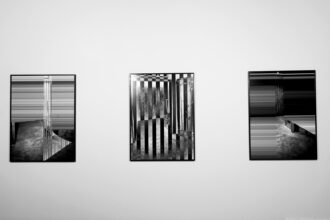
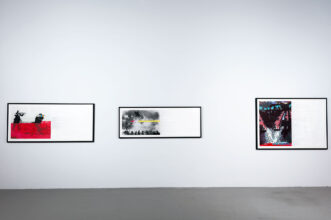
SK: Hans Ulrich Obrist has often described himself as a “junction-maker” referring of course to J.G. Ballard’s notion of the same word. This highlights the idea of the curator as the maker of connections between works and objects, and connections between works and visitors. I like this notion of the curator as an enabler who enables those connections to be made. For example, Santiago Sierra’s provocative planting of black flags at the north and south poles raises questions about borders and the movement across borders. The black flag as the symbol of anarchist movement stands in direct dialogue with MacDonaldStrand’s piece “No more flags” in which the flags used by protestors in right-wing nationalist demonstrations across the UK have been covered in white colour. Removing the flags which have become a legitimiser for nationalism and racism has been described by the artist duo as “act of cathartic Photoshopping” which created a white flag that “left a hole” and “stripped the flag of the icons of national identity.” Of course, this directly relates to my own work “Beun” which uses as its starting point an archive image of a concentration camp in former East Germany. MacDonaldStrand’s and my own work are in dialogue with each other, responding to the current trends and broader developments of nationalist impulses in Western society where a recent boom in voter support and populist parties is visible: from our own Brexit vote to Germany and the rise of the AfD party in parliament to Spain’s Vox Party and Austria’s Freedom Party (to only name a few examples). This moment of populist right-wing nationalism is an ever-growing crisis and as curators of this exhibition Jean and I tried to make these connections whereby the state of today has strong links to the past.
There are also obvious links between the work of Catherine Yass’ image and Ori Gersht’s video works. Gersht’s “Neither Black Nor White” was filmed from the top of the hill in the Jewish quarter in Nazareth looking down on the Arab village of Iksal. The footage captures only half a second every thirty seconds for eight hours, and as the dawn breaks, the contested border landscape is revealed, before being bleached out by the intensity of the rising sun. Catherine Yass lightbox “Wall” presents one section of the physical wall that separates Palestine from Israel. Her method of overlaying a positive transparency on top of a negative adds an extra psychological layer and slippage, to the silent concrete and steel barrier.
There are also other connections in the show: kennardphillipps and MacDonaldStrand are both artist duos and David Birkin’s work and my own work open up a conversation about the contemporary socio-digital conditions of our current photographic culture in relation to the representation of environments of conflict and dispute.
Interestingly, the word curating comes from the Latin word curatus, the past participle of “curare”, meaning “to take care”. I am not interested in the original role of the curator as the caretaker of archives and collections in institutional contexts, but I am interested in the original definition of caretaking; but I mean the caretaking of visual dialogue and metaphorical conversations.
Curating or the word “curated” seems to be everywhere today: from “curated” food menus to “curated” spring/summer collections in high-end boutiques to “curated” song-lists. Recently flying to Switzerland from London Heathrow I came across Heathrow’s newest drinking establishment “The Curator” which according to its website “aims to introduce you to discoveries and innovations, expanding your knowledge, tempting your sophisticated palate to try new tastes and sensations, or reminding you of great dishes that perhaps you’d forgotten.” Jean and I are of course not interested in describing something hip or fashionable or indeed adhere to some current Zeitgeist or present works that claim to be aesthetically conscious.
We are not interested in pleasing anyone’s curatorial palate but we believe in urgency: we believe that our exhibition engages with pressing political issues and those are complex and difficult to understand and this might be a challenge to some visitors but I find the idea of the curator as a form of “showman” problematic. I think it is fair to say that Jean and I do not perceive ourselves as “curatorial show-women” who “package” this exhibition up for “curated consumption”. We think it is important to learn from difficult and different contexts. I think this is also why this exhibition was selected for this gallery which exists within a university setting. A university should be the place of different learning experiences and as art critic and artist, Jean and I are also academics drawn to critical theory but also curation has a strong relation to scholarship.
__________
Documents from the Edges of Conflict curated by Jean Wainwright and Steffi Klenz includes works by George Barber, David Birkin, Mona Hatoum, Alfredo Jaar, kennardphillipps, Ori Gersht, MacDonaldStrand, Steffi Klenz, Paolo Pellegrin, Sarah Pickering, Wolfgang Tillmans, Santiago Sierra, Catherine Yass. Continues at James Hockey Gallery, UCA Farnham, through 18 March 2022.
With thanks to Jean and Steffi for this feature.