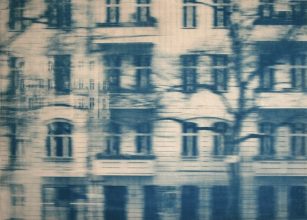
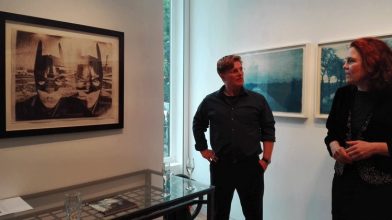
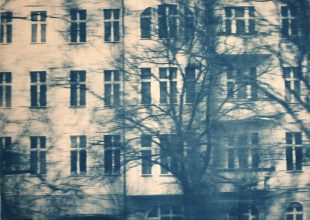
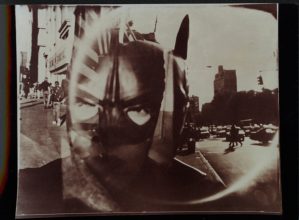
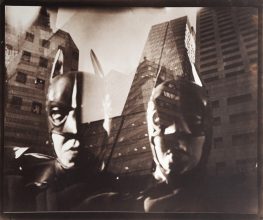
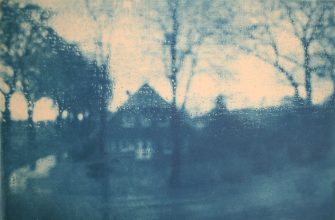
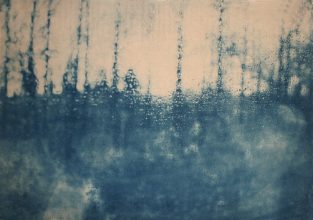
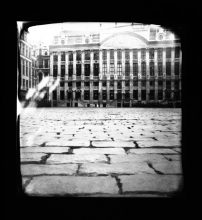
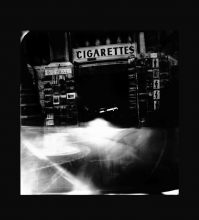
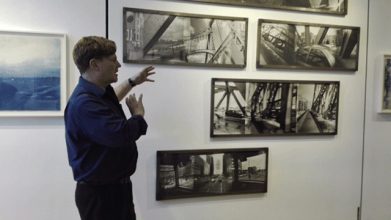
Born in Halle an der Saale in 1965, German artist Katja Liebmann has been exhibiting and teaching across Europe since the 1990s. Her adoption of nineteenth-century methods of image-making – such as the pinhole camera and cyanotype printing – has allowed her to explore themes of time, transience and memory, in an often “painterly” style. Liebmann studied art in Nuremberg and Berlin before receiving a DAAD scholarship in 1995 to attend the Royal College of Art in London. Her iconic ‘Gotham City’ series was acquired by the Saatchi Collection in 1998, and in the same year she was nominated for the Deutsche Börse Photography Prize. Her multi-layered, dream-like early work is currently on show at HackelBury Fine Art, London, until the 8th June, and will be a precursor for future exhibitions of her more recent photography.
__________
DP: The last time you exhibited your work in London was 2011, I believe, although you’ve been exhibiting newer works in Europe throughout the decade. What prompted your decision to exhibit in London again after eight years?
KL: It was a joint decision between HackelBury Fine Art and me to “start over”: beginning with the early work and then to show recent work at a later date.
DP: ‘Katja Liebmann: Early Work’ presents ‘Gotham City’, ‘Journeys’ and ‘Dwellings’, among other series. What was your reason for returning to these more well-known projects, rather than say, ‘Winter Journey’, ‘Blue Leaves’ or ‘Solid Sleep’, which I don’t think have yet been shown by a UK gallery?
KL: We decided to put the focus on landscapes and cityscapes, and in fact, that’s what I’m most interested in, that’s the focus of my current work. One image from the series ‘Winter Journey’ is exhibited actually; you can see it in the gallery window.
DP: While you’ve previously noted the influence on your work by painters such as Rembrandt, Turner and Caspar David Friedrich, have there been any photographers whose work has helped influence your own?
KL: I like David Hockney’s painterly, “anarchic-scientific” and thought-provoking approach to photography, while the early avantgarde Russian photographers of constructivism are fascinating to me. Their experimental and almost excessively radical approach is incomparable and timeless in its quality, I think. Alexander Rodchenko and Yevgeny Khaldei, what great artists they are!! Above all, what a great human attitude behind those images. I find their courage and humanity inspiring.
DP: The photographic image is often seen as offering the illusion of stasis: of a time, people or place preserved forever. However, you reveal this as a phantasy, your layered images evoking constant motion or a dream-like indistinction between subject and object. We see this in the consumerist blur of your ‘Shopping’ series, for example, and the conflation of the landscape with the individual in ‘Gotham City’. What do you think drives this exploration of impermanence in your work?
KL: My work can be summed up as: “developing photos, developing time, developing time like a picture”. That’s exactly what I do, I once realized. Zoom in and you get this low-tech impression. Time-sensitive media provides you with fleeting images, accelerated images, which leave you with a sense of transience. And a low-tech impression or image is just like a memory. Memories are low tech and malleable: raw material and recollection at the same time.
During our journeys through life to our alleged goal, it is easy to become detached from our immediate environment. It becomes hard to see anything beyond what we have already learned to see and most of what we see, when we see, is quick and remote; we are lost in thought. I try to capture these traces of moments, of life happening around us, frozen in one image.
DP: Do you consider photography an especially adept tool for exploring themes of time and ephemerality? If so, what do you think makes it so well-suited?
KL: The medium of photography makes you think about the aspect of time in several ways. My work with the pinhole camera, for example: you have long exposure times, up to ten minutes, which offer the possibility of recording the interplay and concurrence between incidents. It is this that fascinates me when using this camera. It conveys speed and movement…or the absence of it.
I see the resulting image as an “etching of time”: its impressions are literally visible as scratches, lines; permanent traces and marks. My early images depict layered moments, cityscapes I hardly recall anymore…that don’t even exist anymore in this way. Here, the well-remembered presence passes into a brutal absence: turning the place you left into unrecognizable territory. Photography captures this and is therefore closer to reality than painting or drawing, in my opinion.
DP: Are you anticipating exhibiting any new work soon, as a contemporary compliment to this show? And will it be markedly different to what is shown in ‘Early Work’?
KL: Yes, I’m planning on doing so at the end of the year in Berlin with Galerie Dittmar (a gallery I’ve worked with for 20 years), while there will be further opportunities to work with HackelBury in London too.
I’d say my work evidences an evolution…but not a contrast to the work currently being presented at HackelBury’s. I will actually enter into the subject of cityscapes and landscapes even more intensively.
Revisiting my archive however, I had this great revelation about my past… a discovery I did not anticipate: it is raw material. Raw material and recollection at once. It’s waiting to be processed and it will undergo a different treatment than it would have done back in the nineties. This material is looked at differently, is dealt with differently.
Our present times are crisp and merciless, especially with regards to society and politics. Compared with contemporary life, the past was soft and toned to me. And I realized I couldn’t do these softer, toned pictures anymore. So, I’m going to process this archival material as a person of today, and present the raw material alongside the new images.
DP: In what ways do you consider our contemporary moment to be so relentlessly ‘in focus’ as to render the dream-like haze of your early work untenable today?
KL: We live in highly addictive times. Our incessant consumption (of media, of natural resources) creates and reinforces problems that affect us all existentially. Our behavior, however, is avoidant, in a strange, carefree way. In principle, we live as if we had already solved all these problems and we could be as carefree as we want, have as much of everything as we want. I find that enigmatic.
Reflecting this, the blue tone of my images is no longer the soft melancholy blue of German Romanticism, but a merciless, garish blue that assails the eye.
DP: Would you ever envision experimenting with digital technology, or exploring the possibilities offered by social media platforms, à la Cindy Sherman?
KL: I could imagine using digital technology for my work if it supports my ideas – but I think its applications would be limited to the technical. The possibilities offered by social media platforms like Snapchat I find less inspiring, since everything is already predetermined. I wouldn’t want to be dependent on fixed programs in this regard.
Using a self-made or low-tech plastic camera, I accept all images as a gift, I like all of them. They have a completely different charisma, modest yet incredibly intense: predetermined in a different, more thought-provoking way. To me, this kind of image-making has more to do with my perception of reality. How decadent and stubborn! You could call it an old-fashioned, painterly approach to photography.
__________
Katja Liebmann was interviewed by Daniel Pateman for Photomonitor, May 2019