“Sloping hills unfold to the horizon – a soft green quilted landscape. The vastness before you, the desire that distance brings. Out in this space there’s a feeling of freedom. The landscape suggests new possibilities. Slowly, your eyes scour the curves of the land before it falls away in shadow.”
Thus begins the most recent publication by Mandy Williams, forming part of her multimedia project ‘England’ which she recently completed for the University of Arts London LCC MA Photography degree show and which was awarded a Photomonitor commendation. In this new interview, Williams describes the genesis of the various components of her installation, which, due to Covid restrictions, were viewed virtually and in print, rather than in a traditional exhibition format. The ideas that Williams has researched through her visual engagement with landscape have far reaching afterimages of life in England today.
__________
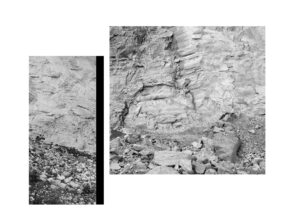
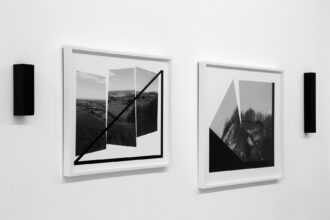
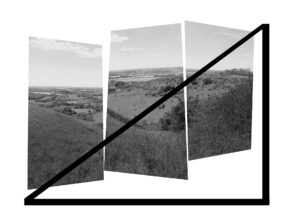
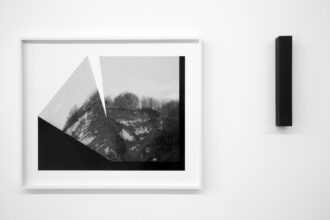
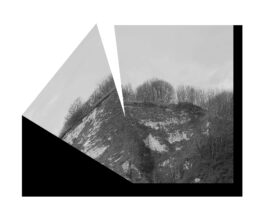
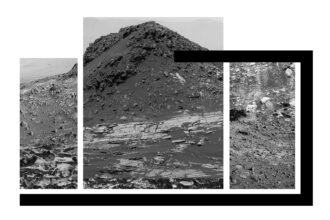
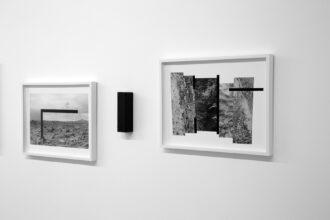
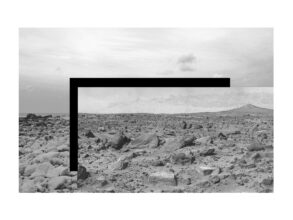
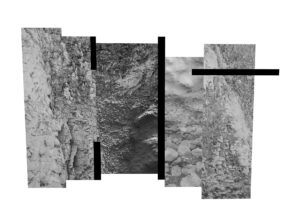
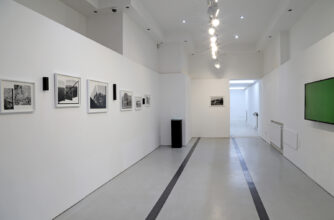
Christiane Monarchi: Approaching your works, online in this instance, I am drawn first to the installation views of your works on the wall, arranged in a non linear manner, which immediately let me focus on the graphic elements at work here. I see black and white rockscapes, and very heightened green tones, signalling a detachment from the depicted nature, perhaps evidence of human intervention. I read the heavy black lines as borders and fractures, is this a way in? Could you let me know what your starting point was with this project?
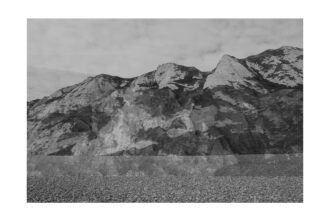
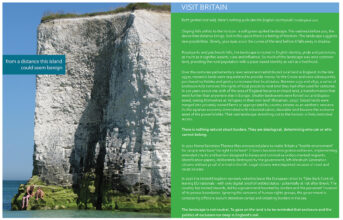
Mandy Williams: Disrupted Landscapes use images of Kent coastal landscapes as their starting point. It’s a landscape of iconic chalk cliffs; a powerful symbol of defence and emblematic of an insular national identity. In recent years the area has been subject to increased surveillance, far-right harassment of migrants, and divisive government rhetoric. In this work I’m exploring the exclusionary politics of contemporary England through the metaphor of landscape, drawing attention to the borders and fractures within a hostile environment.
The work came about because of the dislocation that I feel living in England. I think it’s partly a result of having lived overseas for 12 years with the nostalgia that brings and having idealistic memories of a progressive and European country that I’d left behind. The work is really a re-appraisal of my home country in the years since I’ve returned, and specifically witnessing increasing hostility towards people perceived as outsiders.
CM: What are the sources for the landscapes you photographed in these works, and could you tell me more about your treatment of the images and viewpoints?
MW: In some of the photographs, I’ve merged the coastal landscapes with alien geographies accessed from NASA that resemble elements of our own landscape while being unable to support human life. I am using these geographies to represent a landscape that has become alienated, and which causes harm. The environments bleed into one another. Black borders cross these disarticulated landscapes.
In the non-linear installation of the photographs there is a progression from rupture to deformation. At key points in the sequence, where metaphorical shifts occur, black wooden bars jut out from the wall to reinforce themes of disruption and exclusion.
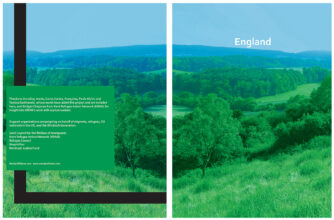
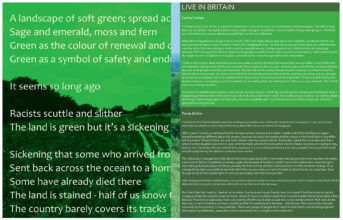
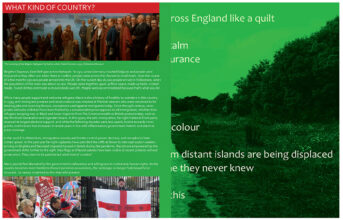
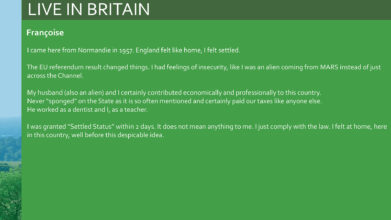
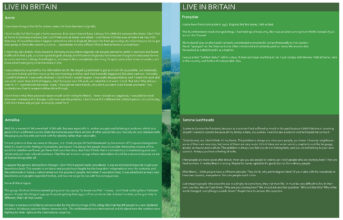
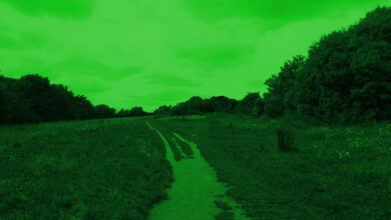
CM: Your newsprint publication forming part of the installation highlights the hyper-green tones seen in the video. Indeed it recalls green and pleasant lands but the text inside clearly doesn’t support this idea, with numerous personal testimonies of residents in England from other places, who recount their stories of displacement and worry about their future in this country. How did you come to gather these stories, and meet these participants?
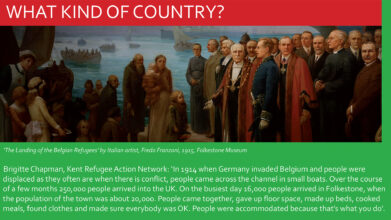
MW: I initially put a call out on social media, knowing that many of my friends and acquaintances had moved here from overseas and were affected by the EU referendum result. Some of the people I interviewed were friends, others were introduced to me. A few people provided anonymous testimonies for research only. I also contacted several refugee organisations and campaign organisations for EU citizens in the UK and had a wonderfully informative meeting with Brigitte Chapman from Kent Refugee Action Network (KRAN) in Folkestone just before lockdown.
CM: Could you tell me about how you made your video work, what your considerations were here visually and artistically?
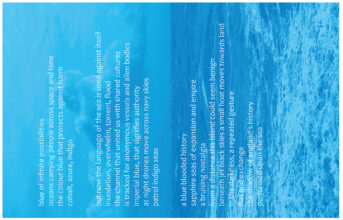
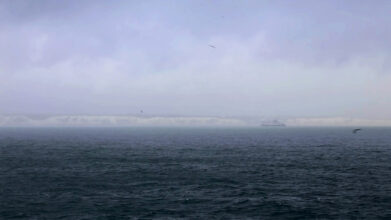
MW: The video, Inward Island, uses an experimental approach to reflect on political issues. It has a spoken narrative that links to images of the English landscape and English Channel, and is enveloped by sonar pulses, manipulated audio from political marches and field recordings.
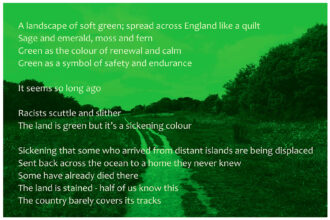
Visually, I’m using the colours of the landscape and sea – green and blue – and their associated meanings – to thread different sections of the commentary and reflect layers of the hostile environment. Increasing colourisation is used on landscape sequences as the narration switches from positive associations of renewal to negative connotations of sickness and toxicity. Through metaphor the beauty of the landscape is revealed, and then reversed.
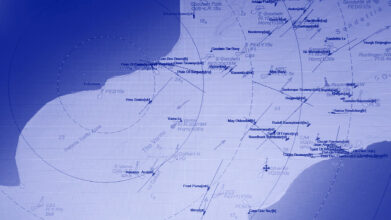
Additionally, there are radar sequences – inspired by Charles Heller and Lorenzo Pezzani’s Liquid Traces. The Left-to-Die Boat Case (2014) – to show how the Channel is monitored for ‘alien’ vessels. Figures published on infomigrants.net on 12 January 2021 stated 9,500 refugees crossed the Channel in 2020 resulting in 6 deaths and 3 people missing. It is important to acknowledge our country’s complicity. In the video, the sea changes from blue to white to red, referencing the tricolor flags of France and Britain bordering the Channel but also reminding us of the bloody legacy of our colonial history.
CM: Do you feel in the time that you have made this work, that you have wanted to add onto it in future, or bring in even more voices? It feels that this topic is still very much in the front of discussion even post-Brexit. How would you like to disseminate your project further, what is the next step for you?
MW: My initial consideration is to develop the Disrupted Landscapes series and perhaps create a small book. I’m thinking about new ways to represent the post-Brexit reality and the different governmental strategies on immigration and border control. The work also seems to lend itself to a 3D realisation but I’m just in the early stages of exploring those ideas. Although I have no plans to produce a second newspaper now, it may be something that I return to later.
__________
For further viewing, visit Mandy Williams’ website : mandywilliams.com
A viewing copy of Inward Island can be seen here: vimeo.com