
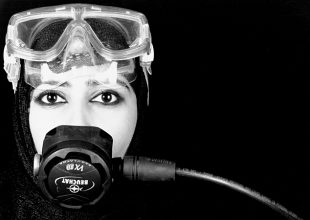
Saudi Arabian artist Manal Al Dowayan addresses issues of Saudi identity and in particular, the role of women in Saudi society through the use of photography, text and installation. Her work has been shown in numerous exhibitions throughout the Middle East, Europe and North America. Here in the UK, her work is part of the permanent collections of the British Museum and the Delfina Foundation in London. Currently, two of her photographs from the series I AM (2005-2007), which concerns where Saudi woman can work and what can they do, are included in Light from the Middle East, an exhibition of contemporary photographic practice in and about the Middle East on view at the V&A through 7 April 2013. Curated by Marta Weiss of the V&A, the exhibition examines the ways in which Middle Eastern artists engage with the medium of photography. Al Dowayan talks with Photomonitor contributor Erika Lederman about her work.
——-
Erika Lederman: In a recent panel discussion at the V&A, you mentioned that the works from the series I AM (2005-2007) were inspired by a speech made by King Abdullah Al Saud upon taking the throne in 2005. Can you elaborate, and further explain the context of the work as it relates to women in Saudi Arabian society?
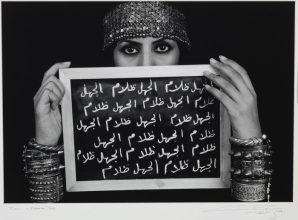
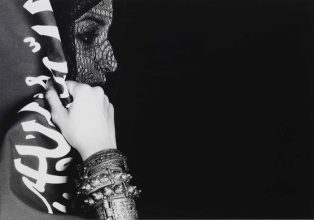
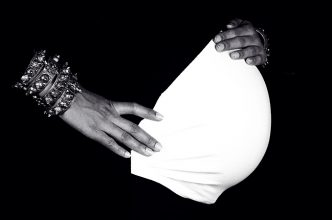
Manal Al Dowayan: This collection was inspired by a speech that King Abdullah Al-Saud gave when he took the throne. He called upon all Saudis to come together to build our country, including specifically the importance of women’s participation. This was a positive time and caused huge hope and excitement across the country. But this raised a question, what kind of jobs are women going to be “allowed” to do? Later, the King’s speech was interpreted by the press and other opinion leaders as meaning that women will only participate in jobs that “suit their nature”. At the time I asked myself, “what suits my nature as a woman? And who decides this?” This sparked the idea behind the I AM collection. I invited women who work in a variety of jobs in Saudi Arabia from engineers to mothers, from scientists to designers, to pose for me as a statement of their existence, as an inspiration for other women, and as a response to the idea that my gender is a limitation to my potential.
EL: I understand that the series I AM was first shown in Saudi Arabia. Can you give us some background on the infrastructure for the production and exhibition of art in Saudi Arabia and within that context, what was the initial response to these works? And how has this changed over time?
MAD: When this collection was first shown in 2005 there were no significant art galleries, museums, or an art “industry” in Saudi Arabia. I showed the I AM collection in 2005 in Riyadh, the capital of Saudi Arabia, at the King Fahad Cultural Centre. The exhibition was hung on partitions in the main hall and the preview night was segregated, with a viewing for men and another viewing for women. The men’s preview night was inaugurated by our Foreign Minister HRH Prince Saud Al Faisal and former UK Foreign Minister Jack Straw. Being the only Saudi woman showing that evening along with different artists, Prince Saud asked me to enter the men only event and walk him through my artworks. I thought, that by standing among one-hundred men and speaking about women’s empowerment (portrayed in my images) I would receive a harsh reaction, but to the contrary I had the most amazing evening explaining my artworks and having wonderful analytical discussions about the state of women in my country.
This year (7 years later), I had my second show in Riyadh at the newly inaugurated Art Space, Alaan Art Center, showing the art of five Saudi female contemporary artists. Titled “Soft Power”, the show was curated by Sara Raza and the opening night included both genders and had a specialized educational program for adults and children to better understand the works that were being shown.
Today we have multiple galleries across the Kingdom and some that are very well-known internationally like Athr Gallery and Alaan Art Centre along with a museum being built with plans to open in 2014 in the East of Saudi. The Gulf region has seen a boom in the Art Industry with its two art fairs, Art Dubai and Art AbuDhabi, a biennale that attracts critical acclaim in Sharjah and multiple museums being built in both Qatar and the UAE. Auction houses have permanent offices across the Gulf and art coming out of Saudi Arabia is catching the attention of the local and international art community.
EL: With such a new ‘Art Industry’ infrastructure, has there been any qualification to the acceptance of lens-based art (as opposed to more ‘established’ or ‘traditional’ medium) in Saudi Arabia?
MAD: In the past there were no proper art curricula in schools, or art degrees offered at University level, or a museum and gallery culture in the Kingdom that fed the general public ideas of what is and isn’t art, this in turn produced a generation of art viewers that had no exposure to historical contexts in art appreciation ingrained in their psyche, so the majority of viewers who interact with art in Saudi today come with no prejudices or preconceived ideas of what is “established or traditional” art. Don’t make the assumption that the audience in Saudi is ignorant to what is happening in the artistic landscape within the region or internationally, they just approach art with a much more open mind. This is evident in the young Saudi collectors who are slowly becoming the undercurrent for the emergence of a local art scene. I find young Saudi collectors will invest in photography simply because they love it as an art form. It speaks to them in a contemporary language that they understand.
EL: You have said that your works, rather than operating as ‘snapshots of reality’, are ‘snapshots of a concept’ as it exists at a time. What do you mean by this, especially as the photograph is so often used as a tool to record reality?
MAD: My photographs are not a record of reality because they are staged or are made to look different than reality, but they are also not fantasy-based because the subjects and the concepts they are portraying are very real.
EL: Where and how did you first learn the technical aspects of the medium of photography? And what effect has it had on your fine art practice?
MAD: I first learned how to use a darkroom in my hometown Dhahran where a darkroom was left behind by the early oil explorers. The machinery dated back to the early 50’s but was left in pristine condition. I later went to London for my graduate degree and studied photography in the evenings in Central Saint Martins while at the same time renting a darkroom for a year during my studies. Because of my early exposure to black and white film photography, I have never allowed colour into my art. I have deep appreciation of the dark and light spaces within an image, and I have an intimate relationship with my photographs. From the second I load a film into my camera until I hand over the print to the framers, it is only me that is interacting with the image.
EL: Throughout your work, there is the recurring element of Arabic text. That, coupled with your use of the black and white medium, often gives your work a distinctly graphic aesthetic. Why the focus on text? How does text operate within your lens-based work?
MAD: Most of my artworks carry multiple messages and meanings that can be revealed by interacting with the artwork over and over. The Arabic language has an amazing capability of encompassing multiple meanings within one statement and I play with this idea of revealing a concept through layers of imagery and text. I sometimes attach a fantasy storyline to place the concept within so when the story is told the meanings are unveiled.
EL: Many of your works seem to operate as tools to raise awareness around gender issues in Saudi Arabia. Recently, the American feminist author Naomi Wolf suggested that the feminists of the Middle East and other developing regions, ‘have outstripped Western feminists as pioneers for gender justice – partly because they do not see women’s fight for justice as pitting them against men, against family life, or even against faith…they draw on the Wollstonecraftian heritage of democracy and human rights…’ How would you define your role within the struggle for gender equality?
MAD: Equality is not on my radar, it is more focused on inclusion and preservation. In my work I don’t seek to be part of any specific movement or allow it to fall under banners that represent a group. My works are very personal and reflect my experiences, feelings, and challenges that I express through the medium of Art. Because of who I am and the ability of other women to relate to my experience, it makes my work relevant to many women who are facing the same issues I am facing. I use my art to mirror my ideas and if that reflection creates a dialogue on the issues I address, then I am very pleased because I know that dialogue always leads to change.
EL: Tell me about your most recent work and what you are currently working on?
MAD: I just showed the full I AM collection at the Clinton Library in Little Rock, Arkansas where I was invited to address 40 former world democratic leaders (Club De Madrid) alongside the actress Geena Davis where we spoke about the issue of women in Media and Art. Currently I am preparing for my first solo show ever in Saudi Arabia with Athr Gallery in Jeddah opening January 15th with a book launch of my collection If I Forget You, Don’t Forget Me.
——-
Works shown at right:
Manal Al-Dowayan, I am an Educator, I am a Saudi Citizen, from the series I AM (2005–7), Gelatin silver prints, British Museum: 2009, 6034.1 to 2, Art Fund Collection of Middle Eastern Photography at the V&A and the British Museum, image courtesy of the V&A.
Manal Al-Dowayan, I am a Scuba Diver, I am a Mother, I am a Petroleum Engineer, I am a Computer Scientist, from the series I AM (2005–7), Silver gelatin fiber prints, 41 x 51 cm, image courtesy of Cuadro Fine Art Gallery, Dubai.
Light from the Middle East: New Photography, runs at the Victoria and Albert Museum until 7 April 2013. From the Art Fund Collection of Middle Eastern Photography at the V&A and the British Museum. www.vam.ac.uk