The phrase ‘For God and Ulster’ has roots which stretch back to The Irish War of Independence. During that time it was synonymous with Protestant resistance to Irish independence from British rule. When The Troubles began in the late 1960s it became a battle cry of the Loyalist paramilitary style grouping known as the Ulster Protestant Volunteers (UPV). Redolent of past violence, for many the phrase is enmeshed with notions of bigotry and bloodshed.
However, Belfast based photographer Gordon Ashbridge’s exhibition, recently on show at The Gallery of Photography, challenges these associations, subverting preconceived notions of this heavily weighted term. Below, Sarah Allen spoke with Ashbridge about the background to this series of images.
__________
Sarah Allen: Can you tell me a little bit about the exhibition?
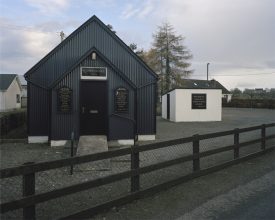
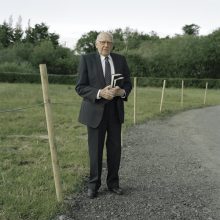
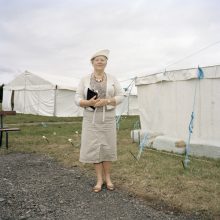
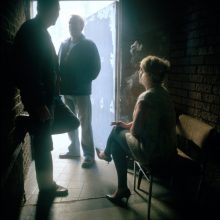
Gordon Ashbridge: The show comprises what I like to call my ‘God stuff and my Ulster stuff.’ Both are projects I completed as part of my degree in photography at The University of Ulster. The first series the miracle of stories and the mystery focuses on a Loyalist bar in North Belfast and the other work explores a small religious community known as The Plymouth Brethren. This project was something quite personal to me as I grew up within this religious community.
SA: Could you tell me a little more about what distinguishes this religious faith from other branches of Christianity?
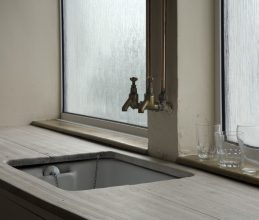
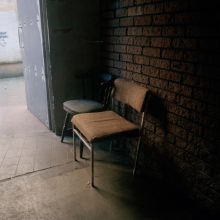
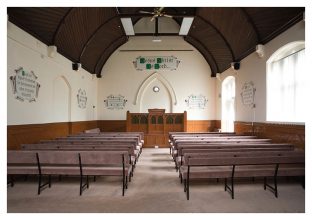
GA: Well the Brethren movement is an Evangelical Christian order which was founded in the late 1820s. The movement doesn’t have ministers or priests but believes rather in a ‘priesthood of all believers.’ They equally desire a more simplistic form of worship rejecting all lavish decoration in favour of plain buildings and surroundings. My typologies of these unadorned church interiors are featured in the show at the Gallery of Photography. Indeed, the movement itself actually started in Dublin so it’s quite nice to be able to show the work here in Dublin today.
SA: How critical did you intend to be? I ask because to me, the images seem both optimistic and pessimistic.
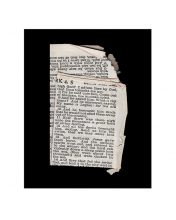
GA: I was frustrated with the narrow mindset of the movement yet, at the same time, I didn’t want to be overly critical. As I photographed I found that I had a great empathy for the church members. I was reminded of the line in the Bible, “you will know the truth and the truth will set you free.” The writer Flannery O’Connor has a twist on this quote, as she puts it: “you shall know the truth and the truth shall make you odd.” This is quite a nice way of thinking about the project; I wanted to show the oddity of this religious order but also to tentatively suggest that it’s ok to be odd. In the end, this is not a judgmental body of work.
SA: The images in the miracle of stories and the mystery appear as though they are shot from the point of viewer of an insider. How important was this insider status to both projects?
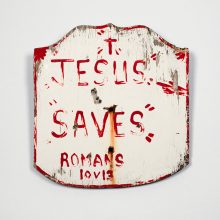
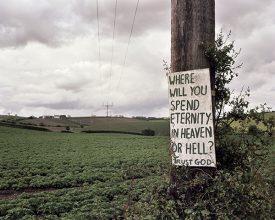
GA: In a way it was important and I think this relationship between insider and outsider comes across in the church typologies too. Each image of the church interiors is taken from the back of the room. This is typically where someone would sit if they were a newcomer to the church. In shooting the images from this viewpoint I’m trying to convey a sense that I see myself both as insider and outsider. I’m an outsider insomuch as I’m questioning aspects of the church and perhaps problematising, in particular, its more staunch characteristics. For example, I have included a selection of ‘borrowed signs’ in the exhibition. These are signs which one might find dotted around the landscape in Northern Ireland. They tend to warn the unreligious of their impending doom should they reject God. Personally, I find these signs to be quite intrusive so over the past years I have been gently removing them from the landscape and then photographing them in a deadpan mode.
SA: In a similar manner to the signs, the church typologies have a certain sense of memorialisation; of cataloguing something which may be on the cusp of disappearing. In that sense they reminded me a little of Donovan Wylie’s projects such as Maze and British Watchtowers. How do you see your work relating to other Northern Irish photography?
GA: A lot of Donovan’s work and the work of other photographers — for example Paul Seawright — has been orientated around The Troubles. However, I don’t see my work fitting strictly into the same category. There has been some fantastic work made about The Troubles and I don’t feel the necessity to add any more. However, I feel I can add something of relevance to the subject of spirituality; I believe this is where I can find my voice.
In terms of the church typologies, I would agree there is a feeling of memorialisation. I wanted to convey a sense that this is a church in decline.
SA: Outside of Northern Ireland, what other photographers inspire you?
GA: Robert Adams would be a definite influence, and that’s Robert Adams as opposed to Ansel Adams! I say that because I feel Ansel Adams is a good example of photography I can’t really relate to. Ansel Adams made images in the beautiful, awe-inspiring and idyllic landscape of Yosemite. Robert Adams, on the other hand, photographed a man-altered landscape and that’s the landscape I feel I can relate to. I admire the simplicity and honesty of this kind of photography.
SA: In the exhibition you include the Michael Longley quote: “It occurred to me when I was young that God and Ulster might not be too good for each other.” Where did you find this quote and what speaks to you about it?
GA: The quote actually came from the book Faith in Ulster, which gathered together various interpretations of the phrase ‘For God and Ulster.’ The book featured interpretation from a broad spectrum of perspectives from Church leaders to Loyalists and from conservative Evangelicals to artists. Longley’s quote resonates with me because I believe that there could be a compromise between church and state, between God and Ulster. There could be a situation wherein they caress each other as opposed to colliding. However, Longley’s quote also points to the problems that arise when people are uncompromising in their beliefs. Ulster has a negative, narrow connotation although I feel this is counterbalanced by a certain brightness and light found in the exhibition’s spiritual side.
SA: It’s a difficult time to show a body of work in Ireland which engages with the Christian faith given all that has surfaced regarding past atrocities of the Catholic Church. How do you navigate such difficulties?
GA: To deny my faith journey would be to deny myself, this is who I am. I am just as broken and messed up as anyone else or as Canadian songwriter Bruce Cockburn put it, “I was built on a Friday and you can’t fix me.” People have been hurt by their church, I have, and so have people of the Catholic faith and equally those of other faiths. I often refer to the project as ‘fragments of faith’ because I feel it deals with issues surrounding the fragmentation of faith, both my own and the Christian faith in today’s post-modern society. I think generally people today have some little scraps of a fading Christian faith in their lives, evoking good or bad memories. I hope these common fragments imbue the project with a universality. I hope that even those from a totally different religious upbringing can tap into a certain frustration and a search for answers. I’m not so sure that there are any answers, but there is sacredness in the freedom to ask questions.
– interviewed by Sarah Allen
__________
Gordon Ashbridge is a photographer from Belfast. His artwork is inspired by the beauty of ordinary places and objects, but believes that these so called mundane things have a deeper philosophical and spiritual significance. He holds a BA (Hons) from the University of Ulster, Belfast. Gordon Ashbridge: For God & Ulster was exhibited between 11 October and 16 November 2014 at The Gallery of Photography, Dublin.