Gina Kawecka is an artist with a background in film, theatre, writing and directing. Fascinated by human relationships, Kawecka considers the camera to be a conduit for connection. She also enjoys physical immersion in all elements of her work, with an iterative and collaborative process making connections along everyday journeys of discovery. Most recently Kawecka has applied these ideas to the sea, literally immersing herself in her newest medium to create a fascinating series of still and moving image works. Having recently exhibited her works in Brighton, Kawecka recounts for us here her inspirations and observations on this profoundly haptic series, Immerse.
__________
Christiane Monarchi: What was the initial inspiration to take a camera to the sea and look for swimmers?
Gina Kawecka: I didn’t actually have to actively seek swimmers – I started sea swimming in April 2017. I had separated from my partner, moved house and was readjusting to not having my children with me full-time (all very painful). I ended up moving almost to the edge of the sea. Looking at it every day so closely I decided that it seems a waste to not establish some kind of relationship with it! I filled my ’empty pockets of time’ (not having my children) with sea swimming. I then joined a club and became part of a dedicated, passionate sea swimming community. In some sense a new family formation.
I swam with my underwater camera from the start – not thinking it would ever become anything other than a personal dalliance. When it came to returning to my MA (I had intermitted due to home changes) it made sense to continue with the sea photography and filming as it had become such a central part of my life. Also, the sea swimming itself – as many many swimmers will testify – has kept me buoyant physically, emotionally and mentally. It has, as I have heard from many others, saved me.
CM: What does it feel like to embrace sea swimming for the first time, does it feel confusing and disorienting (as it does to me, a pool swimmer) ?
GK: I’d never been much of a pool swimmer so I didn’t initially compare it to that. It was only when I did some swim training in a pool (to learn front crawl) that I then realised how challenging sea water is (comparatively) due to its density, the lack of vision and no pool ends to hold onto when you’re tired!
The first time I went in with determination the shore break was really quite rough. I threw myself in (in ignorance – not recommended) and was unceremoniously spat out. The power was overwhelming. But it was so exciting – a full bodily experience – it made me feel ‘alive’.
I have felt confused and disoriented sometimes in the sea when the tide is against me – I think I’m swimming in a straight line or a certain direction when I’m not. I’ve also felt a bit scared when swimming in the dark and the tide has turned. I didn’t wear goggles at first either – it became a whole different experience once I found the right pair. The visual element is a huge part of the sea experience; it draws upon all the senses. For orientation I sometimes use the light I can see underwater to guide my direction. My MA research covers the introduction of goggles and the relationship of this to underwater vision, art and photography in the western hemisphere in the early 1900’s. I find it continually fascinating to chart the relationship between the use of the lens, vision and human social development.
CM: How did you start to use your camera to communicate your experiences?
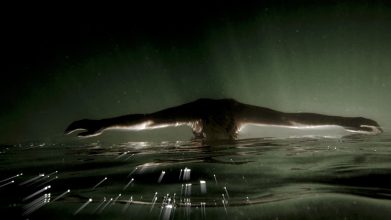
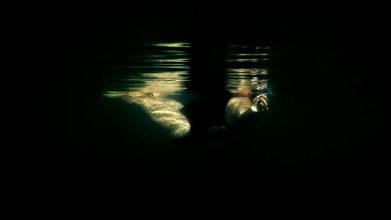
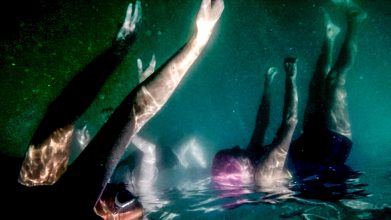
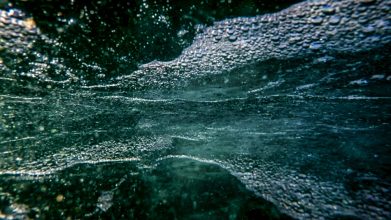
GK: I’d used my GoPro camera on holidays, as it’s small, tough and portable. I spent hours just shooting the light rays moving through the water in the Adriatic. I marveled at the images yet didn’t consider it ‘serious’ photography. Last February, I began ‘consciously’ shooting women swimmers in Kerry, Ireland. My swim friend introduced me to the amazing crystal clear waters there. We swam and I just shot whatever I could get in the time we had (it was frost-on-the-car cold so we didn’t have very long). I didn’t know exactly what I was looking for but knew it would surface at some point. The fishing analogies begin here! I spent hours going through the images and playing the footage.
It was when the season changed in May/June (algal bloom had passed, temperatures rising, water calmer) that things really shifted conceptually. The calmer Brighton waters invited a more relaxed approach to being in the water. No longer constantly swimming to keep warm. I happened to catch a friend just lying on the surface – it was a particularly beautiful morning – and shot her. On reviewing the footage I realised that this was the work. The clarity from the combination of the clear water and strong morning light makes for a beautiful ‘studio’. It was then the decision was made that Immerse would be a moving image piece.
CM: In your statement you discuss this series being about a ‘specifically female’ relationship to the sea, physically and spiritually. Could you tell me more about your feelings about this?
GK: There are the obvious physical connections of tides, moon and women’s biological cycle, the amniotic environment etc. This biological circumstance intersects not only with the sea but also draws upon the ‘sea/waterscape’ as an established metaphorical emotional/psychological inner landscape. For me, the swimming and the work are both deeply connected to my separation (relationship, mothering) – which is what photography is always about for me – overcoming a sense of separation. There is something about the female experience that makes us adept at navigating the depths, to go under the surface of things, to be dissatisfied with residing in the shallows. It is easy to fall into clichés here, and hard to pin down precisely, but that is what I love in this work: it illuminates the ineffable beauty and danger (water is dangerous) of the voyaging/seeking female spirit/psyche.
Anecdotally the benefits of sea swimming are well documented, with many women coming to the water and then finding themselves saved in one way or another. To be candid, I came to the sea utterly lost and it held me, and it holds me still. Like a reverse shipwreck! On a more ‘earthly’ level, I also found a community that has become a constant presence. The women change communally, and it is really liberating to step outside of the pressures we can feel about body image etc. It took me a while to understand a crucial part of the daily swim ritual – we all choose to be there. It is not bound by family commitments, partner, salary; it is purely for us. Historically, of course, women had to fight for the ‘right’ to access swimming (that men were automatically given).
I am not religious, I do not believe in ‘God’ but swimming is a way for me to connect daily with some kind of divinity. This work is a form of gratitude to the wondrous women of the sea.
CM: Is this an ongoing work / series or have you concluded your visual investigation ?
GK: Working toward an MA imposes a finished point! I concluded my visual investigation for this piece of work, then edited and installed in Brighton last September for my degree show. This installation was another voyage of discovery. I played with scale and surface throughout the research process. It was always intended to be an immersive experience. It was presented on three vertical fine fabric panels (3m x5m), one in front of the other. These created surfaces to capture and diffuse the images, creating a sense of depth and dimension. The projected image poured through the first screen onto the second and the third. These screens (one metre apart) invited audience immersion into the subaquatic world, encouraging a discovery of multiple viewpoints. There was a lovely play of scale with the limbs that float across the screens and the audience. Some people returned to experience it two or three times and enjoyed it for different reasons each time. I hadn’t considered its potential appeal to different ages. It successfully reached beyond the deeply layered and psychological realm to appeal to really young people who responded to the colours, sound and the sense of play in scale.
CM: What are you working on now?
GK: I am currently re working Immerse as a site specific response to the ONCA Barge Gallery in Brighton. The barge is smaller than the university site, but it is on the water so I am excited about reproaching the piece and seeing what might unfold. Clips from Immerse are also being used for a VJ set at club night House of Go Bang this weekend so I’m excited to see how the work is incorporated into a completely different context.
I am also reviewing footage I shot of seaweed, and I have been invited by an arts organisation to begin research for work focusing on the rivers of Welsh valleys. I am returning to portraiture stills (on dry land) as I have so much more to discover in that area. I’ve also been acting again over the last couple of years so that is offering exciting opportunities alongside my visual practice.
It is becoming a steadily productive phase of life. It takes some adjusting, but it is deeply fulfilling now I’ve learned to make the most of this extra space. This ship is buoyant!
__________
For further discovery of Gina Kawecka’s works, including an excerpt from her Immerse video footage, please visit: ginakawecka.com