
Astrup Fearnley Museet, Norway
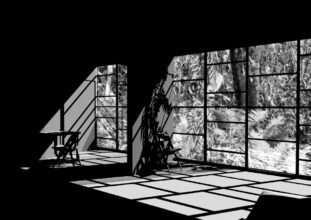
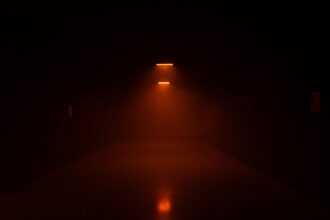
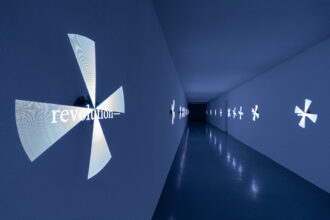
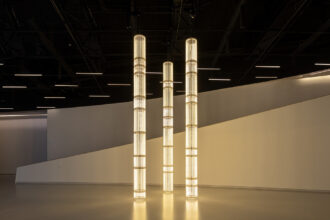
Curated by Astrup Fearnley Museet’s Canadian-born head curator, Owen Martin, Grammars of Light examines the manner in which three artists employ immersive environments, large-scale video projections, and luminous sculptures crafted from repurposed lighting to transform the museum’s galleries. Highlights of the exhibition include P. Staff’s video installation, Penetration, 2025 in which a medical laser is projected onto a figure’s body, effectively obscuring the boundary between interior and exterior; Ann Lislegaard’s Crystal World (after J.G. Ballard), 2006 which integrates science fiction author J.G. Ballard’s apocalyptic depiction of a world devastated by catastrophic sea level rise with the aesthetics of Brazilian modernist architecture in a precise digital animation; and Cerith Wyn Evans’ StarStarStar/Steer (Transphoton), 2019 which comprises six LED light pillars that pulsate according to algorithmic chance operations inspired by composer John Cage. Finding the show in turns unnerving, bewildering and exhilarating, I spoke to Martin about the genesis and the process of putting it together.
Akin Oladimeji: So the genesis of the show. How did it come about?
Owen Martin: I was interested in each of the artists’ practices sort of separately. Ann’s Crystal World is a part of our collection. When I was working on an exhibition for the thirtieth anniversary of the museum, I had been looking through the collection and I came across her work. This was only a few months into my new position. And so that work, Crystal World, had stayed with me for some time. And I was thinking about Ballard’s novel, thinking about this sort of image of these crystals, which the narrator continually describes as glowing, so that was at the back of my mind. I had seen the work of P Staff roughly concurrent to that time. Then I realised how particular lighting techniques and technologies are used by P to cause friction between the audience and the artwork. I was very interested in what that friction might mean, because I think Ann in a very different way, is also working with this narrative element and is finding ways to break it open, to create fissures in this narrative. And then I thought of Cerith’s work which I had been very much aware of for many years. There was an opportunity to undertake a show this winter and as I was thinking about the choreography of this exhibition, I thought that this combination of artists could open up to a lot more nuance and complexity. Obviously, these are very distinct artistic practices although they share some technologies in common. But I was interested in what that distinction offered. What that sort of friction, not just between the work and the audience or internally within a specific work, might create within the exhibition.
AO: Whose idea was the title of the exhibition?
OM: That was my idea. I was thinking about the different registers that the work was operating in. And the particular language that each artist was using at some point, literal language at times, but then obviously much more abstract as well. I was thinking that these are different, they are distinct grammars.
AO: You’re right, words do invade the space with the various works. I love the neon text in Ann’s ‘Come the Future’, 2016. I noticed she’s in the current Munch triennial as well as the subject of a solo show at Henie Onstad, the arts centre on the outskirts of Oslo. What is it about her that’s making her have a moment now?
OM: Well, Ann has developed a distinctive, quite sophisticated body of work from the 1990s to the present. The practice now has a maturity to it. She grew up in Norway and her last major exhibition was at Astrup Fearnley Museet in 2006, if I’m not mistaken. And then there’s been very little since then, but different local public galleries have acquired some of her pieces. I was meeting with Susanne Østby Sæther who curated the Henie show and we decided that rather than fight, we should work together with regards to which works are in which location, and collaborate on the public program. You can actually accomplish more that way sometimes.
AO: I love the poetry of Ian Hamilton Finlay. Cerith said that’s one of the influences which led to the title of StarStarStar/Steer (Transphoton). Where did you first encounter the columns in the work? They’re so big I can’t imagine where they’re stored.
OM: You know, I’m not sure. I don’t remember where it was that I encountered them. With some works, I know exactly the day that I first came across them. With Cerith’s, I can’t quite remember. I mean, I was just very much aware of the work, maybe it was at White Cube in London, actually.
AO: Regarding P’s work, any complaints or concerns about Hormonal Fog 2026 and the fact that it’s a room filled with sickly sweet fog meant to lower testosterone temporarily?
OM: We haven’t actually had any strong sort of feedback. We put up a warning just so anyone who visits the institution is aware. Many substances are not necessarily dangerous if you consume them in very small quantities, even by eating them or through skin contact. And so the vaporisation of these materials I think is not really dangerous for the human body. What’s remarkable is that we actually move around the world and we’re not necessarily aware of the impact of certain substances, which are safe to consume, but which change the chemical composition of our bodies.
AO: How do you normally get the public’s comments on your shows? And how has this show been received by visitors and critics?
OM: We receive feedback on all of our exhibitions via email. I do quite a few walkthroughs during the run of the exhibition and many of our members join for that and give their feedback. Plus, I pop down to the galleries every so often, speak with the hosts, ask them what the reception is to the works and to the exhibition overall to get a sense of they are received. One of the things I’ve adjusted is the language on the wall labels around the work. I’ve had feedback that many of the members of the public would like the text to be in simpler language, so we rewrote them so that those materials are more accessible to a wider audience. So that’s a very concrete outcome from the feedback we’ve received. We’ve only had one review out so far, which was great. It was very positive. That’s important but the sort of feedback that I’ve really sought out in the last few days is really with the artistic community here, my colleagues, artists, to understand how they’re responding to the exhibition. And it’s been quite positive. I’ve been struck by how much the choreography of the spaces, and the sequencing of works has been commented on. I wasn’t expecting that.
AO: Great to hear the show has had positive feedback. Thanks for agreeing to do the interview.
OM: No, thank you.
__________
Astrup Fearnley Museet presents Grammars of Light, a major exhibition featuring the work of Cerith Wyn Evans, Ann Lislegaard, and P. Staff (6 February – 10 May, 2026) curated by Owen Martin. Interviewed for Photomonitor by Akin Oladimeji.