These are interesting times for photography. Cameras and digital technology enable widespread making and distribution of images; even lockdown has enabled creativity and image sharing for photographic artists on a global scale. Does that make everyone an artist? Terminologies and labels on creativity become tentative, we can we find ourselves speaking more of the photographic or lens-based medium rather than of photography; the term ‘photographer’ can become image-maker, or art practitioner using photography. Consider this with the backdrop of the global market in art, galleries and art fairs as well as the constant, constant online sharing.
London-based artist Marisa Culatto’s creative musing has often included these ideas, when considering her own practice, not sure if she fits the label of ‘photographer’ or is purely interested in communicating what and how she sees. Four years ago she started creating some new images, which became this series, ‘In Order to See’. Below, Christiane Monarchi asked Marisa to take us back through her creative process to help us see like her, exploring “the half truths and half lies contained in the seemingly sincere narrative of testimonial photography”.
__________
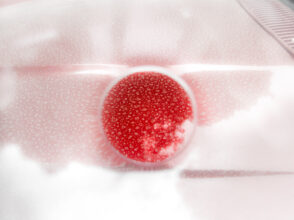
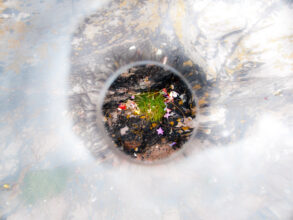
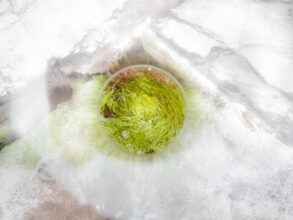
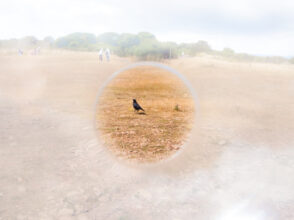
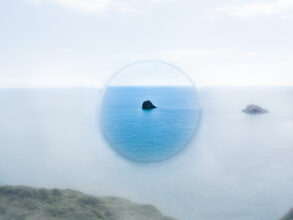
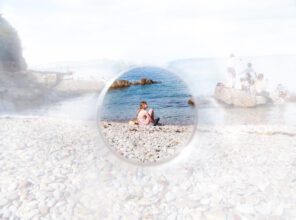
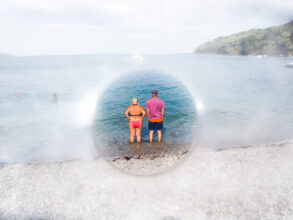
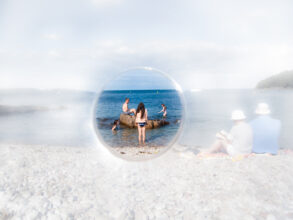
CM: I’m enjoying looking at your images from ‘In Order to See’ in the morning, one of those times of day you sit down to start thinking. I’m putting on my glasses, to bring images in focus. And I see a wonderfully round focus, a guide, helping me along. Perhaps I’m looking through a microscope? The subject looks a bit abstract, then we get to pull back, and recognizable elements appear. Where did you start with the idea of this way of looking?
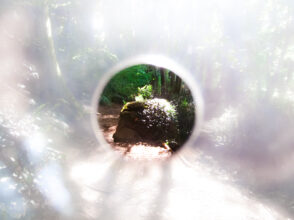
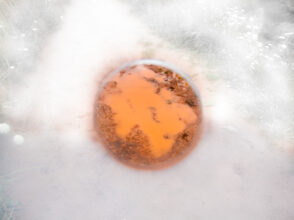
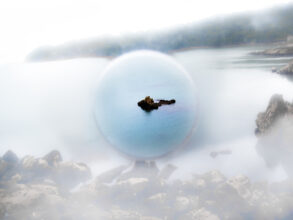
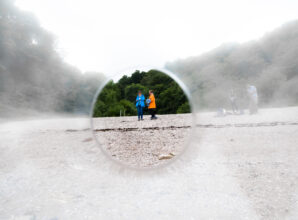
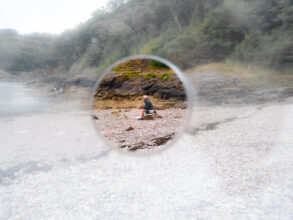
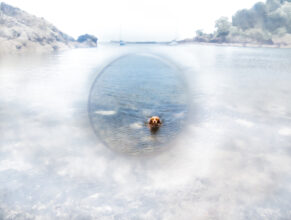
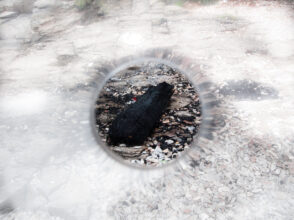
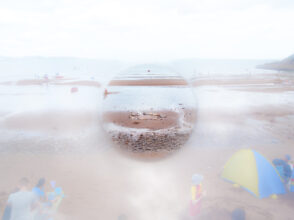
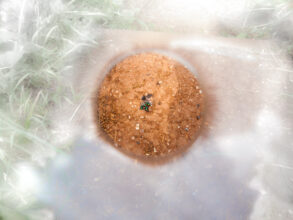
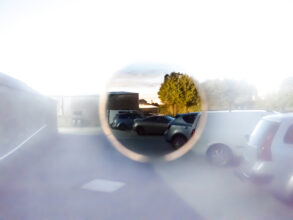
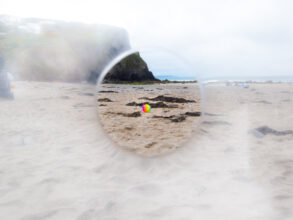
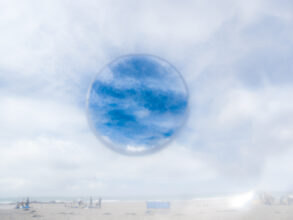
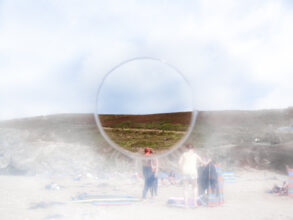
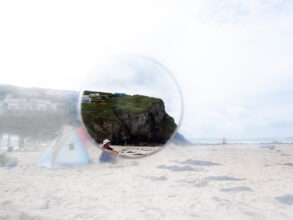
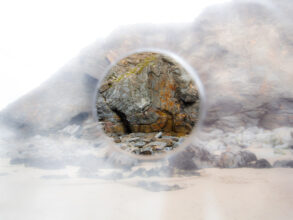
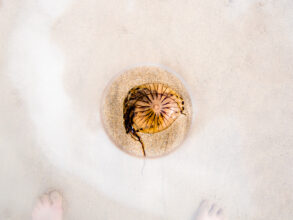
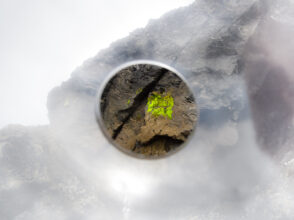
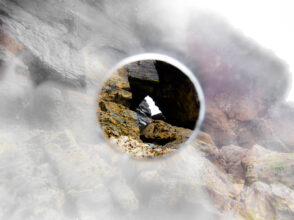
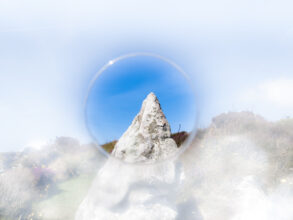
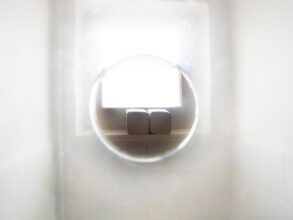
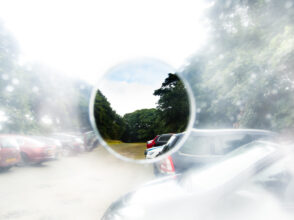
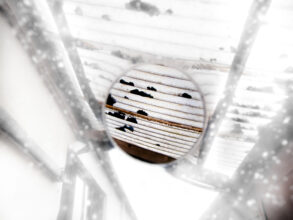
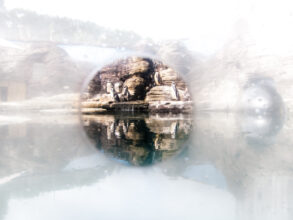
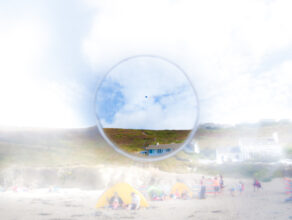
MC: This body of work dates from 2016, and I was having a bit of an identity crisis because, at that time, I was working exclusively with photography but felt very strongly that I didn’t fit either in or out of the photographic realm. So I decided to produce a body of work for which I had to pretend that I was “real” photographer, of the sort that carries a camera around and takes pictures of what they encounter, in the tradition of street or testimonial photography. I wanted to take pictures that said “I was there and this is what I saw”. This is such an unnatural way of working for me that, in order to be able to do that – in order to see, hence the title – I came up with the idea of using a prop, a plastic dome with a hole in the middle. The prop was mostly for me to hide behind, but I was delighted to find out that it also provided the images with a degree of texture, or pictorial quality which is more akin to what I normally do.
CM: As we move through the series, we have a focus on what could be the punctum of the image, definitely a source of movement, of action, the areas that demand investigation. It becomes a kind of tunnel vision, but in a positive way – blocking out extraneous details and helping us look at what interested you. Is this interpretation an intention?
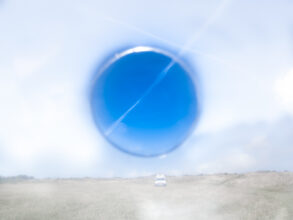
MC: In the first instance that was the intention, to draw the viewer to the clearer image contained in the centre of the photographs – inside the hole, so to speak – which acts as the “proper” composed image. Nevertheless, the wider background is also visible, albeit blurred by the plastic dome. So while exploring the side of photography which takes images directly from the world, my intention was to also examine it in a critical – albeit, I hope, playful – way by uncovering the half truths and half lies contained within this seemingly sincere narrative, by showing at once the framed image and its “context”: what we choose to capture versus what we consciously – and/or inevitably – leave out.
CM: Were there some ideas or images that were not possible to make with this process? I am often interested in as much as what we see, as what we discard.
MC: Yes, at the very beginning there were many attempts that didn’t work. For me both the composed centre and the wider context had to work as independent images. Sometimes the problem was that the wider image didn’t add anything to the smaller centre, and other times some just didn’t work compositionally. I can’t always explain exactly why an image doesn’t work; it just doesn’t.
CM: It’s funny now when I go back and consider your process, I notice some images that are frustratingly not focussed on the bits I would have thought I’d like to see there, like the clouds on the beach, or the back of a car in the carpark. In this one can see a possible slippage, to make room for the ‘machine’ making decisions on what I can see. Were these decisions yours or did you notice afterwards what was captured?
MC: Everything about the images was quite deliberate. After a while I knew exactly what was going to happen, and, as they were taken with a digital camera, it was possible to inspect the results on the spot. This tension between what you would have been able to see if the clear image had been all I had given you, and what the rest of the photograph offers you is exactly what I’m after.
CM: I am noticing that this round focus also constricts any sense of ‘sublime’ one may feel in losing oneself in a large image of the horizon at sea, or a dramatic cliff. Quite possibly it could be analogous to looking at a small .jpg onscreen, that you can’t enlarge by clicking or swiping. But in the real world, how big would these prints be, and how close would you like one to view them?
MC: As with all my series, I have done tests to arrive at the ideal size according to what I would like the works to do. The size for these, once printed, is roughly 40x50cm. I wanted them to be small enough to talk the language of classic photography, but large enough to allow the detail of the blurry part of the image to be clear enough so that, with a bit of mental acrobatics, the whole image is also revealed – and, therefore, after the frustration of the limits of the circular image, this sense of sublime you talk about can be, to an extent, re-obtained. So I think that, for the viewer, there has to be two distances at play: close up to look at the detail, and a bit further away to get a sense of the whole image.
CM: It’s quite an engaging feeling looking at these scenes, I wonder – does the process also relate in evening and darker settings?
MC: I did try taking photographs later in the day/evening for this project, but for different technical reasons – mostly to do with light reacting to the plastic prop – they never seem to quite work. The only surviving one taken the latest is the car park one with artificially illuminated trees at the back (nº 18)
CM: I am interested in control, as I feel it is something that comes back in other series of yours, like Flora, where you set yourself parameters and achieve a large spectrum of creativity within them. Is there a clear point when a project with a certain idea will be finished, or does it become a pattern to look in a certain way that may carry on for a long time?
MC: You are absolutely right in that I set myself parameters – self-imposed constrictions – for each project, as I find total freedom too daunting. These boundaries help me focus and are specific for each project. There is always a moment when I know a project is finished, and it is when I feel I can add nothing else to the point I’m making. With ‘In Order to See’, however, it has been a bit different. There are two phases to this project. The first one, the one we are presenting here, took place during a summer holiday by the sea in UK. The project then continued at quite some pace for a while back at home. Then the pace dwindled progressively until it has virtually come to a halt. It is not closed down necessarily, although somehow I doubt I will keep it going.
CM: Has Covid changed your working process?
MC: It has indeed, and in an unexpected way for me. As I said before, constrictions are generally fertile ground for me, so I decided to embark on a project which would be done exclusively indoors. It also felt important to me to use materials and methods available already in the house, as a way to prove that an artist’s mind would not be constricted by lockdown. At the time I had been thinking a lot about painting, and its liquid nature on execution but how works are actually dry once ready for display. So I came up with a body of work which, although photographs, in origin involve painting, drawing, pigments and a liquid support. A painting caught before it dries, that is unable to ever be dry. As you know, I had also been thinking about physical publications, so, to start with, I produced diptychs, or pairs of images in which one evolves into the other as a sequence of two images thought to appear next to each other as they would in facing pages.
Then, as lockdown continued and the sense of drama increased, the works evolved into single, very red, quite dramatic pieces. And after a while I started to think about the pigmented papers as works in themselves, doing away with the photographic process altogether, and leaving them at their physical stage.
CM: What are you making at the moment?
MC: Not photographs… I am making works on paper using water-based ink. Some are manipulated paper and ink on paper, and more recently just ink on paper. This might seem like a departure from my practice, because since I started exhibiting over a decade ago I had always done photography. But the truth is that, before that, since I was very young, most of my work was mostly watercolour and/or pencil on paper, and then it evolved to mixed media using photography, until I dropped everything except the photographic medium. So to me it feels more like going full circle.
__________
Marisa Culatto was born in the Canary Islands, and lives and works the UK. She has exhibited her work mostly in Spain and the UK in numerous solo and group exhibitions. In 2011 she won the AlNorte Grant within the X National Contemporary Arts Week of Asturias, Spain. She was finalist in the 2015-2016 “Contemporary Talents” competition of the Fondation François Schneider, France, Juror’s Special Commendation of the XXI International Photography Prize Rafael Ramos García, Tenerife, Spain, and in 2017 was finalist of the VIA Arts Prize, London. Recently her work has been acquired by Soho House collection for permanent display, and her body of work Flora was published by The Observer both online and in print.
For further viewing: