Indrė Šerpytytė is a Lithuanian born an artist, living and working in London. She studied editorial photography at the University of Brighton, before studying an MA in photography at the Royal College of Art. Her work looks at themes of conflict, culture, hidden histories and memory. Amongst other venues, her work has been included in Age of Terror: Art Since 9/11 at the Imperial War Museum (2018), Conflict, Time and Photography at Tate Modern (2014), and in a solo show at Ffotogallery (2013). This interview coincides with her new work When the Golden Sun is Sinking, commissioned by Grain. This work is on exhibition at Rugby Art Gallery and Museum between May 7th – June 22nd 2019.
_________
CM: It is an interesting title for this body of work, how was it chosen?
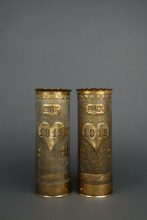
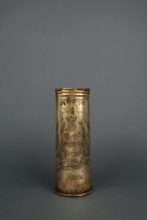
IŠ: When doing research for this work, I came across this poem engraved on one of the vases (which later became the subject of the work). It reads ‘Think of me when the golden sun is sinking, and your mind from care set free, when of others you are thinking, will you sometimes think of me.’ Further research locates the poem to a first world war ‘sweetheart’ pin cushion, which was made from a commercially produced kit designed for convalescing and disabled soldiers. This felt like a poetic way of linking a title to the work.
CM: Could you speak a little about this new work ‘When the Golden Sun is Sinking’
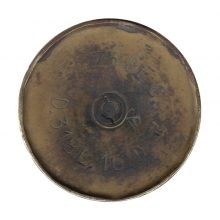
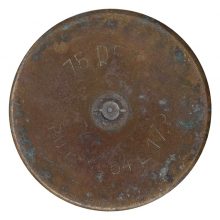
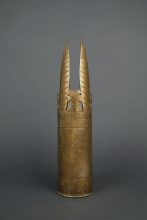
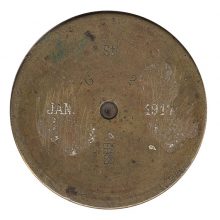
IŠ: It has been an interesting commission that talks about the economy of war. I found out it was mostly women who worked in the munition factories during the world wars making weapons of war. In times of reflection the men sent these munitions back home as crafted vases. This I found to be an interesting way of looking at the relationship between families and loved ones, in times of war. These vases speak about the relationship between home and war. My photographs catalogue and document these vases.
CM: I am fascinated by your research process and how it informs your practice. What interests me about this body of work is having started in the archive, how it develops beyond the initial research. My understanding is the work is inspired by photographic images of the ‘munitionettes’ taken during WWI and WWII, which were found in the Imperial War Museum and the Birmingham Library archive collections. Could you speak a little about how you navigated the broader archive collection and settled on these images, as the point of focus?
IŠ: You have to find an emotional story that speaks broadly about conflict. I was looking for a poetic way to respond to the sadness of war, which interested and spoke to me, and at the same time got to the core of the conflict. The ‘munitionette’ portraits were widely publicised propaganda photographs of women working in the munition factories during both world wars. These were commissioned photographs taken by 2/3 official photographers to boost moral during the war. The women were made up and staged for the photographs. These photographs do not reveal the bad conditions the women worked in. This interested me, I wanted to investigate this issue somehow.
CM: This is a question about your process, when making the work. Having located these images, could you explain what led you to look at the munition vases?
IŠ: The vases were made in the trenches and sent back home to loved ones. I had looked at these vases before and in fact found them a quite kitsch, so it took me a while to make this connection. However, domesticity kept coming up in the research, that is the connection between war and at home. I saw the vases again and they really worked, they became the anchor through which to ground the work. They are objects of war that speak of beauty, pain and loss at the same time. I started buying them on eBay and came across James Gordon-Cumming, an expert in munition vases and trench art. He was able to decode the information on the bottom of the vases, which located the vases and gave another layer to the work.
CM:There is a distillation in the work, that shows a circular relationship between the narrative of the archival images and your own work created in response to these images. This methodology that can be seen in your broader portfolio of work, specifically I am thinking of ‘1944-1991’ the photographed models of KGB control centres, which focus on objects imbued with traumatic histories. Could you discuss your thinking around the symbolism of objects as containers of memory?
IŠ: Well actually the process of making each work was quite different. With the vases, in When the Golden Sun is Sinking, each vase has different memories of love, memory and trauma inscribed onto it. I photographed these vases as objects imbued with memory. In 1944-1991, I first photographed the KGB control centres but realised, these places had been cleansed of their histories. I realised I needed to re-embed them with the trauma and memory they once held. I commissioned a crafts person to create these models based on my photographs. The hand-touched models imply a personal memory that is not accessible, a door, a window that cannot be opened. For the final work, I photographed these models.
CM: Your practice is broader than photographic; it also includes sound, video, and sculpture. Could you explain how you decide on which medium to use when thinking through and developing new work?
IŠ: There are many ways to work with visual language. I work with a number of different methods. Each project has a fresh approach. I clear the decks to see what comes naturally, I use the medium then comes instinctively. At the moment I am making a lot of textile based work.
– interviewed by Caroline Molloy for Photomonitor
__________
Indrė Šerpytytė will be speaking about When the Golden Sun is Sinking at Rugby Art Gallery and Museum at 12.30 on June 13th. This is a free event, no booking is required.
Further information and viewing:
Rugby Art Gallery and Museum website