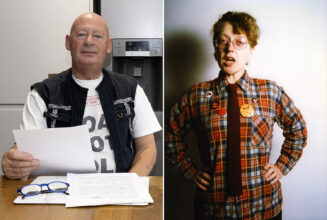
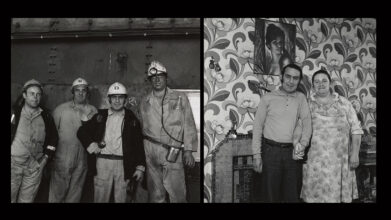
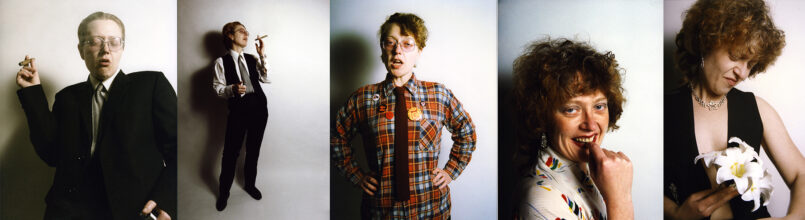
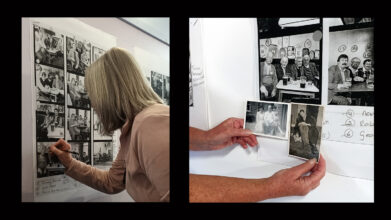


On the occasion of two major exhibitions Before and After Coal: Images and Voices from Scotland’s Mining Communities and Women In Revolt: Art and Activism in the UK 1970–1990 at The National Galleries of Scotland, Nicky Bird (Before and After Coal) and Rosy Martin (Women In Revolt) reflected on their shared concerns informed by two very different photographic practices.
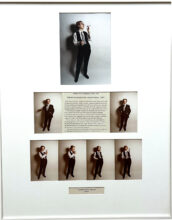
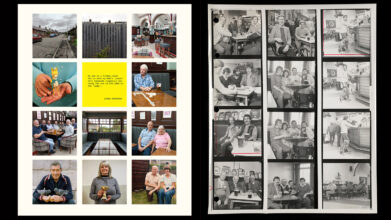
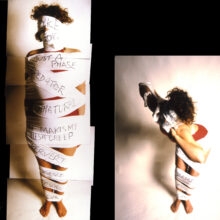
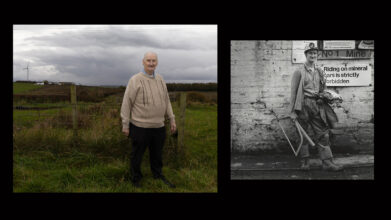
(Image above: LEFT: Nicky Bird, Detail from Mineworkings: Andrew ‘Watty’ Watson, Fife I, 2023. RIGHT: Rosy Martin in collaboration with Jo Spence, Detail from ‘Transforming the suit: what does a lesbian look like?’ 1986)
__________
Nicky Bird: Let’s start with the themes of art, photography, and activism. How do these inform your practice and how you work?
Rosy Martin: I work on issues that are of concern to me, that importantly have much wider social, cultural and political resonance regarding for example the formations of identities. ‘Transforming the suit: what does a lesbian look like?’ questions the construction of lesbian identities by performing the stereotypes embedded in society. In the 1980s there was a kind of uniform, here re-enacted as the ‘alter ego’, the ‘right-on’, ‘politically correct’, (‘woke’) ideal that set an impossible standard. Historical research led to the sexologist Havelock Ellis (1897) and his prejudiced descriptions of ‘inverts’. Using the same man’s suit in every photograph, with a few key additional signifiers, I placed myself within a range of roles and definitions by ‘so-called experts’. I re-staged, re-enacted, examined and exploded the mythologies of the lesbian, butch/femme and masculine/feminine, my ‘alter ego’, and the lesbian still closeted within a heterosexual marriage. My aim was to challenge any reductionist notions of my ‘identity-as-a-lesbian’, to break the concept of a fixed immutable sexuality, to destabilize female/male stereotypes, to decode role play, and to foreground ambiguity.
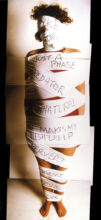
‘Unwind the lies that bind’ was my activist response to Clause 28 which stated that
‘a Local Authority shall not promote homosexuality or produce material for the promotion of homosexuality, or the acceptability of homosexuality as a ‘pretended family relationship’. (1988) These were heightened times of political resistance. I spent time researching the language used by MPs in Parliament, (pervert, disease, evil, sick, predator…) and was shocked by the deep-rooted homophobia within society. I had quite recently experienced my mother’s rejection of my sexuality when I came out to her. I had anticipated this and consequently only told her when the Arena programme on Jo Spence ‘Putting ourselves in the picture’ was due to be aired on TV, in which I had chosen to frame my work through my lesbianism.
To make visible how it felt to have the negative projections of others stuck upon me Jo wrapped me tightly, from head to foot in bandages, thereby blinding me, gagging me and tying me down. She wrote the pejorative words current at that time, along with those that my mother had said (it makes my flesh creep, just a phase, wrong). Such entrapment showed how it felt to be the object of hatred, disgust and fear and how internalising such judgments can silence and restrict. In the phototherapy session I did break free, but escaping homophobia is not that simple. I showed this work widely, as a political statement and campaigning image.
1980s social documentary practices also involved activism, what have these meant to you?
NB: The work of Format Photographers in Women In Revolt! reminded me of the importance of women’s activism both behind and in front of the camera. Their photographs of women during the Miners’ Strike (1984-85) were also included in Ten 8’s memorable issue Another Coal Face, published within months of the strike ending. Format’s captions named the photographed women and provided information on their roles during the strike. I still have that issue.
I have spent a lot of time with the work of the American photographer Milton Rogovin (1909-2011), particularly his photographs of Scottish mineworkers and their families from 1982. His series is central to Before and After Coal. An activist with a social documentary practice, Rogovin arranged his Scotland visit through the National Union of Mineworkers. His ‘Family of Miners’ project was a global one and his working method to make portraits of mineworkers at work and then at home. Rogovin provided names of countries and year dates for his photographs, but the rest is up to the viewer. When I saw his contact sheets from Scotland, I knew I would need to find out where he went and then take his work back to the communities he had visited.
RM: Where are you in the work? What’s your intervention?
NB: This began with retracing his footsteps with the copied contact sheets, and with the help of many others, recovering names of people and places. This brought along individual stories, community memories and issues that needed to be carefully thought through. Listening was fundamental. The different forms of photography, audio interviews and online content that is now in my works for Before and After Coal came through a series of ‘Show and Tell’ events held in mining communities. Participants brought in their own mining memorabilia and shared what these meant to them. The editing was the point when I was mostly alone with all the materials, which led to the final presentation of ‘Mineworkings’ as wall-based works. The space for your own voice as an artist must work respectfully with the materials but also produce something that will draw audiences into the works, including those not directly connected to its themes.
What does the listening process mean for you?
RM: Listening, deep empathy and a ‘being with’ is key to how I work. Re-enactment phototherapy is a collaborative practice, which I evolved and developed with Jo Spence from 1983. Through counselling and deep attentive therapeutic listening an issue or personal distress is identified, and a moment that encapsulates it. The one whose story is being told then finds clothes, props and researches how to make it visible. In the photography session the subject moves through and tells their story performatively, held by the therapeutic gaze of the photographer. A transformation is aimed for and occurs through this permission giving. The body speaks. It is a playful yet deep exploration leading to personal insights and addresses societal issues through empathy and intention.
NB: Thinking of those two bodies of work you have in Women In Revolt! can you talk more about decisions you made about their final presentation on the gallery walls?
RM: ‘Transforming the suit: what does a lesbian look like?’ is designed to resemble museum objects of classification and coded to be read as examples of specimens to confront any simplistic readings; thus, showing the multiplicities of identities.
‘Unwind the lies that bind’ is life size, made up of separate fragmented images to confront the viewer to identify with the subject.
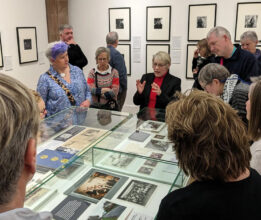
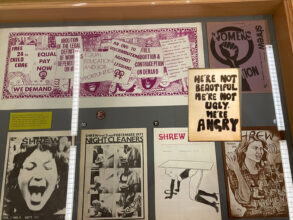
NB: Being a young woman in the early 1980s, Women In Revolt! was at times an unsettling experience, especially when looking at certain campaign materials now in a display case – a piece of your own autobiography is now living history…
RM: Indeed. The vitrines were so evocative. Linsey Young, the curator, did a fantastic job excavating ephemera. Those years of DIY production, what I call ‘gestetner/photocopy politics’ which enabled an immediate response to political/personal issues of concern. The energy and commitment to communities of interest: feminisms, actions in the moment, Greenham, punk, lesbian and gay, anti-racism… was palpable. No wonder these were so popular, the audience who had lived through and taken part in these actions and young people who were inspired by them, these scrappy old bits of paper somehow contained the energies of resistance and the will for change.
NB: In Before and After Coal I created display cases to represent the life of one man’s life, Alex Doolan, who met Rogovin off the plane back in 1982. The selection of photographs, objects and audio were shaped by working with his son John. John’s agenda was making sure the life, politics and times of his father was properly remembered. For the women I worked with, it was also about remembering their fathers, but from a daughter’s viewpoint.
RM: Whilst Women in Revolt! looked at art works from the 70s and 80s, Before and After Coal deals with the 80s until now. How did you reflect the current concerns?
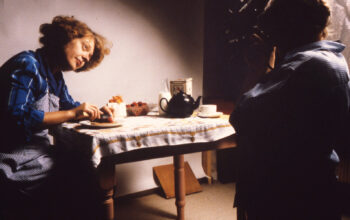
NB: The issue of coal mining communities being properly remembered, and on their terms, was a reoccurring one. For some participants, this was very practical, such as being actively involved with heritage work and local history groups. In the case of Jim Rutherford, he suggested being photographed in the same spot where he was first photographed by Rogovin in 1982. For others, there is still unfinished business such as Watty, whom I photographed in his kitchen with his Scottish Parliament victimisation testimony. A pardon is not enough: compensation for sacked miners and The Orgreave Truth and Justice Campaign go on. These all speak to the point to you raised when we visited both shows together: what remains relevant, what becomes relevant again – and crucially – why.
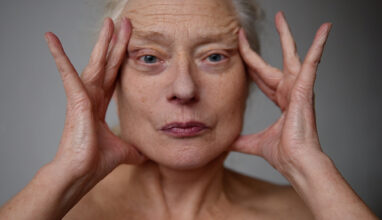
RM: I continue to make work that makes issues visible. On turning fifty I began to examine representations of ageing for women in ‘Outrageous Agers’, with Kay Goodridge. For example, in projecting pejorative texts upon the naked ageing body in which the words are only visible in contact with flesh, the body answers back. Working with Verity Welstead recently, I am again examining ageing. In ‘Letting go’ the reality of an old face is denied and revealed. What if we embraced wrinkles?
I made visible the contradictions in the caring role in ‘I didn’t put myself down for sainthood’. The selflessness that is demanded and the anger that must remain hidden in our society which takes caring for granted and offers little support.
__________
‘(It’s) About Time’ was developed from a National Galleries of Scotland event, held on Tuesday 10th September. To watch (10 minutes in): https://www.youtube.com/live/tqNhw9kK8CY
__________
Nicky Bird (born 1960) is an artist whose work considers contemporary relevances of found photographs and latent histories of specific sites, investigating how they remain resonant. Her work incorporates new photography with oral histories and collaborations with people who have significant connections to the original site and its photographic archive. Recent commissioned projects and exhibitions include: Before and After Coal | Images and Voices from Scotland’s Mining Communities, National Galleries of Scotland (2024); Going through the Mill, Signal Film & Media, Barrow-in-Furness (2022); and Legacy, Street Level Photoworks, Glasgow (2021). Before and After Coal will tour to Kirkcaldy Art Gallery, Fife (7 December 2024 – 20 April 2025) and The Baird Institute, East Ayrshire (8 May – 23 August 2025).
Rosy Martin (born 1946) is an artist-photographer, psychological-therapist, workshop leader, lecturer and writer. She explores the relationships between photography, memory, identities and unconscious processes using performative self-portraiture, still life photography and video. From 1983, with Jo Spence, she pioneered re-enactment phototherapy, which explores the psychic and social construction of identities through embodiment. She has exhibited internationally and published widely since 1985. Her practice explores issues including gender, sexualities, ageing, class, desire, memory, location, family dynamics, shame, bereavement, loss, grief and reparation. Collaborations include ‘Outrageous Agers’ with Kay Goodridge and ‘Gravity Gravitas’ with Verity Welstead. ‘Women in Revolt!’ curated by Linsey Young is currently on display at the National Galleries of Scotland (Modern 2) until 26 January 2025. It will then tour to the Whitworth Gallery, The University of Manchester (7 March – 1 June 2025).
Note: details on works by Milton Rogovin in the National Galleries collection can be accessed here.