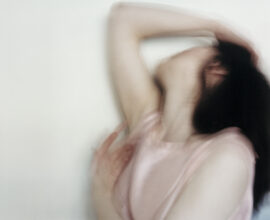

I first encountered Jessa Fairbrother as part of Beyond the Frame exhibition, which was on display at the Bristol Museum and Art Gallery, between May and October 2021. What intrigued me about Fairbrother was her use of needle and thread, or what she refers to as ‘stitch’, on her photographs, an element of performance and above all, an almost child-like yearning for her mother.
When I began my research, I found several essays, but I realised that Fairbrother had not been interviewed in the past, something she wholeheartedly agrees with, as we catch up over a Zoom conversation. She doesn’t say why that is. Should artists just focus on making art and not get caught up in the rigours of PR, or is marketing important for art to find a wider audience? Either way Fairbrother is excited to talk to me, to see how the younger generation responds to her work. Her themes are sombre—death, loss, severing—but she doesn’t take herself too seriously, she has a sense of humour, and certain humility.
Despite being a visual artist for the past 15 years, photography was not a first choice. ‘My original degree was in English, but I always knew I wanted to train as an actor. I went to drama school and slogged for a few years but it didn’t really take’. Her father’s cancer diagnosis curtailed her life in London as she moved back to Wales to care for him in 2000, and got a job at a local paper as a journalist. He died in 2001. Art was something she grew up with, as both her parents were artists. ‘I think I was avoiding it (photography) for as long as possible. After my dad died, it was more a case of acknowledging I had been interested in photography. He’d worked as a graphic designer but he was a photographer.’ Fairbrother did a photography HND but an MA was in order, fuelled by a series she made, An Important View (2004), wherein she documented memorial benches and plaques. ‘I thought I was making a body of work about other people but I was really making it about my own grief. I was projecting out. I was looking for a thing to talk about the way I was feeling.’
Fairbrother produced her second body of work, I Did (2006-2007), in order to apply for an MA at University of Westminster. She photographed women with their wedding dresses, exploring the idea of ‘yearning’ which is an important theme in her later works, especially Conversations With My Mother (made between 2012 and 2014). Fairbrother didn’t name the women in the photographs as the series was not about individual stories but a collective narrative of happy endings. The wedding dress was the symbol ‘because they are entry points for other people to have a feeling. And what I’m interested in is making something where someone recognises something very familiar. I like familiar because it’s easy for people to engage with, and you want people to understand what you’re saying.’
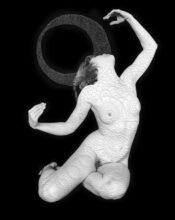
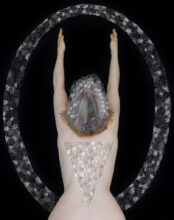
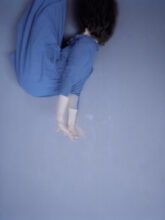
Between 2007 and 2011, she photographed people (I Did, 2007) and spaces (Here, 2009). She gradually built up to expressing the personal in her MA work Subtitled (2010). The Rehearsal (dedicated to Augustine) and associated Studies (2011) wove together the personal with the historical. From 2012 onwards, the self portraits have become more dramatic, like My Too Blue Heart On Your Two Blue Sleeves (2014) where one doesn’t know if she is falling or flying, and we see the introduction of the ‘stitch’ which is the mainstay of Fairbrother’s practice in Conversations With My Mother, evolving into perforations in Constellations (2018). She agrees that her work is about herself. In her world, ‘personal’ is not dismissed as non-serious.
Was she always confident talking about feelings? ‘It wasn’t very fashionable to talk about your feelings when I started making work. It’s difficult… a funny area. Yes, I make stuff originating from the personal, but it is absolutely work,’ she explains, using the analogy of memoirs and diary. ‘People write memoirs to be read by other people. Life writing can be very broad. You know, like Olivia Laing or Maggie Nelson. It’s intended to go into the world, to have an audience. That’s different from diaries that go under the bed. I make something I hope is recognisable for somebody else. And it’s taken me a while to become more confident.’
Even when using her body as material to interpret other people’s stories, for example the commission she did for Wellcome, Reframing Sex Work (2020), she is trying to make meaning beyond her. Is she using the personal to reflect on something universal? ‘I wouldn’t want to be that grand. I inhabit this body and I am used to the world in this particular way. In that specificity can I touch something that’s not going to touch everybody but is recognisable to somebody who encounters it?’
Stitch, she says, has helped her find anchors. ‘The stitch was how I could locate myself because it brings with it a completely different language. A lot of what was out there – when I was beginning to make work – was not reflecting what I was making. I felt very lonely. Yes, there were other artists using stitch with found images as part of their practice, like Maurizio Anzeri and Julie Cockburn. And while I understood where I sat in relation to them, it was difficult to find work in photographic practice, unselfconsciously, about feelings located in the personal. I still think it’s difficult to talk about feelings within a critical framework because they’re ephemeral. And maybe there’s slippage – confusing ‘feeling’ with ‘sentimental’ – and that isn’t what I’m doing.’
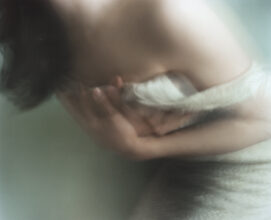
Fairbrother has been sewing since she was eight but it became a way of processing her grief when her mother, Shella, died of cancer. Shella worked in the medium of printmaking and painting. Though she didn’t have commercial success, Fairbrother always remembered her as an artist who played a significant role in her life. Conversations with My Mother was her attempt to explore ‘how you can have a conversation with somebody when they’re not there’. After she moved back to Bristol post her mother’s diagnosis, mother-daughter duo photographed each other, creating a small collection of images, albeit not technically accomplished. ‘I started to feel inadequate as a photographer as the images looked rough. I got some photographs printed out and I started intervening on the surface. I put some in a wheelbarrow full of water and left them for three days, started sewing on top of them and then I burned them. Sewing became a tactile way of spending time with an image. It’s like the material body, standing for the thing you haven’t got.’
With her series Constellations (2018) she’s moved into perforations, which she describes as ‘clothing I make for my body in space’. ‘If I’m using the needle and no threads, it becomes this articulate conversation with a needle where you are making the hole but not attaching yourself to anything. With the pictures I made of my mother (Conversations with My Mother), I was trying to make work that was about the umbilical cord and about attaching myself to her. I was also going through fertility treatments and I wasn’t going to have children. So I felt severed. I’m not held in the past by my mother as she’s dead, and I am not taking any one forward because I can’t have children. The maternal line has been cut. When I’m using the needle without the thread, it’s just markings signifying the abyss. I am in nothing. I am not held.’
An element of performance is apparent in Fairbrother’s recent works which is not surprising considering her training as an actor. Though they are self-portraits, they have an innate choreography; she is consciously taking up space, especially in her work Constellations (2018), where she is rejecting traditional art history practices of depicting women in a contained manner. She likens herself to an octopus with its many tentacles. Why is performance important for her? ‘When I’m making work, I am performing for the camera. But I’m intending for it to go into the world. What’s fascinating about performance is that the audience brings their meaning and activates something. When you go to the theatre, you feel a difference between one performance and the next. The actor translates something through their body. It might originate in their personal experience and the audience brings their reception to it and the meaning exists in the middle of that space. I love that idea because it means there is something alchemical going on between the viewing of the body and making meaning. For me, performance is an acknowledgement of that relationship. I know this is going to be looked at and I’m expecting it to be activated by the encounter and for the other person to receive the information. I find the language of dancers really helpful because they have this extraordinary understanding of the vocabulary of the body.’
With all the work that she subjects her body to, how does she care for it?
‘I saw the dancer Siobhan Davies re-present material from her archive once, and I remember her saying something like….the body was compost and you nourished it with what you put in…that it was nurtured to make things grow. Words to that effect…this idea stayed with me. So if my body is material I really have to look after it. I’ve got much more conscious of it in the last two years. When I’m making work, it’s physically demanding. It hurts to do something over and over again. It’s another performance in itself. My photography is analogue. I don’t have an automatic. My husband has helped me in a recent body of work where I needed a second pair of eyes to focus the camera but virtually everything else has been on my own.
I want to make work for a really long time and to do that I need to take care of myself…..so I pay attention. I run every day – it’s a form of meditation for me. I nourish myself. I’m a good cook. I cuddle my dog.’
As I near the end of my time with Fairbrother, I want to know how she would like viewers to respond to her work, or if there is just one takeaway what would that be? ‘I recently changed my Instagram profile to include the phrase “making things, to make people feel things”. We are only alive for a portion of the time the work exists. I won’t always be here to speak for the work; it will go well beyond me. I really hope the work I make provides some anchors to have a critical discussion about what are feelings, how we use feelings, and why we need to be able to talk about them in an image-based practice.’
‘I am tethered by an invisible thread which binds me to my own story. I sew into my photos to feel attached to something I still yearn for’ reads Fairbrother’s artist statement for Constellations and Coordinates. What is Fairbrother yearning for at this point in time? ‘Happy endings’ she says without missing a beat. ‘But I fully acknowledge – and this is my dilemma – they don’t exist.’
Does she really believe that?
‘We live in this world and so much of it is absolutely fictitious rubbish. It’s like when you watch a rom-com, knowing the ending but watching it over and over again because it’s soothing. My dilemma is: I want to be soothed because it avoids me looking at the abyss… but I know its fiction and I don’t agree with being soothed into passivity. From the position of both my parents having died pretty young– my dad was 54 and my mum was 64– there are moments in the period immediately after, where everything is at a heightened sense of experience. When you have a trauma you live in a heightened sense of reality. Everything is vivid; it’s just so intense. You can’t live in that state all the time because it’s too much. And you want to be soothed back down to actually getting up, going to work, and going to the shops, doing your laundry. So, yeah, my yearning is for a happy ending. I mean that sounds so glib. We all just yearn to be seen, to be recognised: that I existed, that I am here and I had something to say, and that it meant something. And it meant something to more people….not just me.’
‘What do you yearn for?’ she asks me in return.
‘For my father to say, “Good job. Well done; proud of you,”’ I reply.
Jessa Fairbrother’s work may be about her, but she’s not just about herself. I don’t know why more people are not speaking to her.
__________
Jessa Fairbrother spoke with Shyama Laxman, for Photomonitor, Autumn 2021. With thanks to both for this feature.
For further viewing: Jessa Fairbrother