![John McCarthy. Image © Julian Lass 2013. [Please see caption in interview text for details on the creation of this image]](https://photomonitor.co.uk/wp-content/uploads/2013/11/001-web850-218x220.jpg)



The handmade versus the machine-made. Where does the photographic handmade printer stand in the age of instant digital reproduction? What exactly is the hand print? There is the whole problem of definition, of the words ‘bespoke’ and ‘handmade’. An aura of luxury lingers on its bespoke surface. As with being fitted for a Savile Row suit, the photographer also plays a role in its design. So, what status to accord?
Questions linger between the words of this interview. What is the craft of the hand printer? What happens to the aura of the print’s individual manufacture when sold? If we scan it, does the uniqueness disappear? If ‘auratic’ power is nothing more than an lingering of a past ideal, where does it exist in an economy of exchange?
This interview doesn’t pretend to answer all of these questions, but will perhaps answer some.
———-
Creating a following of photographers
“Okay, there are people who can’t afford to hand print, but I say, you know, you can’t afford not to hand print properly. Hand prints are just so beautiful to look at. And if people don’t get to see that, it’s sad,” says John McCarthy, photographic hand printer. It’s a week before the Taylor Wessing Portrait Prize deadline, an annual photographic award run by the National Portrait Gallery, London, and John is pointing out a photograph he’s just printed. “Last year I did about 10 prints for the Taylor Wessing,” he says. “This year it was about 50-60.
“It sounds funny,” John says, “but I think if I couldn’t take care and try to get the most out of everyone’s work, I wouldn’t bother doing it at all. If I didn’t have a passion for it, I wouldn’t be doing it. I mean, I now work seven days a week, at least 12-hour days. You wouldn’t do that unless you were really into it.”
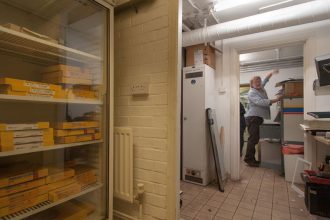
Labyrinth Photographic Printing, one of only a handful of professional labs left in London offering bespoke colour handprinting services, is situated in a small basement in the east end of London. The strong smell of photographic chemicals wafts from the bottom of the narrow flight of stairs leading down. To the first-time visitor, it can all seem a bit intimidating, this descent into photographic darkness, like discovering a secret society of those in-the-know. But John always emerges from the backrooms to greet you warmly. The constant handling of photographic spotting inks and a light-sensitive squint lend him a rugged, artistic appearance that quickly disarms.
“Film is back in everyone’s psyche, and editors are actually commissioning film again,” John explains. Both this ‘renaissance’ of photographic film and his years of handprinting skills are key to the success of Labyrinth, which he runs together with business partner Cos, Cosimo d’Aprano.
Silk screens and lithographs
Hard work is something that John has applied to his entire photographic career, which started at art school in Dun Laoghaire, Ireland, in the 1970s, and included working as a photographer for a number of years. “They didn’t have much in the way of photography then,” says John about his art school, “but I was really interested in it and I started printing there, doing silk screen and lithographs, and then I got more and more into photography and then I came to London and realised I didn’t know anything about working as a photographer, so I went to a lab and that’s where I first learned to print.”
The lab was Colour Centre, a professional outfit in the centre of London. “I learned the basics of printing there,” John recalls, “but then moved away and did photography for years and years, and sort of only came back to printing in the last 10 years. But I always freelanced in the evenings around London. I always kept my hand in. There was a lab called Outback, just before Goldenshot [photographic lab], and I was helping them out, and Cos was there, and they asked me to work full time, so I stayed.”
Chemical smells
Handing over negatives is always nail-biting, like separating a parent from a child, but smoothing down his shirt and squinting over a lightbox, John immediately knows what to do to print them and how long it will take. His question “how soon do you want them?” is therefore a courtesy, but it’s also possible to book a slot to sit on Labyrinth’s comfortable sofa while John pops in and out of the darkroom at regular intervals to show you the latest version of your print. Or you can leave him alone, trusting him – as you can – to make the best print he possibly can.
“What generally happens is: I’ll say to people, come in and start printing with me, and then just leave it to me. I can’t tell you exactly how it will happen, how it will work, there’s going to be a balance. Some of it is a collaboration, but people take it only so far, and then hand over and are quite happy. I’m doing at least three projects with photographers on that basis, where they’re shooting and then handing it over to me.” In turn, John is moving the image on and creating a new insight into the work. “There’s one photographer,” he laughs, “we talked about what she wanted, you know, and then she left me to it. She actually licked the print she just loved it so much. I just managed to create something that was so beautiful to her, and she can’t come in and say, you know, ‘can you do it exactly like this’, in order for that to happen.
“I work on up to six ‘lamps’,” he explains, referring to the photographic enlargers that he uses to make prints. “I try not to start too early, about half ten, I’ll print all day, and I might be booked in to print with a photographer. And then round about six, seven o’clock I work properly, and then I work through to one o’clock, I think it was, last night.” There’s a pause, the barest hint of a frown. “And the weekends as well.”
The concentration required to print simultaneously on several enlargers is immense. “You look at the colour tests, then you’ve got to get back [to the lamps], then you’ve got to hold your head down and adjust [the colours and the exposure], then you’ve got to dodge and burn, or whatever, on each print,” says John. “You have to try and take in what the shot’s all about and find the focus of the picture, where your eyes go. You go to people’s faces first,” he adds, “and then you look at the rest.
“And then you’ve got people talking to you at the same time. I did actually break my record last month, 91 prints in a day, individual prints, which is fairly going for it. But that takes a lot of concentration just trying to hold all that information. On an average day I get pulled off doing so many other things, I spend a lot of my day organising the talking [to photographers], so I do around 20 to 30 [prints].
“I always say, it’s just down to your imagination,” John adds. “You’ve just got to think, well I’ve got this image in the enlarger, and I’ll do this to it. People ask me, will I teach them to print,” he says, “and I say: ‘go off and learn’ (up to a certain level). There’s no point in me showing people the basics. When you know the basics, there’s still a lot more to learn. Some people are really natural. It’s not rocket science, it’s just problem solving, like I said at the very beginning. It’s solving the problems within the picture to make the picture work. I think that’s the way it’s always been. One of our interns, she was really good, straight away. And again, where you draw the information to answer those questions, is what it’s all about, talking to the photographer and using all of your experience. Very often I’ll tell people to walk round the lab and come back to the print again, because that thing of staring, you can stare at the print like you can at the screen, and you can just get totally sucked into it. You need to go away and look objectively at it.”
Film is beautiful
“Film got so good before digital came in,” John says, “it got really beautiful. I went to Arles [‘Les Rencontres d’Arles’, 2013, the annual summer photography festival in the south of France] to look round the exhibitions there, and you can just see the difference. There was a whole big room of black & white prints, and there’s about two hand prints and the rest are all digital. Beautiful shots, but it just feels all grey. There’s only one range, one ‘palette’ there,” he says, referring to the range of tones in a picture. “Last year there was a big exhibition in the Barbican [Everything Was Moving: Photography from the 60s and 70s]. There were such iconic, amazing images there, and they were all printed digitally. And I just couldn’t engage with them. People have become used to it, seeing that digital quality, and it just doesn’t have to be like that. If you get a nice bromide print, there’s a huge range of tones in that. And if you go to a platinum print, the range of tones in that, it’s just immense. [A platinum print is a specialised black & white hand print, that’s often printed with masks.]
“I think it’s to do with profiles, I think they put a particular profile on it and that just handles everything.” [A ‘profile’ is a tiny piece of software that enables a digital printer and a computer to talk to each other and therefore synchronise tones and colours.]
In development
Once a year Labyrinth holds an exhibition titled A Year in Development, which showcases the work of many of the photographers he prints for, photographers such as Leonie Hampton, Laura Hynd, Anastasia Taylor-Lind, Laura Pannack, Jennifer Pattison, and Ivor Prickett. “We don’t really advertise,” John says, “we have the yearly show, in February. We don’t select, we just invite people to submit. And that has proved really popular. You know, it’s our only advertising tool.”
At the moment all of John’s printing is on ‘c-type’, or colour coupling paper, the same type of paper that high street labs still print snaps on. When exposed, the paper ‘couples’ to make the colour. “We buy rolls as the [c-type] paper you get in boxes is a coating on a much thinner base,” John reveals, “whereas the rolls have a thicker base, which is better.”
A future development for Labyrinth, though, will be ‘dye transfer’ prints. “I wish I’d known what dye transfer was sooner,” John explains. “It’s what [the photographer] William Eggleston prints. It’s the purest form of colour printing. You separate the colours out from the negative, and then you print them back together. And the dyes you use are mineral-based and pure dyes. Without getting too technical, the dyes are soaked into the paper and then you print. And it’s beautiful. We’re reinventing it, it’s our next mission. It’s impossible to get the materials, so we’re getting them made, and we’re importing some, and it’s taking a while, but we’re investing very heavily in it.”
Labyrinth also has a dip and dunk film processor and a high-end film scanner, which is where many photographers using film prefer to end things: with a high-resolution scan straight off the negative, bypassing the need to make a print. But this is not enough, John thinks, and he really encourages photographers to let him handprint their images. “We then do a scan from the print,” he explains. “That way you end up with something that needs very little colour work, and if the client wants to change something, or spot something out, they can do it after.” This way of working, John explains, is usual for his clients, such as fashion and advertising photographer Tyrone LeBon. “In the last month I did three to four hundred prints for Tyrone,” he says. Not that they meet in person very often. “I haven’t seen him for I don’t know how long. We have a really good working relationship, he leaves me to it, and his style that he has developed, that’s what’s giving him all the work. People absolutely love it.”
Despite the increase in work he is taking on, it’s being alone in the dark that John loves, and he’s keen to return to his darkroom cubicles and carry on printing. “I just find when there’s no one else around, I can really concentrate. What I like best is being here on my own, turning the radio up, and printing.”
Essay and interview by Julian Lass
———-
Labyrinth Photographic Printing is located at 121 Roman Road, London E2 0QN www.labyrinthphotographic.co.uk
———-
NB: Full caption for the first image in the grid, at right, relays the labours of its creation:
John McCarthy. Image © Julian Lass 2013. Photograph taken on Hasselblad 501CM on Fuji 160S. Film developed in Labyrinth’s dip and dunk machine by Cosimo d’Aprano. Contact prints made by Cosimo d’Aprano and John McCarthy. Negative handprinted by John McCarthy. Final print scanned by Tess Hurrell and TIFF file emailed via WeTransfer. No digital retouching has been done.