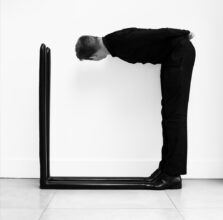
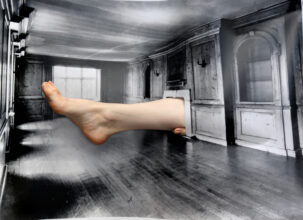
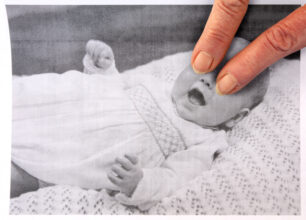
Born in Berkshire in 1985, Jonny Briggs is a multidisciplinary artist best known for his idiosyncratic brand of highly autobiographical, self-psychoanalytical and yet universally relatable photography, whose arresting, hybridised, multi-media creations operate in the interstices between fact and fiction. Briggs’ work is reflective of both the artist’s preoccupation with his own family history and with the practice of psychoanalysis, facilitating the articulation of the once unspeakable. Playful, intuitive and deceptive, much of Jonny’s work over the past eighteen years has featured his parents in a variety of imaginative scenarios, their presence having much to do with the artist’s sustained interest in the credulous condition of childhood. Endeavouring through a series of reincarnations and reconfigurations, “to think outside the reality I was born and socialised into,” he attempts to animate an “unconditioned self.” The dialectical relationship between self and other is clearly something which fascinates Briggs whose work turns compulsively on the paradox that self and other whilst seemingly insuperably separated are at the same time mere recto and verso of one another.
__________
Nicola Baird: Although your work continues to be very autobiographical and to feature your parents as (inspirational) subjects, how do you feel your work has changed and is changing over time?
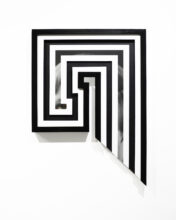
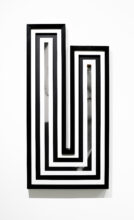
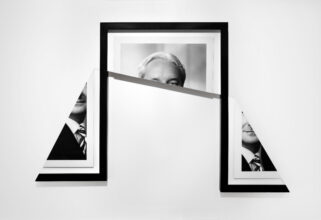
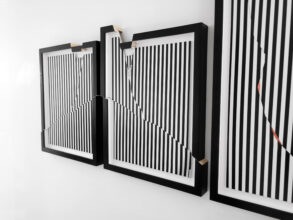
Jonny Briggs: The work is moving beyond the immediate family. The family photograph is regularly cropped out of the frame as the work veers towards minimalism and abstraction. In earlier work, forms of restriction showed themselves within the photograph, whereas now I rebel against these restrictions within the frame itself which houses the image. I’m playing with both literal and figurative frames. I rebel against restrictive social frameworks that can’t accommodate marginalised people. The stark, formal frame reminds me of constructed socialised ideas about gender and sexuality as well as the formal suit. Slices through frames liberate their contents, revealing the otherwise hidden construct. It feels like a dissection lab of deconstruction.
The ‘dazzle’ has also become important to the work as my colour palette has shifted to incorporate black and white, often in nauseating stripes. Dazzling is a defence mechanism, in both nature and culture. Forms of hiding have always been part of my practice which I can’t help but relate to my queer experience – learning how to hide myself and know when it’s safe to show who I am. Sadly, many queer people must perform as others, camouflage. Some people fear difference but there is beauty in difference and an opportunity for us to grow together, united in alternative perspectives.
I’ve grown to value and draw upon my dyslexic approach, thinking non-linearly like a spider diagram spreading ideas outwards, embracing distraction and linking abstract thoughts together.
NB: What is it that makes you/ motivates you to keep working/making?
JB: The thrill of the idea. When I get an idea it energises me, there’s a buzz from it. It’s exciting, surprising and often revealing. Art gives us the opportunity to self-reflect. Whether we’re viewing someone else’s work, or our own, it’s a valuable opportunity to listen to ourselves, contemplate our reaction, and to speculate why these thoughts and feelings have been stimulated.
The work liberates me and allows me to voice feelings once held silent and to show what was once hidden. There may be traumatic parts of our pasts where we weren’t in control, yet now as makers we can be in control – artmaking can give us agency and empower us.
NB: What is the relationship between thought and intuition or feeling when making work?
JB: My process often involves an impulsive idea that feels right. It feels right before I think it’s right – it takes a while for my thoughts to catch up. As a result, I usually have less to say about the most recent works – I need time to digest them, to speculate on what they point to and how they connect with other works I’ve made. Sometimes I’ve seen the work as a conversation between my thought and intuition, where the thoughts are following the clues that intuition leaves behind.
NB: We’ve known each other since 2008 and in 2013 I wrote as part of an exhibition review that your work seems characterised by radical uncertainty, uncertainty in particular concerning the distinctions between past and present, self and other, fiction and reality- would you say that this is still the case?
JB: I think that although often viewed negatively uncertainty can be valuable. There’s truth in contradiction. To say ‘this is this’ or ‘that is that’ can be reductive, encourage polarisation and deny the multiplicity of meaning. Each artwork comes with its own cocktail of connotations. The more we observe, the more we notice interconnectivity. No matter how much we try to categorize or package, there will always be seepage and blurring. This queering connects to my queer experience, and resistance to being labelled or put in a box. To be branded a noun is to deny the liberating fluidity of experience.
It’s easy to assume we’re separate, and yet the more we pick this apart, the more we notice how interwoven we are with everything we consider ‘other’: our environment, our past, and those around us.
NB: More specifically, how do you explore and interrogate selfhood?
JB: I often slip into saying ‘the work’ rather than ‘my work’, as the work feels beyond me. I don’t want to claim ownership of it, which feels false as it’s a mash-up of external experience. To say ‘my’ reinforces self-other divisions, yet all ideas are connected, and I want to acknowledge and celebrate that. It feels more honest to me to alternate between self and other because that’s where the work is situated. I also feel I hover above the work, looking back on it from an alternative point of view.
I don’t feel particularly attached to an idea of self and think more around deconstructing ideas of the self and thinking beyond the self, than labelling it. Rather than thinking of people as nouns, I prefer to see us as verbs. In some ways the work feels like an attempt to deconstruct my social conditioning. Social conditioning pulls the wool over our eyes.
NB: We worked together on a solo exhibition of your work which I curated at Burgh House in 2021-2022, how did the opportunity to make site-specific work/ intervene within and without a heritage space/ work with and respond to a/the museum’s collection impact your work/ ways of working/challenge you?
JB: I relished the opportunity to disrupt a traditional building, to ‘contemporize’ a heritage building and to play, to subvert, to create surprises smuggled throughout the building. Museums and heritage buildings don’t have to be static, they can be dynamic, infiltrated, re-imagined and reinterpreted. One piece, Moustaches, made up of 9-metre-long steam-bent wooden broom handles, protruded from windows and covered the front of grade 1 listed building like vines. I think of my granddad, who was a window cleaner and perhaps also of neurotic cleaning, the subverted phallic, and the childhood fantastical.
NB: A related question- how do you see the relationship between the photographic and the sculptural in your work (considering hybridity, multidisciplinarity, photo sculptures/3D works)?
JB: My interest in photography comes from a dislike of the medium. Performing for the idyllically staged family photograph masked family trauma, and now, I seek to kick against the medium and the frames which contain it. By incorporating sculpture within photography, I’m able to approach my subject matter from different angles. I think we are too binary in our thinking about artistic practice. Categorising Fine Art in to ‘sculpture’, ‘photography’, ‘painting’ and ‘performance’ can be restrictive particularly for people who start with an idea and subsequently decide which medium best suits them, why not think across rather than within mediums?
NB: What does a day in your life look like? What is it/when is it that you feel most creative?
JB: Every day is different. Usually, I make a particular work when the moment takes me. I’m intuitive and unstructured in my approach. Usually ideas spark when I’m quiet, still, around nature and can hear myself.
NB: Do you/how do you find teaching impacts on your work?
JB: Teaching is a privilege, the opportunity to discuss ideas is an opportunity, granting an insight into the shape of things to come. When I’m asked who my favourite artists are, I think of my students. Teaching keeps my perspectives malleable. I often finish a day of tutorials with more energy than when I started, and the more I get to know a student’s work, the more I connect with it.
NB: Do you think about how your work might be perceived by others when making it, how important is audience reaction/response to you?
JB: If nobody were to see it, I would still make work. There is value to be found in looking back on what we make, and speculating why we’ve made it, and what it connects to. It reflects us, like an intelligent mirror. It can be an opportunity to externalise thoughts and feelings that would otherwise be held inside. Audience is, however, important to me. As makers, we can often make in a bubble – the perspectives of others can be a valuable bubble popping experience, which can further inform our own perspective. Because I often don’t know why I’ve made my works, I’m eager to hear the thoughts of others to help untangle it.
NB: What are you working on currently?
JB: I’m bursting limbs through archive photographs of cameras as if the present is infiltrating the past. I’m cutting into more frames. I have a feeling colour may return, disrupting the dazzle of the black and white. I’m also making more masks which fit parts of my body exactly, restricting my movement.
NB: What’s next, what are your ambitions for the future?
JB: I’m keen to keep surprising myself with the works I create. I love working with heritage properties as a way to contemporize history, create surprising interventions and rethink collections.
__________
Jonny Briggs lives and works in London. He studied Fine Art at Chelsea College and the RCA in London, graduating in 2011. He was awarded the Conran Award for Fine Art and the Saatchi New Sensations prize in 2011 and Foam Talent 2014 in addition to being a Catlin Prize finalist in 2012 and a Saatchi Gallery UK/raine Finalist in 2014. In 2017, 2018, 2019 and 2022 he received Paul Huf nominations. Solo exhibitions of Briggs’ work have been held at Kristin Hjellegjerde, London, 2022; Julie Meneret, New York, 2014; Marie-Laure Fleisch, Rome and NContemporary, Milan, 2015, 2021 and 2024, Photoforum Pasquart Photography Museum, Switzerland, 2017 and Burgh House, London, 2021-2022. His work has also been represented in group shows at Shanghai Centre of Photography in China and The Benaki Museum in Greece as well as Saatchi Gallery, 176 Zabludowicz Collection, Jerwood Space and the Photographers’ Gallery in London. Commissions include Saatchi Gallery, Leica, Grain, Channel 4, The Financial Times, Jerwood Visual Arts and V&A Wedgewood Collection.
Dr Nicola Baird is an independent researcher, writer and curator affiliated with the Centre for the Study of the Networked Image, London South Bank University. In 2021 she completed a PhD, which was a Collaborative Doctoral Partnership between London South Bank University and the Ben Uri Research Unit. Curatorial projects have included ‘The Making of an Englishman’: Fred Uhlman, a Retrospective at Burgh House and the Hatton Gallery in 2018, Czech Routes to Britain: Selected Czechoslovak Artists in Britain from the Ben Uri and Private Collections and Becoming Gustav Metzger: Uncovering the Early Years, 1945-1959 at Ben Uri Gallery in 2019 and 2021 respectively and Knots: Jonny Briggs x Burgh House: Contemporary Interventions into an Historic House, at Burgh House 2021-2022. She is the editor of Fred Uhlman: The Making of an Englishman (2018) and Becoming Gustav Metzger (2021), funded by the Paul Mellon Centre for Studies in British Art and the Association for Art History as well the author of an introduction to Jo Spence: Gypsies and Travellers 1970s published by Café Royal Books (2017). She is a contributor to the International Yearbook of Futurism Studies, the Journal of Avant-Garde Studies, the Journal of Modern Periodical Studies and The Modernist Review and has spoken at conferences in the UK, Belgium, Czech Republic, Portugal and New Zealand.
Lon