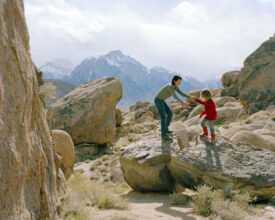
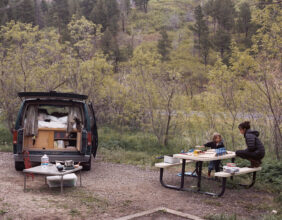
I took Casper on his first road trip when he was 3 months old and by the time he was one we managed to stay out most of each year for the next five years of his life. On one the hand it was the most beautiful way to be together, nestled under down comforters in the back of a van with all our worldly possessions packed in around us; among red wood trees where we would build forts in the hollows and make soup from their needles, finding starfish in the Pacific ocean and the many glass jars that might spill insect specimens were our car to hit a sudden bump; climbing rocks in the desert, climbing trees in the forest. But it was also the most brutal way to try to be a mother, trapped together alone for months on end while I was always struggling with him to let me make work. [1]
In 2012, Justine Kurland wrote these words in response to our call for contemporary artist mothers to tell us how they did both — make work and raise children. Kurland’s essay about life/work on the road with her son between the years 2005-2010 was a riveting read and (despite the apparent struggles) seemed to so emphatically answer YES! to the last of our 3 questions: Did having children enhance your creativity?
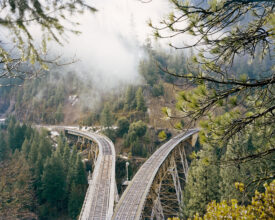
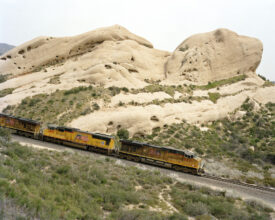
Carefully flipping through her latest concertina publication, This Train (MACK), I’m still in awe of that special chemistry of creative enthusiasm, audacity and what I’m sure some may have called sheer insanity, swirling in Kurland’s brain for 5 years as she took on the challenge of making pictures with a large format camera (!) on the road as a single mother. These are the pictures that she wrote about 12 years ago but hadn’t yet published because perhaps the photo world wasn’t ready to consider that a majestic, train landscape photograph could’ve been made just seconds after the photographer had made her son a peanut butter and jelly sandwich.
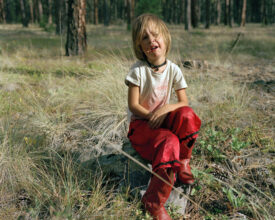
On a chilly, spring evening this past March, Justine and I sat down for a taco dinner in Brooklyn and because it had been a while since our last encounter, we talked about everything but her new book. Eventually we flip through This Train and Justine laments about the one “mean” photo she included of her son. I quickly reassure her that we’ve all taken pictures of those ugly moments of our children. At the end of our dinner, we agreed that I would email her the questions I had already written down in my phone’s Notes. In Justine’s answers, as in her pictures, I am reminded, there is no one way to be a mother just as there is no one way to be a photographer.
Qiana Mestrich: For me, the posturing of you and your son in This Train is similar to Girl Pictures. What are you thinking of when you pose people in your photographs?
Justine Kurland: Yes, it’s true! Although it wasn’t intentional. When I made Girl Pictures I pulled back because I wanted to balance the girls as the subject and the landscape as a subject, because it was as much about the girls’ interdependency to the land as each other. And when I scouted locations, I would look for places that could hold the girls, absorb them, and I would wait until they were absorbed with each other.
It was easiest to photograph Casper when he did something that absorbed him, like watching the trains go by (he would stare transfixed until the entire train passed). Actually when I think about it maybe I was trying to return the girls to that childhood state of being in awe of their surroundings. I see that in your zine (up)rooted. [2]
Posing Casper was tricky business, usually involving prolonged negotiations, bribing, and begging. But the pictures I pried out of him rarely worked out but the ones I love are usually the ones he gave me willingly. (There is one in the book where he’s crying, that was a mean picture to make but important to include, because it shows the full emotional range of our time together.)
QM: Can you talk about the logistics of photographing on the road with a child/toddler. In How We Do Both you state that the “work became less directed and more prayed for, each picture a kind of miracle,” As a mother I can imagine the challenges but were there any surprisingly easy moments?
JK: I have so many pictures in my memories that I never made, like contorting myself around Casper in his car seat so I could nurse him to sleep and get some driving done. Or the loose skittles he found behind a restroom toilet, sobbing as I pried them out of his hand. Or when he decided to use my camera bag as a bucket for loose gravel.
It’s funny how we remember the challenges first, but traveling with Casper was filled with delights. I had been working on the road for a decade before he was born, but never really took it in. Kids slow you down and if you surrender to that you have so many more opportunities to enjoy the journey. Because of him I went to many more swimming holes, found boulders he could scramble up, or trees to climb. I saw things through his eyes, his astonishment at finding fields of flowers crawling with ladybugs, their red shells against the green leaves and yellow petals. The frogs and snakes we caught and released. Or just cuddled up together with wind in our hair and sun on our face.
Also, because I started the road trips when Casper was 6 months old he was completely acclimated to the journey, a pro traveler. And the van was completely decked out with compartments for all his toys and snacks, a cozy bed, everything a family needs. He traveled in the front passenger seat, and we balanced a tray between the dashboard and car seat, so he had plenty of space for projects.
He thought other kids lived out of vans, that it was normal. Plus you know how hard kids love their parents in those early years, and how hard you love them. We were two turtles living in one shell as happy as could be until it got too tight. Then the real difficulty came, he had to acclimate to school and stay with his father when I left on my own.
QM: Pictures of Nature can be deafeningly silent. What is the soundtrack to your pictures? Can you talk about the book’s title and this reference to music?
JK: The pictures in This Train are a 3-4 year slice of our time on the road when Casper loved trains and I followed his enthusiasm by photographing them. At that time everything was trains, we had books, toys, stickers and I made mixtapes of any song I would find that mentioned a train. That’s how I found Sister Rosetta Thorpe’s ‘This Train’. She was an incredible blues singer, maybe the only woman of the time (30’s and 40’s) who rocked an electric guitar. Trains show up in all sorts of ways in early folk recordings but I believe Sister Rosetta Thorpe’s use of trains as metaphors for Christianity is also a reference to the underground railroad.
Lily Cho wrote an incredible essay for the book called ‘The Quiet Violence’ where she writes about “the ghostly remainders at the ragged edges of myth and triumph,” and reminds us of the thousands of Chinese immigrant laborers, barred from citizenship, that died building the railroad. When I photographed the trains, I did it to be in sync with Casper, but I simultaneously photographed the path of early Americans pushing violently westward, the first carbon emissions from those trains that started the Anthropocene, and the horrific labor conditions of those Chinese immigrants who built the railroad and inspired the US government to enact their first racist anti-immigration policies. These histories are embedded in the landscape and can be heard alongside my son whispering the name of every train car that passes (hopper, tank, gondola, flat bed).
QM: At your April 11th Dashwood book signing in NYC, someone told me that the photos in This Train were outtakes from your 2016 book Highway Kind. What was that decision about back then?
JK: Highway Kind covers 11 years of photographing on the road at the point where I turn away from staged narrative and begin working in a more observational mode. Casper appears in the book but out of the 80 plates he’s only in about 10 of them, a supporting actor rather than the lead.
At the time I published Highway Kind I was afraid of leading with the family pictures, I was legible because the work sat inside (and against) traditions of road trip photography. I was warned against showing pictures of Casper by friends looking out for me. I remember one person saying, who do you think are, Sally Mann?
Now I think of that as a huge compliment, but at the time I understood it was coding for being sentimental, female, and uncool. After I cut up my photo books for my collages in SCUMB I freed up enough psychic space that I could own the experience I had as a single mother on the road. And I can acknowledge that my ability to do it was not because of Robert Frank, but because my own mother traveled on the road with me and my siblings to sell handmade crafts at Renaissance Fairs. I inherited a certain knowledge from her, how to build a home in a van long before van life, how to raise children as an extension of a female business and how to embrace a nomadic life.
__________
[1] Justine Kurland. (n.d.) (pp. 20–23). essay. Jigarjian, M., & Mestrich, Q. (2012). How we do both: Art and motherhood. Secretary Press.
[2] For the April 11, 2024 book signing at Dashwood Books, Kurland curated and Dashwood published a series of six limited edition zines with artists on the subject of Motherhood. Entitled The Mother zine series, they were printed in an edition of 100 copies, 20pp staple bound color zines sold with an obi band. Featuring Family Table by Elizabeth Pedinotti Haynes, My Minky by Jacky Marshall, (up)rooted by Qiana Mestrich, Ouroboros by Jacquelyne Pierson, env-IRON-ment by Júlia Pontés, and Origin by Gwen Smith.
__________
Justine Kurland is an artist known for her utopian photographs of American landscapes and the alternative communities, both real and imagined, that inhabit it. Her early work comprises photographs, taken during many cross-country road trips, that counter the masculinist mythology of the American landscape, offering a radical female imaginary in its place. Her recent series of collages, SCUMB Manifesto, continues to make space for women by transforming books by canonized male photographers through destruction and reparation.
Qiana Mestrich is an interdisciplinary artist, photo historian, writer. Born and raised in New York City to immigrant parents from Panama and Croatia, Mestrich’s autobiographical artwork and research engages issues around Black, mixed-race identity, motherhood/mothering, women’s corporate labor and self-determination through fashion. Mestrich has exhibited worldwide including the international Triennial RAY Fotografieprojekte Frankfurt/RheinMain and London Art Fair’s Photo50. In 2007 she founded Dodge & Burn: Decolonizing Photography History, a blog diversifying the medium’s history by advocating for photographers of color. Her forthcoming book based on the blog’s interviews will be published by Routledge/Taylor & Francis.
__________
With thanks to Justine and Qiana for this feature. Justine Kurland’s This Train was published by MACK (2024).