

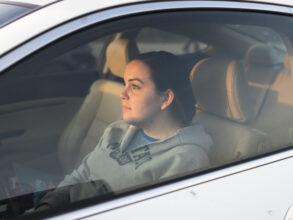
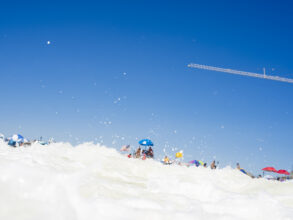
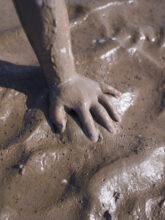
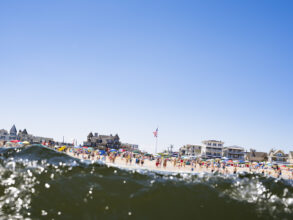

London-based photographer Andy Sewell has become synonymous with creating a certain type of work that explores ways of picturing the unrepresentable. Sewell describes his working process as being “broadly focused but very attentive.” Often imbued with a sense of strangeness, his works are concerned with what he calls “the contradictory quality of seeing” – the idea that things become more lucid the more we look at them and yet, at once, more unknowable and mysterious.
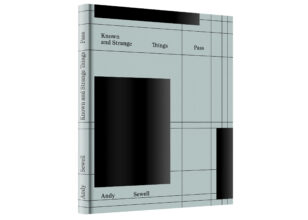
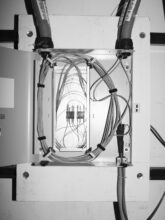
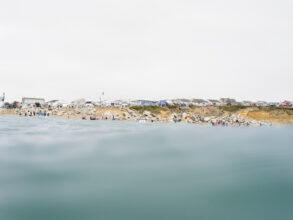
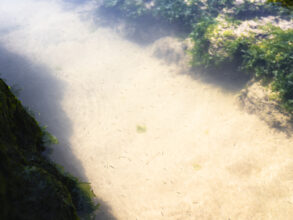
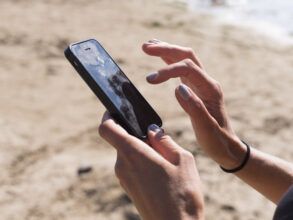
Sewell applied these themes in his most recent work, “Known and Strange Things Pass” – a meditation on our complex relationship with technology, in a series of photographs that are focused on the cables carrying the Internet beneath the Atlantic and the coastal landmasses they link. As always, he presents his subject in a complex and nuanced manner: in a literal and metaphorical enmeshing of two vast worlds that we think of as entirely separate – the ocean and the internet – the resulting works are as moving as they are masterly in their understated observation.
__________
When did you come up with the idea for Known and Strange Things Pass, and why did you decide on making it now?
I’d read about these cables, hair width strands of optic fibre, that stretch thousands of miles across the seabed and carry the internet from one continent to another. The idea of them was surprising. Until that point I guess I’d assumed this data was flying around in the air and bouncing off satellites or something like that. The material fact of the cables – that they exist, as tangible things, as points of concentration through which almost everything we do online passes – felt strange and compelling, at once abstract and deeply grounded.
This gap, a kind of sublime, between the visible and the invisible, the physical and the conceptual, was part of what propelled me to make the work. There were questions I was trying to articulate. How do these vast unknowable objects – the ocean and the internet – speak to each other, and to us? How do they relate, these things we think of as being completely separate, but that when we look closer, are literally and metaphorically enmeshed with each other.
It’s an interesting title, how was it chosen?
It’s taken from one of my favourite Seamus Heaney poems, ‘Postscript’. I like titles that open a work up, that can be interpreted in multiple ways. I like how it sets up the idea of movement and of a relationship between the familiar and the unknown.
(The last 5 lines of the poem)
Unless to think you’ll park and capture it
More thoroughly. You are neither here nor there,
A hurry through which known and strange things pass
As big soft buffetings come at the car sideways
And catch the heart off guard and blow it open.
You’ve shown previously that you’re adept at picturing the unrepresentable, but how did you set about drawing the distinction – and parallels – between humans, nature and technology in this work?
This drawing of distinctions between things is central. My work, in a way, is all about how things are so much more complex and specific than the predetermined patterns and categories we fit them into. The categories, human, nature, technology, for example: these are concepts that help us shape the world but nothing ever sits cleanly within them.
There is a common assumption that the more we know about something, the more clearly we see it, the less mysterious it becomes. For me the opposite is often true. The closer I look at something the more complexity and unknowability I find in it.
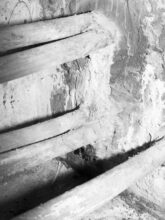
I am in this place where the digital network is concentrated. I can scrutinise this cable and learn facts about it – how many terabits are passing through it per second, how long it is, I might even learn who is using it, what stories are flowing through it – but that doesn’t make the fact of it, the relationships between its scale, its vulnerability, its power, the signs of the hands that installed it, the world of the spiders that make their webs around it, any less mysterious.
Within a picture and in the relationships between different pictures I’m trying to access this strangeness – the relationship between the lucid and the hidden, between the conceptual and the specific. I’m trying to make something that reflects this experience of entanglement, that pulls in different directions and challenges my assumptions.
I am fascinated by your research process and how it informs your practice. Could you speak a little about how you researched, and subsequently settled on, these places as a point of focus?
It’s kind of the other way around – I chose these points of focus and in doing so created a frame, a set of rules, to make work and to research within.
With this project, the concept – that all the pictures were taken in places where the internet was concentrated – was set up by the idea of the cables. Then I needed to research the practicalities of where they were, how to access them, etc. This frame also started a process of thinking and reading about the Internet, about the sea, about Victorian telegraph cables, about what it is to be embodied and disembodied and how technology affects these feelings, about how very large objects like the sea or the internet affect us, about Kant’s ideas of the sublime, about Gilles Deleuze’s rhizome, about Timothy Morton’s Hyperobjects, about how we hold ourselves in relation to the world around us, about touch and trace and lines and vulnerability and power and the indeterminate . . . All of this is fed by the pictures I’m making and feeds into what the work becomes.
What were some of the biggest obstacles you’d had to overcome?
Getting access to these cables is difficult. At a subsea optic fibre conference in Dubai I was talking to a woman from Google and when she found out I wasn’t part of the industry she actually went white and walked away mid-sentence.
I was in Dubai because while on a residency at Columbia University, I had a conversation with an academic studying this area. She said email is no use in contacting the people who make and operate and own the internet, you have to meet them face to face. And that I should go to this conference the following month where everybody in the subsea optic fibre cable industry would be. Although I didn’t get very far with Google I did manage to persuade one of the main companies involved to let me see what they do.
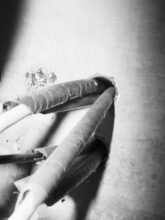
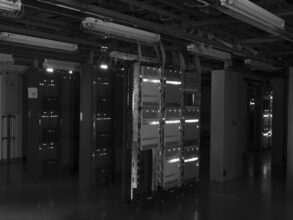
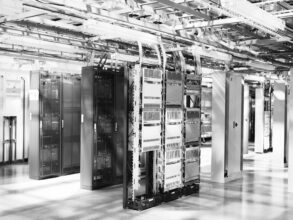
Once I had access it took me a while to figure out an aesthetic that worked. One reason I settled on black and white with heavy flash was precisely because these things are so difficult – literally and metaphorically – to see. I liked the idea of the burst of flash pulling something unseen into the light, referencing the aesthetic of evidence pictures and Weegee with his photographs of vice and crime scenes.
I also like the way this approach does something to our sense of time. The early twentieth century feel it gives speaks to my experience of looking at the cables. It was strange; I knew this thing in front of me was the cutting edge of contemporary technology, it’s what allows the world to work in the way we have come to expect, but it felt archaic. This was partly because the materials looked so familiar, like things I could buy in a hardware shop. But I think it is more to do with being so conditioned to think of this stuff as intangible: data moving effortlessly, frictionless through the ether – that to see this abstraction made the physical feel odd.
Another challenge in making any work is sustaining a faith that this will lead somewhere, that it will become something. When talking about a finished work it’s easy to sound like there was always a sense of what it was going to be. But the process is much more driven by chance, it’s about bringing images into relation with each other without knowing exactly what is being suggested. Obviously as a work is developing I form ideas about what it means and how I am shaping this meaning, but I think if it’s successful it also retains an unknown quality, it can’t be fully resolved or rationalised.
With this work I was trying to bring together things that we don’t normally think of as relating to each other. For the first few years of making the work I didn’t know if this was possible to do in a way I was happy with. It is something that could easily feel trite and reductive or incoherent – these were all obstacles I was trying to find ways around.
What was the starting point for your edit – were there some images that you thought were essential to the architecture of the body of work from the outset?
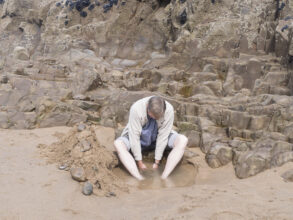
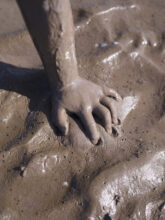
This was one of the first pictures I felt was really working, that seemed to be leading me somewhere. I like the way the man is clearly middle-aged but also seems like a little boy. The sense of vulnerability and absorption, a feeling of being self-contained and embedded, the way he’s shaping the material in front of him but also entangled within in a larger set of forces. The work, in a way, became an exploration of this entanglement, of affecting and being affected.
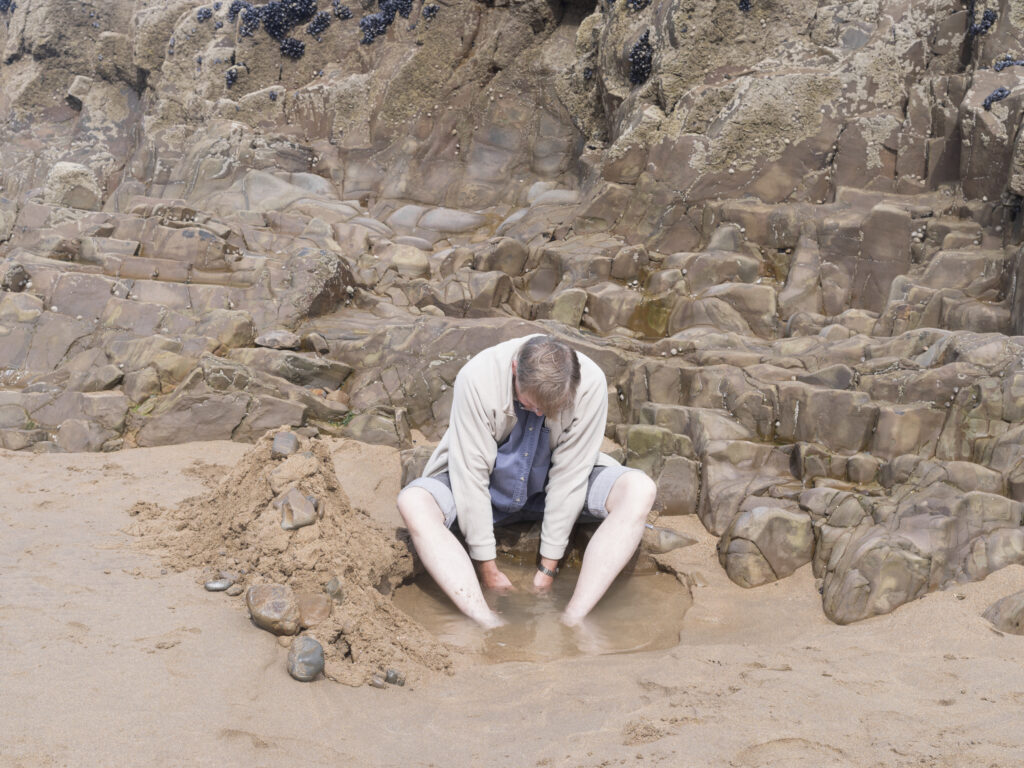
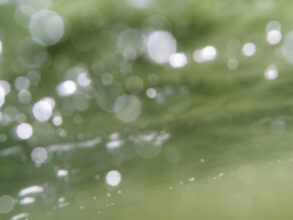
There is a kind of flow and interconnection in the picture – everything in the frame feels directed towards the hole at the centre. Even the rocks, a symbol of solidly, have a look of fluidity of sliding down. I love the whiteness of his legs. Points of bright light, in various forms, became one of the motifs that run through the work.
I can’t remember at what point I started moving towards the push and pull structure of intermeshing sequences, but it came quite early on. The sense of things in different spatial and temporal phases intertwining and coexisting felt integral. I knew this was an important part of what I was looking at but didn’t know if it would be possible to find the right form for it. That took a lot of working out!
Your work is complex, concerned with multi-layered subject matters and invites prolonged engagement on the side of the audience. Slow and sustained looking versus the quick, casual consumption of images we’ve all become resigned to experiencing is something I’m curious to hear your thoughts on.
Thanks – that is how I hope people are engaging with my work. I’m trying to make something that has a seductive quality to it, that pulls the viewer in, but doesn’t resolve easily. Hopefully there are new things to discover, new responses provoked, with multiple viewings.
I think it’s good that almost everybody today is a photographer, maybe this can help give all of us a richer sense of the complexity and strangeness of pictures. But it’s also true that the way we tend to experience images doesn’t invite prolonged engagement. The huge number of pictures being made might lead to a more casual consumption but I think a bigger problem is the way algorithms, designed to maximise profits for a few companies, shape so much of our relationship to images. They want to keep us hooked, keep us flicking quickly from one thing to another. These platforms could be designed to help us engage in a deeper way but that isn’t their purpose. The current model works very well for a small number of very rich and powerful people, so changing it will be a struggle, but it doesn’t have to be this way.
How do you approach taking pictures? Do you visit locations specifically and allocate a set time to shoot, or are you always alert to possibilities, with equipment ready?
I usually visit places specifically to take pictures. When I’m photographing I want to be fully absorbed in what I’m doing, trying to mix this with spending time with friends or family doesn’t work so well.
Would you describe your work as politically motivated? If not, how, if at all, do politics manifest themselves in your works?
I would say my work has been shaped by politics, among other things, but it’s not the primary motivation. There are political issues that I feel strongly about and I’ve used my skills as a photographer to help various campaigns. But that is something different to what I am doing with this kind of work. Normally I am trying to make something that has an openness to it, that provokes complex responses. Campaigning material on the other hand it is trying to make you think a specific thing or respond in a specific way.
Art, I think, is a rare space in our culture where things are made without a specific utility; the only purpose of an artwork is that it exists for you to respond to it and there is no ‘correct response’. It is inherently about multiplicity and indeterminacy; maybe this in itself is a political act given the way our society is structured.
While I don’t think of the work as overtly political, I hope one of the things it does is challenge the boundaries we place between things. Many of the problems we now face seem connected to a belief deeply embedded in our current politics that boundaries can be clearly defined and sealed. But when we look closer at any thing we find this is not the case. Which is not to say objects are interchangeable, but that the boundaries between them are permeable, and there can be no way of cleanly separating one thing from another.
What draws you to photography as the medium with which to observe the nuanced subject matters you choose to explore, and to express your ideas? Do you ever feel its limitations?
There is a line in Timothy Morton’s book Hyperobjects (a text that has been really helpful in thinking about this work) that is a great distillation of why I am a photographer. He says “What things are and how they seem, and how we know them, is full of gaps, yet vividly real.” Photography is a medium that is so limited, so much about gaps, but also linked in a strange, slippery way to the vivid, the lucid, the real. It’s the limitation and strangeness and straightforwardness of photography that draws me to it.
I find wandering around with a camera is valuable because it’s a useful way of trying to let go of a few of my assumptions. To notice and attend to what’s actually in front of me, which is usually so much odder, more challenging, more beautiful, more alarming, than what I expected to be there.
Enmeshment is always present. No matter how limited the frame, it will be filled with an uncountable number of contingencies woven together to form the view. Clarity, rather than revealing neat clear boundaries, shows us the opposite. Many of the photographs I love most manage to capture and convey something of this.
What’s your selection process in deciding which of your photos to include in an exhibition or book?
The selection, position and size of pictures on the wall or in a book is critical. The work is made in the relationships created between pictures. From the very beginning a project is an iterative process. Photographing and then editing and then photographing and editing again – finding relationships and correspondences and questions in the edit that feed into the next time I am taking pictures, those pictures feed into the next edit, and then that feeds back into more photographing and more editing and so on.
One of the things that art can do well is represent relationships that exist outside a conventional logic space. This is an important part of what I am working to discover and shape when editing. Poetry and photography are both really good at this. The gaps and limitations, the deep relationship between form and content make them effective for exploring a space not bound by the law of non-contradiction.
One specific question I was addressing in the edit was to do with hierarchy. A way of constructing the work might have been to begin with a picture of the cable emerging from the sea in Europe and end the book with the cable emerging in America. But to do this would imply that everything in the book was contained within the world of the cable, within the internet. A similar problem if the book began and ended with the sea, implying everything is contained within a classical idea of nature.
I needed to avoid wholism and reductionism. The beginning and end of the work should feel porous. I wanted to convey the sense we are seeing something partial, something extended beyond what we have access to. But which also contains a push pull rhythm, something cyclic without being closed. When thinking about the book design it didn’t feel right for the work to be limited by the fixed edges of the page. So the pictures move across this boundary and imply a bigger set of connections beyond what we can see as we go through the book.
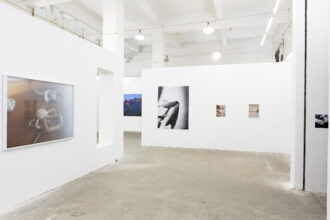
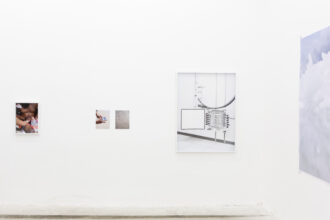
Many of the themes in the work – including those of scale, of power and fragility, of spatial and temporal enmeshment – can be explored in exciting ways on the wall. Each installation responds to the specific space. I use prints at various scales from the very large to the very small: some framed behind glass, while others, with a contrasting feeling of fragility, are clipped or taped directly to the wall.
In the gallery I construct multiple and perforated sight lines, exploring the repetition and sequential enmeshment of the work. I want the exhibition to invite people to reposition themselves and become aware of the limitations and the richness of their view.
Which other photographers do you admire, and why?
Jim Goldberg – the combination of text and image, and brilliant installations of his work, especially Open See. Combining multiple photographic approaches to create a something that feels cohesive, complex and compelling. Politically engaged and tender without being didactic.
LaToya Ruby Frazier – another great artist who manages to make urgent political work that is open and complex.
Rinko Kawauchi – for the rich and unforced poetics of her work and especially the way she sequences pictures.
Wolfgang Tillmans – Again brilliant installations! A way of positioning pictures in a space that feels, like sculpture, deeply three dimensional. He is also great at bringing together seemingly disparate strands of experience into something that feels connected without being overdetermined.
Robert Adams – for his clarity, honesty, sincerity and insight.
Allan Sekula – The brilliant way he combines text and image to address abstract theoretical and conceptual ideas and at the same time access something deeply specific and visceral.
Walker Evans – for amongst other things living up to his definition of photography – “the capture and projection of the delights of seeing, the defining of observation full and felt”.
Paul Graham – for the way he thinks about photography and for what his work makes me feel. He captures so powerfully the feeling of noticing what is in front of you. He is another artist who makes great use of the way pictures work in relation to each other.
Sirkka-Liisa Konttinen – for her picture of tomato plants growing in the window of a funeral directors in Newcastle, which is perfect! And many other great pictures, especially those in her Byker series.
Who are your heroes outside of photography?
I’m not sure about the idea of heroes, but I think it takes a heroic level of stamina and courage to stand up against the entrenched forces of power and of the status quo. So I’d say the people on the left fighting against an establishment filled with many malevolent and mendacious or lazy and narrowly self-interested thinkers. For much of my life we have been signed up to an end of history, technocratic, neo-liberal consensus. So much in the present shows us that this is unsustainable. The right have figured this out and weaponised it to give us the horror show of Trump and Johnson, driving us faster and faster towards division, intolerance, huge inequality and climate disaster. We have to find a better way of putting society together.
Any future plans? What are you working on now?
I’m thinking about irony and activism and about the relationship between climate and weather, and about the way that we model reality. There are a few things I’m at the beginning of but have no idea yet what the shape of the next thing I make will be. I’d like to embrace more absurdity in my work, not sure how that would manifest, but it’s something I’m thinking about.
I wrote these responses before CoVid19, how this will affect my work and everything else in the future is hard to know. With so much unknown and so much suffering happening right now it’s a strange time to be thinking about making art but I hope what I’m exploring in Known and Strange Things Pass is useful at this time. As we go through this pandemic, I find I’m thinking more than ever about the works themes – touch and action at a distance, the relationships between the virtual and the physical, between power and vulnerability, and about the permeability of the boundaries we place between things and the fragility of what holds them together.
__________
Andy Sewell was interviewed for Photomonitor by Claire Holland
For further viewing:
Known and Strange Things Pass by Andy Sewell has been published by Skinnerboox and will be available September 2020.
An exhibition of Known and Strange Things Pass is planned for January – March 2021 at Robert Morat Galerie, Berlin.