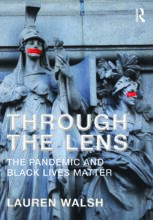
Visual journalism holds the power to attest, to interrogate, to educate. In the current conflicts around the world, journalists and photographers relay stories to their audiences, yet few may stop to consider how these images and news features are created and what roles they can play in future. In her new book Through the Lens: The Pandemic and Black Lives Matter , Lauren Walsh conducts interviews with leading photographers and photo editors in visual journalism during 2020’s biggest crises, and discussed the challenges they faced in this time, as well as how photojournalism continues to evolve in the present.
__________
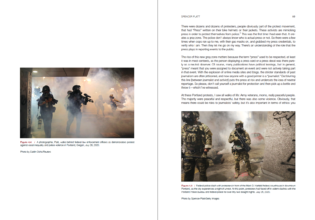
Christiane Monarchi: Your opening page shares images from Washington, D.C. on January 6, 2021, a day of infamy for democracy and its purported ‘defenders’ invading the Capitol. Within the following 100+ pages, your interviews with leading photojournalists and directors of photography across the world consider the making, dissemination and interpretation of images during the time of Covid and Black Lives Matter, leading up to this fateful day. What was the spark that made you want to start these interviews, to bring the journalists’ words onto the page?
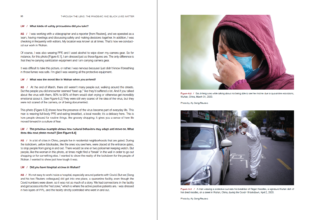
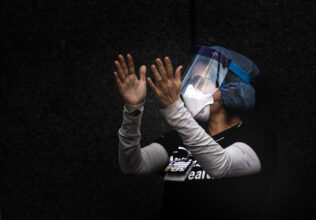
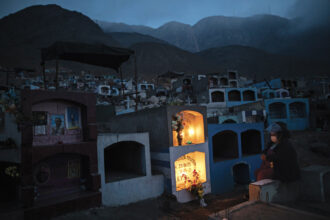
Lauren Walsh: My work on this started fairly early in the pandemic, and initially for myself, as I am always thinking about the challenges visual journalists face. In spring 2020, I was, like so many other people, isolated at home and looking at the visual coverage. I was hearing my photojournalist colleagues talk about how they felt sometimes hampered in their efforts to show what is “really happening.” In the US, there are privacy laws that limit media access within hospitals; and even outside of hospitals, photographers were telling me that they had a hard time photographing, for instance, some of the temporary morgues that were set up in NYC. In short, they felt the coverage was incomplete.
Meanwhile on May 25, 2020, George Floyd was murdered and America erupted. All notion of isolation went by the wayside and the US witnessed the largest demonstrations in its history. But at the same time, a subset of protestors were requesting that their faces not be documented. This is new. If you think of Civil Rights-era photography, you see faces. That’s part of what makes that photography so powerful—reading emotions in people’s eyes and expressions.
All this was happening at once and I was thinking through these issues and reaching out to colleagues to hear their takes. And pretty quickly I realized these are topics that matter to a lot of us: we are all living through the pandemic, and many of us have been to or watched BLM protests. Ultimately, this is about the changing journalistic landscape—and that has ramifications for everyone. Journalism exists to keep the public informed and to serve the populace. I do believe that the more we all understand how journalism works, the better it can serve us.
So my goal with this book was to think through these various concerns as connected to the photographic coverage of Covid and BLM—to ask the complicated, at times difficult questions and to communicate the responses to a broader public.
CM: Reflecting on these events, whose importance continues into the present, your book is a timely and urgent read of a constantly changing photojournalistic landscape. In this way it is also possibly a book that would not naturally lead to its own ending, how did you work towards the completion of this book?
LW: The concerns addressed within the book absolutely continue on, and that was a motivation for getting the book out into the world. In other words, these are urgent issues that impact our lives, and the way they’re covered also impacts our lives. So I wanted very much to offer a breadth of insight and perspectives on the visual coverage of 2020 and then also to get these observations out to a wide public. My hope with my book is that it raises one’s understanding around how photojournalism works, the challenges that media face, and role that images can play in shaping our sociopolitical perception of the world.
CM: Your previous book, Conversations on Conflict Photography, included reflections from photographers covering events in faraway places, seen from the perspective of US/European audiences and networks. Covid and Black Lives Matter brought conflict ‘home’, in places that may not have seen such disruption and unrest before. As we are writing this interview, a new conflict in Ukraine has escalated into several shocking weeks of war. Do you believe the subjects of Covid and Black Lives Matter will continue to be investigated in the same way in the coming months?
LW: In general, the news tends to have cycles, where just a few stories dominate the headlines. As we speak, it’s Ukraine. On the one hand, there is only so much information that a person can take in and it’s not possible to be fully informed on all things occurring at all times. On the other hand, that means that we aren’t paying attention to a number of stories because they’re buried under the larger headlines, or receiving no coverage at all.
One of the things explored in my new book is the idea of giving more attention to the systemic issues that sit beneath the major headlines. For instance, it is common to report major one-off events—spectacles like a brutal murder—but less common to have sustained reportage that investigates the social, economic, and political structures behind that murder.
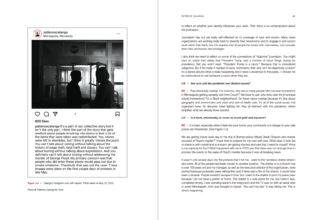
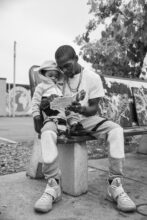
Patience Zalanga, a photographer featured in my new book, Through the Lens, pointedly asks us to not just look for spectacle, but to absorb the quieter moments that don’t get as much play in our news feeds. By way of explaining, she offers a photo of a father and son reading together on a bench in George Floyd Square in Minneapolis. She says, “It might be a moment you would otherwise pass by, but this is an image that challenges the usual perceptions of Black men, particularly in this space that memorializes the violent death of a Black man. This is a tender, quiet interaction, and I hope it deepens the context and invites new perspectives on the Black Lives Matter movement.” Meanwhile, MaryAnne Golon, the Director of Photography at The Washington Post, spoke to me about a series her paper did, which was a long-form, deeper look at George Floyd’s life and systemic structures of racism in the US. I think both of these examples can teach us.
Journalism doesn’t happen for free and the more we support outlets doing good work, hopefully the more we will have access to this kind of thoughtful, sustained, investigative reportage whether the topic is Covid, Black Lives Matter, Ukraine, or otherwise. Breaking news is critically important—but so is the coverage that takes more time and that compels us to see the subtle, often overlooked details.
CM: Without invoking a ‘spoiler alert’ you have included some very hard-hitting questions that go right to the core of race, representation and the media. Were there responses to your questions that surprised you?
LW: As an author and scholar, I do a lot of research, to really understand the nuanced complexities. But as an interviewer, I walk in with my own ideas set to the side, and I listen without preconceived expectations. In that sense, I am open to pretty much any response.
Having said that, in the book I offer some alarming statistics about diversity in US newsrooms, including the fact that Black women comprise only about 3% of news leadership positions. Even knowing that, there was a moment in my interview with Danese Kenon, where her succinct words on this subject slammed the point home better than any statistic. I felt the power of her statement as soon as she uttered it. As Director of Video and Photography at the Philadelphia Inquirer, she said, “to my knowledge, there are maybe four Black women, including myself, who are DoPs [Directors of Photography] in some form of a traditional newsroom in the entire country.” Let that sink in.
CM: Looking to the future, and indeed the legacy of this important book, what would you advise younger photojournalists to take away from these interviews, when starting a photojournalism career today?
LW: The technical skills – how to use your camera or edit your sequence—are important; but equally so are the ethical considerations. Visually documenting the world is an amazing thing to do, a critically important thing to do, and it’s a position that comes with power – so being mindful of the role you occupy as a documentarian is crucial.
I hope, with my books—both Through the Lens and Conversations on Conflict Photography—I help contribute to that culture of thoughtfulness.
__________
Lauren Walsh teaches at The New School and New York University, where she is the Director of the Gallatin Photojournalism Lab. She is also the Director of Lost Rolls America, a national archive of photography and memory.
Walsh’s newest book is Through the Lens: The Pandemic and Black Lives Matter (2022). Her other books include Conversations on Conflict Photography (2019) and Shadow of Memory (2021, co-author); and she is co-editor of The Future of Text and Image: Collected Essays on Literary and Visual Conjunctures (2012) and The Millennium Villages Project (2016), and photo editor of Macondo: Memories of the Colombian Conflict (2017). She has published widely in mainstream and academic journals and anthologies. In addition to her appearances on CNN and BBC, Walsh has appeared as an expert on photography in radio programs, podcasts, and documentary films.
She is the co-director of Biography of a Photo, an in-progress documentary about two iconic photographs of conflict.
Walsh is interested in the politics and ethics of photography, and in exploring contemporary visual culture. She focuses particularly on photojournalism, with a specialty in conflict photography and peace journalism. Walsh was awarded the Excellence in Teaching Award from NYU.
__________
With thanks to Rodrigo Abd/AP, Nina Berman, Caitlin Ochs / Reuters, Spencer Platt / Getty Images, Aly Song / Reuters and Patience Zalanga for the reproduction of their images, above.