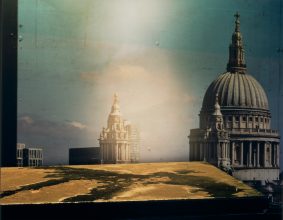



Rut Blees Luxemburg is a London based artist whose large-scale photographic works explore the public spaces of the city. She creates immersive and vertiginous compositions that challenge established urban perceptions and bring to light the overlooked, the dismissed and the unforeseen. Her work has been gathered in the monograph Commonsensual, which presents her collaborative forays into opera, Liebeslied/My Suicides, and documents her public art installations Caliban Towers and Piccadilly’s Peccadilloes. Rut Blees Luxemburg’s photographs have been exhibited internationally and are in public collections including the Tate Modern, Victoria & Albert Museum and the Centre Pompidou.
Below, Olga Smith spoke with the artist about the background to her most recent exhibition London Dust: Rut Blees Luxemburg and Keef Winter, at Chandelier Projects, London (March – April 2014).
———-
Olga Smith: London Dust is devoted to charting the transformation of London: the exhibition gathers photographic work made in response to the city’s expansion, specifically the construction of The Pinnacle tower in Bishopsgate, while the video piece, London Winterreise, makes reference to the recent events connected with the Occupy movement. You are well placed to record the transformation of the city, having lived in London for the last twenty years and photographed it continually. What has changed for you between your project from the 1990s, London: A Modern Project, and London Dust?
Rut Blees Luxemburg: If one looks at these two bodies of work one can see the transformation very clearly, and not just in the way the city has changed, but also in the way photography has changed. In my work around the city I am trying to show how photography permeates the public territories and infiltrates our lives. The images of London on construction hoardings are CGI ‘photographs’, which are not photographs in the traditional sense but images that are entirely constructed, where the pixel is used as a building block to build a ‘vision’ of a future city for imaginary city dwellers. Caliban Towers from the 1990s was about real people living in high-rises, while CGI advertising prescribes an aspirational lifestyle and suggests a certain type of ‘citizenship’ from which most of us are excluded. It’s a commercial proposition that looks convincingly like a photograph and is very seductive.
OS: The notion of dust, foregrounded in the title of the exhibition, is it then the material antithesis to the fantasy of the CGI?
RBL: Dust unmasks the fantasy of the CGI once it is placed in the public territories of the city. The CGI becomes hostage to the materiality of the city, which very quickly covers the images with dust, dirt, pollution. So the CGI’s smooth surface becomes stained, it ‘suffers a sea-change’, it becomes material in this sense and thereby real. London Dust tries to unravel some of the increasing complexity in the relationship of time and photography. The CGI declares a bright and clean future, while photography as a medium has often too narrowly been understood to have a privileged relationship to the past, capturing, documenting, witnessing, archiving history. Yet photography is also a very potent tool used to construct and imagine potential future narratives, as well as acting as a forceful critique of the present. Dust, this tiny yet inescapable, all-covering substance, drags the CGI into the presence, into a joyously filthy reality.
OS: A vision of the future stained with present, then. I mention stains because of the frequent appearance of liquids in your photographs, as in Walkie Talkie melted my Golden Calf, for example. Liquid gathers in pools and leaks over, and seems to stain the fabric of the city.
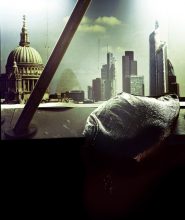
RBL: Can the experience of the materiality of the city relate to the perception of the physical body? The liquids that are spilling out in my photographic works, in A Girl from Elsewhere, may suggest a loss of control at a crucial moment, but are they not also a sign of release, asserting a freedom, like Molly Bloom’s ecstatic monologue at the end of Ulysses, coinciding with the gushing onset of her period. These liquid-fluid streams in my work might leave a stain, but they explain nothing, they make nothing happen and the reason for their existence is not made visible. Yet the stain has been historically understood as the sign in which the ‘proof’ resides, like in a criminal investigation, or the stain on the cloth of Veronica. In the work Aplomb, included in London Dust, I place an ubiquitous sack – which is also a kind of stain that should not be there, heavy and lustrous in its material density – between the viewer and the CGI image displayed on the hoarding.
OS: It is interesting that you mention the viewer. I think their presence is inscribed in the strong sense of the gaze in your work, its direction and intensity. The prime example is Vertiginous Exhilaration, where the viewing position is that of looking down through the many floors of an apartment building. In Caliban Towers, in the meantime, the angle from which the photograph is taken suggests surveillance, further emphasised through the presence of the razor wire fence, framing the image. How is this problematic of the gaze interpreted in the new work?
RBL: There are two distinct versions of the gaze in London: A Modern Project. Caliban Towers was being surveilled by security cameras and fenced off with barbed wire; the viewer of the photographic installation, when it was placed under a Bridge in 1997 in Shoreditch is looking in from the outside, hovering in a not dissimilar position to those controlling mechanisms. In Vertiginous Exhilaration the gaze is plummeting downwards, not ending on a suicidal impact with the ground but bouncing back up. It is like the experience of a character in Caspar David Friedrich’s painting Kreidefelsen auf Ruegen who creeps to the edge of the precipice and looks down in the Abgrund (abyss). A slightly unstable, even dangerous, yet very exciting viewpoint. In London Dust it is about unpacking the different layers that have complicated the ‘question of the gaze’. The CGI backdrop of the proposed new city is displayed in the real city, on the site where the CGI version is intended to be built – yet construction is stalled, becoming a temporary ruin – the planned intervention is only visible as a ‘photograph’ that is nevertheless able to trigger a type of desire for the city… The stain of the sack interrupts the fake allegory announcing a surface future.
OS: When we were agreeing a time for this meeting you proposed that we meet after dark, when conditions would be right for viewing the film. I find it fitting that we meet after sunset, given that this is the time when you go out to make your photographs.
RBL: For me, the night suggests certain flexibility. Darkness allows for the loosening or suspension of habitual behavior, norms and constraints and therefore also might allow for a shift of perception. In London you can see a city where architecture and public spaces are used differently at night shifting to spaces that promise temporary shelter and protection.
OS: Through the use of night-time photography your work acquired a very distinct colour palette. For example, a particular shade of piercing yellow, described by Jean-Luc Nancy in his text for London Dust as ‘the colour of mimosa’. For me this kind of yellow represents your signature colour – I can recognise your work immediately because of it.
RBL: Through these intense and heightened colours, the representation of the city hooks onto a sensual pleasure, and yet there are also hues that suggest the decomposition of forms, luminous, almost contaminated greens and yellows. I have been developing my palette over the years. Each artist tends to have their specific colour schemes just like a writer has a specific rhythm and syntax. The colours and tonal saturations I am interested in are closer to hallucinating the city.
OS: The title of this exhibition, London Dust, is at once precise and poetically allusive; precise in that it evokes a geographically specific location but it is also open to a range of interpretations promoted by the notion of ‘dust’. In this it is similar to your other titles, such as Commonsensual. What is the relationship between the image and a title? What comes first for you?
RBL: The title for the series or an exhibition comes after the first works. And then it becomes almost a programme and the development of the body of work is contingent on the title. With London Dust the intention was to make work specifically about London. As I am observing how the city is changing I wanted to focus on this transformation. Dust is an exceptional material in relation to photography, precisely because dust is conceived to be the enemy of photography – everyone is constantly trying to remove dust: from the lens, the negative … now cleaning scans with photoshop – everyone, except from Man Ray, who made with Duchamp in 1920 the prescient photograph Dust Breeding.
OS: I sense in your titles a fascination with the feel and texture of language. Am I right in thinking that this heightened sensitivity comes from being a speaker of several languages?
RBL: Having access to several ways of saying something, however limited, is very enjoyable as well as useful. For example, Aplomb, meaning self-confidence or bravura, also refers to an ancient and still contemporary tool, a plumb-line, that insures that a building is vertical. There is ambivalence even cryptic quality in certain words that reflects for me the equivocality of images. When I worked with the philosopher Alexander García Düttmann on a book a while ago, he turned my Liebeslied into his My Suicides, so the ‘translation’ between languages isn’t always accurate and more a question of an interpretation … We are currently working together again on a book titled The Academic Year, where this time I respond with a series of London views to his ‘chants d’amour’.
OS: German Romanticism seems to be an enduring source of inspiration for you, including Romantic literature and Goethe’s Faust. The video work London Winterreise is based on Schubert’s cycle of songs based on Romantic poetry, but the action takes place in contemporary London.
RBL: Schubert’s Wanderer rails against the contingencies of love, the egotism of the bourgeoisie and the alienation of the artist, who has to leave these constraints to make the work. The soundtrack of German Romanticism becomes a contorted echo chamber to London in 2012, the year of Occupy, the Olympics and the ongoing financial crisis. The version I use is by the contemporary composer Hans Zender, who made this re-interpretation of Schubert’s song cycle in the 1980s, hence the amplification and Brechtian interruptions.
The soundtrack of Die Winterreise gives the journey of the film a beat and connects the experience of the city to another historical time, which is also visible in the different historical buildings. The film starts out in the margins of hedonistic Shoreditch and moves swiftly into the City, passes the Occupy camp in Finsbury Square, past Sir John Soane’s Bank of England and onto the gigantic developments in mid-construction towering over the small, knotty streets. On the second turn the camp has been cleared, and the ruins of London Wall are lingered on while the Wanderer’s song becomes soothing, not wanting to wake up the Dreamer.
OS: The film was installed in a very particular and striking way, inside a viewing structure designed by Keef Winter. Do you see it as an extension of your investigation of the urban architecture using photography and film, as matter of expansion into the third dimension?
RBL: The question of how to exhibit this film has been challenging for me. Keef Winter created a solution by responding to the film with a sculptural viewing apparatus, which gives the film a structure that refers back to the city. Keef Winter has a material approach to sculpture he calls the ‘Handyman Aesthetic’, which engages with the city and its dissonance, something I am thinking about too in London Dust. Working with other artists or writers is for me very interesting, and it is not so much collaboration but working in parallel towards something together, so in the end there are two distinct voices.
OS: In some ways, you work in ‘pure’ photography, taking ‘straight’ pictures free from any digital enhancement, but you have also been probing the boundaries of photography in combining it with installations. I am thinking about a number of public commissions you made that integrated photography into the fabric of the city, such as Pied-à-Terre Lumière in France, as well as your collaboration with Düttman and Paul Clark on an opera, Liebeslied. This new film, installed inside a sculptural form, is this an attempt to stretch the limits of photography and film?
RBL: What are the limits of photography? Photography exists in many different public contexts, from billboards, or projections to museum installations. Liebeslied/My Suicides became an opera with photography about photography. I do think about photography in different forums and in different relations, be they to architecture or opera. Photography as a medium is promiscuous – the very essence of photography is expansive and reproductive, now more than ever, which is of great potential.
OS: What a great way to end this conversation. Thank you, Rut.
———-
For more information:
www.rutbleesluxemburg.com, the artist’s website
London Dust: Rut Blees Luxemburg and Keef Winter, at Chandelier Projects, London, March – April 2014
Rut Blees Luxemburg: Black Sunrise – London Dust, Photomonitor portfolio, February 2013
Rut Blees Luxemburg’s work will be shown at the Liverpool Biennial as part of A Needle Walks into a Haystack, Tate Liverpool: 5 July – 26 October 2014