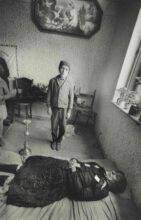
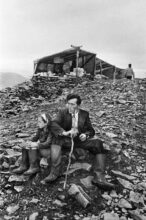
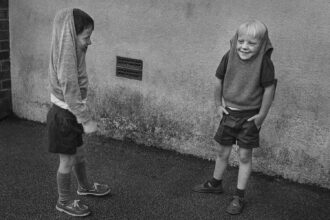
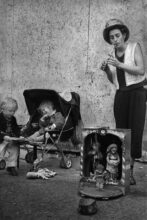
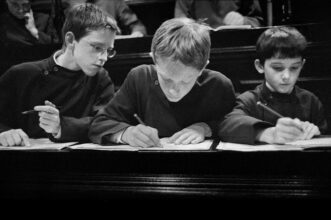
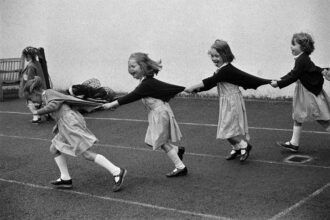
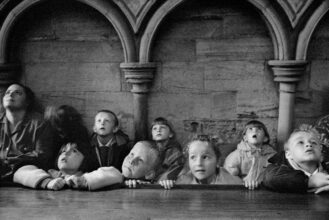
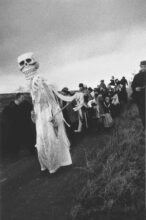
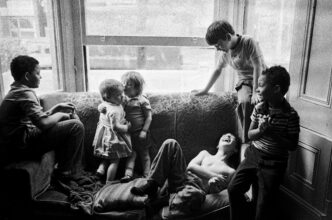
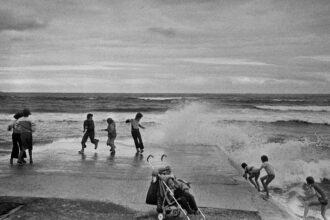
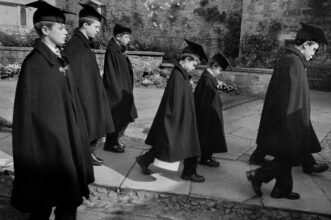
A major highlight of Edinburgh Arts Festival 2023 was the launch of the first exhibition in Scotland to profile the work of Markéta Luskačová at Stills, Centre for Photography in Edinburgh. The show, that runs from August 12th until 7 October 2023, brings together more than 50 works from some of her best-known series such as Pilgrims, Juvenile Jazz Bands in the North of England, Durham Cathedral and Chorister School, London Markets, London Street Musicians, Chiswick Women’s Aid and Carnivals in the Czech Republic. The Prague-born, UK-based photographer worked with Stills in selecting photographs on the theme of children made in the UK, Ireland, Slovakia, and the Czech Republic between 1964-2010. Following her in-conversation with Stills Director Ben Harman in August, Luskačová spoke to artist Nicky Bird.
__________
Nicky Bird: The exhibition represents over forty years of work and seven of your best-known series. Can you tell us why – and how – you became a photographer with such a deep interest in people?
Markéta Luskačová: I was a university student of sociology when I became interested in photography. I started to read voraciously anything, everything about it. In Prague of those days, the books on photography were available only in one copy in the library of UMPRUM (The Museum of Decorative Arts). I would have to read them in the museum’s reading room. It was not possible to borrow the books and take them home. Reading Beaumont Newhall’s History of Photography was for me like reading the detective story, the librarian had to remind me that it was the library closing time. Discovering the photographs of Dorothea Lange was very moving for me and I loved everything about Weegee and his photographs. From the beginning, I was aware that photography was the powerful tool for remembering.
NB: The social context of your work is very important. Could you tell us more about this, for example, in relation to Pilgrims and Carnivals in Czech Republic?
ML: By utter chance during the summer holidays in Slovakia I encountered the procession of pilgrims. For the student from Prague it was like an Epiphany… for in Communist Czechoslovakia of those days, with its materialistic ideology, the open expression of faith of any kind was directly and indirectly punished by the government. Yet, the Slovakian pilgrims were practising the old ritual of their ancestors regardless of the consequences to their lives. I thought that it was important to show the proud faces of the pilgrims, to bring the news about their existence, their determination, and their integrity. And I thought that the photography was the best medium for it. And I thought that it was up to me to do it. That is how I got the first theme for my photography. During the winter I earned the money for my first camera at the night shifts at the Post Office of the railway station in Prague, transferring the parcels from the lorries to the railway carriages and vice versa. And next year I returned to Slovakia to photograph the pilgrims.
Czech Carnivals is my last theme. During the Communist era, they were banned by the communists. When the democracy returned to the country, there was a renaissance of the old pagan winter festival. It was somewhat: the celebration of the freedom to celebrate. To get together with their friends, to create something for children, to reconnect with the past. The intention behind my photography of the Carnivals is similar to that of Pilgrims: I want it to be known that they exist.
NB: You have talked about the beauty of being a stranger when you came to the UK and worked in Ireland. You have also talked about the importance of being both pregnant and a young mother when working as a photographer. How did these positions help you develop bodies of work, such as Photographs from Ireland, Chiswick’s Women’s Aid and By the Sea?
ML: To see things for the first time is immensely powerful. I was amazed by the music in the streets of London. Enchanted by the vivacity of London street markets, they did not exist in Prague, and there was a feeling of the experience of the freedom too. That was wonderful.
But please, do not get me wrong: to be the stranger, to be pregnant and later the young mother and living on my own in London was not easy. I sensed that women in the refuge felt closer to me, because I was pregnant and living on my own, than they would be if I had been a smart woman journalist reporting on their desperate situation. So, it was the adversity turned into its opposite.
Having the baby with me while photographing at the seaside I was not a voyeur; I was one of the mothers on the beach. I was very fortunate that the women and children there helped me to look after my baby son. Without them I am not sure that I would manage to do the work.
NB: You have photographed children for over a period of forty years. When did you first become conscious that children were becoming an important subject matter for you?
ML: For your record, my first picture of children is from 1963, taken with a borrowed camera. And I have photographed children still this year. But not all pictures made it to the Stills exhibition.
When reading the contact sheets of Chiswick Women’s Aid in 1977, I realised that all the pictures had children in them. It was so good to photograph their quest for happiness in spite of the circumstances. For women it was all very difficult, the lack of privacy in the overcrowded house, the worries about the future. But the children loved to be so close to other children, they behaved as if they were at the summer holiday camp. The resilience of the children and their tremendous energy and their strive for happiness, was great to discover. When photographing at Northeast seaside, I became aware that whatever was the subject, I ended up with photographs of children. In my book By the Sea there was 120 pages of photographs only 11 pages were without children. From then on, I started to photograph children consciously. The next series was on Juvenile Jazz Bands. In 1985 I won 1st. prize in the GLC (The Greater London Council) competition Portrait of London with the photographs that I called ‘Children of London’. That helped me to get some commissions to photograph children.
NB: There is an informal, relaxed feeling between you and the photographed child, who sometimes seems very aware of you; other times, the children seem absorbed in their own worlds. Is this what you feel when you are looking through your viewfinder? Or do you discover the results when you come to look at your contact sheets (for example in Durham Cathedral and Chorister School)?
ML: I love children and they sense it. They are relaxed when I am photographing them, often the forget that I am there, they feel safe. When I am looking through the viewfinder, I am watching for the geometry, for the expressions, the movement and at the same time I am framing and focusing and trying to find the best vantage point. The average speed of the exposure is 1/125 of the second, there is not time to think of any feelings, but they are there.
NB: This leads to the darkroom. Looking at the exhibition, the consistency of your camera framing comes across strongly in beautiful monochrome prints. Is the traditional chemical darkroom – from film processing to printing - still an important part of your photography? How has it changed for you?
ML: I develop my own films and I print myself most of my silver-bromide photographs. Mike Crawford sometimes prints my large prints; he is a very good printer. The exhibition prints for my show at Martin Parr Foundation in 2019 were all printed by Louis Little from MPF: they were beautiful, he is the true master in digital printing. I bought myself digital camera when I broke my wrist and my Leica became for me too heavy to hold, but my wrist got better so soon that I did not start to use the digital camera.
NB: Finally, looking back at your career and the theme of children, what have been the challenges and joys for you?
ML: Photographing children was always a joy… To be the immigrant, a single mother, a freelance woman photographer, the challenges were many. But whatever they were I always managed to take “my own pictures”, that nobody commissioned, nor paid for, because they were things that I wanted to say with my photographs.
But the way my life went, not all of them I managed to print. And this is my last challenge: to contact sheet them, to scan them, to print them, to sort them out.
__________
Markéta Luskačová ran at Stills, Edinburgh from 12 August – 7 October 2023. The exhibition was part of Edinburgh Art Festival 2023 (11 – 27 August 2023) and was developed by Stills in partnership with the Centre for British Photography, London.
Markéta Luskačová was born in 1944 and became a freelance photographer in 1968 whilst undertaking postgraduate studies in Photography at the Academy of Film and Fine Arts, Prague. She relocated to London in 1975 and was a Nominee Photographer with Magnum Photographic Agency, Paris from 1976-80. Since 1971, Luskačová’s work has featured in exhibitions around the world and notable solo exhibitions have been held at the V&A, London (1983-84); Bethnal Green Museum of Childhood, then a branch of the V&A, London (1989) Whitechapel Gallery, London (1991); Stills Gallery, Sydney, Australia (1998); Leica Gallery, Prague (2014); Tate Britain, London (2018-19); and The Martin Parr Foundation, Bristol (2019).
Nicky Bird is an artist and writer based in Scotland.
All images shown here are © Markéta Luskačová and shared online courtesy of the artist and Stills Centre for Photography.