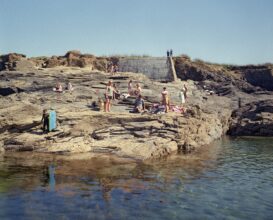
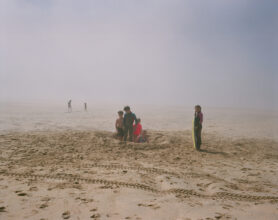
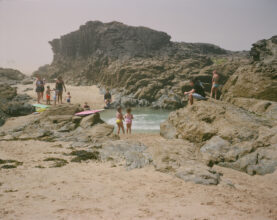
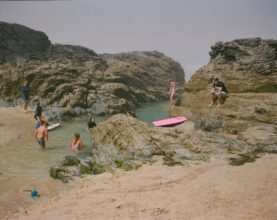
Stefanie Braun, curator and co-editor of NU Review, in discussion with photographer Melanie Stidolph about her ongoing series ‘Last Summer’.
SB: First of all, thank you again Melanie for agreeing to showcase previously unseen images of ‘Last Summer’ in the first issue of NU Review, some of which are now also available here on Photomonitor. NU’s first issue looks at ideas around habitat through the eyes of artists, photographers and writers, how we as humans relate to our environment and to each other, and in the context of this it was fantastic to be able to include images of your project. I was wondering if you could talk a bit more about the title first. ‘Last Summer’ is a very understated yet evocative title and suggests, probably for most of us, positive thoughts as well as feelings of nostalgia. The images have actually been taken over several summers and the project is ongoing. What does the title suggest to you?
MS: Thank you for the invitation Stefanie to be part of NU, and to Christiane for offering us a platform at Photomonitor, it is great to reflect on this work here. This is the first time I’ve made a work that is intentionally a series of images. Giving it a title gave it a frame to stretch into. Previous work has often leant on the longing implied in looking at photographic images; you feel something of the live moment when it was captured, but at the same time, you know that moment is passed. ‘Last Summer’ is reflective of this and a sense of holding onto an ideal; projecting forward from a moment of loss and holding on to a possible future while the reality of it gets further away.
SB: The project started in New Zealand in 2017 where you had gone on holiday, but then you carried on taking images on beaches back in Cornwall, UK, where you live. How do you think these different locations, countries and time zones have informed and shaped your images? To me the images taken in New Zealand are definitely more dream like, nearly other worldly, whereas the images taken in the UK appear to have a greater physical distance to the groups photographed, a harsher light, more elements of rocks… This could all be due to the landscape being so different but maybe also how your own perception of looking at the beach and its inhabitants has changed?
MS: Before this project began I had been working in a completely different way for several years and had turned away from subjects that used to excite me, and from shooting on film. I was using automatic triggers to fire the shutter in response to movement and changes in sound and light, and came indoors where I had been outside. In New Zealand I was far away from home, so anything I saw I had to photograph or I’d never see it again in that location. It gave me a freedom and an impetus to photograph. The picture on the title page of the feature in NU became the beginning of the series. It was being in the rockpool with the group and seeing them from the other side that made it so special, sharing a love of water, being in the same pool of liquid and using the camera to feel closer to the subject. There are images taken in Cornwall, additional to those shown in NU, that were taken on a misty morning, and they have that same ‘other worldly’ quality I think that you are referring to, perhaps even more so; the groupings are separate from the landscape behind them and the focus is more intent on their relationship with the rocks and each other. Continuing the series opens the potential for me to react in a more nuanced way to the idea of family I had been holding on to. Through photographing I become open to the generosity of strangers in the moment of encounter, I become part of the scene, if not part of the photograph.
SB: In your text for NU you use this intriguing expression ‘the theatre space of the beach and the riverside’ to describe your preferred location as well as this lovely term of ‘co-habitation’. The beach has been photographed countless times and generates expectations like no other – most of us document each detail of our trips to the seaside in our own amateur photographs. What I like very much about your images is that the groups you photograph seem on the one hand very composed and directed, as if the rocks or the beach act like a theatre stage, the figures perfectly in harmony with their environment, folded into it nearly. Yet the images also appear very accidental, nonchalant – observations of groups where the intimacy between the individuals is very much present, it is preserved and felt. What is your relationship to the groups photographed? Do you ask permission? Do you think this is an important factor?
MS: That’s a beautiful phrase Stefanie – ‘folded into it’. Sometimes I ask permission, if I need to be close to capture the scene and if people will become more easily identifiable because of that. I’m nervous about it, partly because I don’t want people to say no (if I’ve worked up the courage to ask them, I really want the picture) and partly because as soon as you ask, the scene changes. I’m not sure if that’s because in the slight shift of attention and posture that happens, we become more aware of the subject, or more aware of the photographer. When I’m close I ask, I don’t want to take liberties, and people so far, have always said yes. I compose quickly, so the moment of taking isn’t long, but I’m often around in the scene for a while, going swimming, or sitting in the sun, sharing the space and making it obvious I am taking pictures while making eye contact. That’s part of what helps me feel my way into finding the photographs. There’s a few I haven’t taken because they felt too intrusive, and some I’ve taken but only shared with the subjects.
SB: Not being part of the group you depict seems an important element in your work. Yet, there is a warmth the images exude that could be seen as a desire for wanting to be part of the picture. In your text for NU you also explain that one of the motivations for taking these images of groups of people comes with the painful experience of not being able to have a family of your own. I think it is very brave to go out and talk about childlessness, an issue that is often pushed aside in our society, still a big taboo. How does it feel for you to openly address this issue through your work?
MS: I think brave is an interesting word in relation to this. It doesn’t feel brave to share the photographs and the motivation for them but perhaps more in the taking of them. There is a heart-quickening self-consciousness that is part of feeling separate from the scene and part of the activity of being there with a camera, which might not be welcome, for understandable reasons. When I was in the middle of trying to get pregnant, the grief and the feelings of embarrassment and shame in not to be able to have a child were strong. Coping with that was down to friends and amazing organisations like Gateway Women, who put my struggles in the context of a bigger social picture. This is part of why I started the project, to hopefully give a foot-hold or different angle for others who are in this experience.
SB: There is an extra-terrestrial quality in the light of some of the images. It is as if we can mirror ourselves in the warmth of the scenes, but also experience a slight unease because it shows the elusiveness of our earthly existence. Is this something you intended?
MS: A scene and the light is so fleeting and unpredictable, that’s why I love to go out a lot, to go walking, for an hour or all day, again and again. I am reconsidering my relationship to the subject as I walk or sit and observe. Every image that becomes part of the series expands on the starting point for the project and shifts me to a different place. Being interested in what’s outside us is an enormous gift; shifting from a place of pain to one of curiosity has been an unexpected effect of the project.
__________
NU Review – a new journal mixing art, photography, fiction and journalism – is edited by Stefanie Braun and Wouter De Broeck and was recently launched online and in print. Stockists in the UK include The Word Bookshop, The Photographers’ Gallery and Dulwich Books.
For further stockists and more information please visit nureview.org
__________
Melanie Stidolph – I work with moving image and photography. My work is influenced by experiences of childlessness, and I am drawn to rock pools and mis-using photographic equipment. A detachment between the subject and the spark that initiates its documentation runs through my work; ‘Estate’ films bursts of light in a dark room revealing a vase of flowers, the camera shutter and flash triggered by the raised voices on the estate below. I studied at the University of Leeds and University of British Columbia, tutor, Jeff Wall. Commissions include The Photographers’ Gallery and Learning, Tate Modern. Solo shows with Northern Gallery of Contemporary Art, Sunderland and Kamloops Art Gallery, Canada. Curated exhibitions include FORMAT photography festival. I live in Cornwall where I am Learning Curator for Public Programmes at Tate St Ives. melaniestidolph.com
Stefanie Braun is a consultant based in London supporting artists and photographers with the development and editing of significant bodies of work. She is co-editor of the occasional journal NU Review which brings together a carefully edited mix of art, photography, literature and journalism to reflect on issues that matter. For over a decade, Stefanie worked as curator at The Photographers’ Gallery, London, organising exhibitions of historical and contemporary photography and editing many catalogues and publications along the way. nureview.org