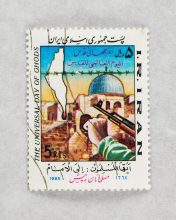
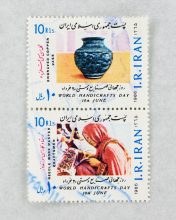
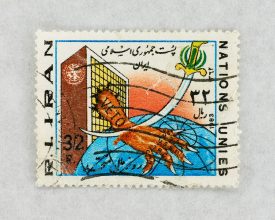
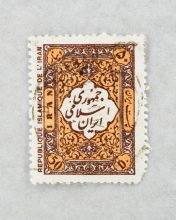
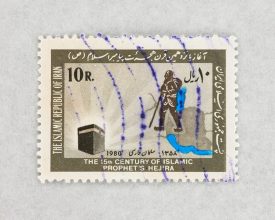

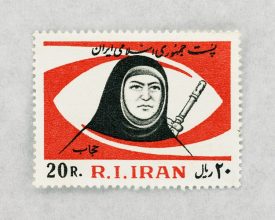
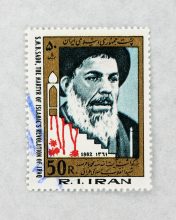
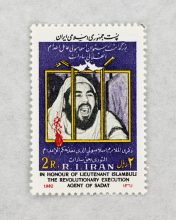
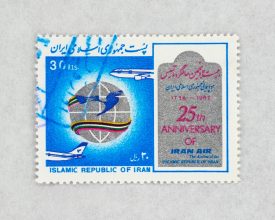
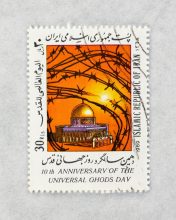
Ali Mobasser (b.1976) is a London-based visual artist whose work presents an engagement with identity, geopolitics and coming of age, as seen in his current presentation of highlights of the artist’s childhood stamp collection. Mobasser’s work touches on his intercontinental relocations, familial relationship shifts, births, deaths and significant personal events – all of which have shaped the artist’s engagement with and interrogation of his Iranian heritage and its present day manifestation in a distinctly personal but very accessible exhibition. In his current London show, Stamps of a Revolution, close-up photographs of 107 stamps from Mobasser’s collection present a compelling visual diary of time – another time, another place, letters received from far away – which hints all that lies untold behind this alluring catalogue of graphic postal imagery. Below, Christiane Monarchi asked the artist about the background to these recent photographic works.
__________
Christiane Monarchi: When I came to see your London exhibition, I had learned a bit about the background to this collection of stamps, but I hadn’t realised how much their story and yours would become enmeshed in my appreciation of this exhibition. Could you share with us an overview of how these stamps were gathered, and why?
Ali Mobasser: That is the main function I intended for this series. For my story and that of the stamps, over time, crossing over one another both physically and metaphorically. The intertwined timeline text at the start of the show represents this. When I had just graduated from my Fine Art degree, wanting to enter the world of photographic assisting, a fairly successful commercial still life photographer told me that you would only be a true artist once your life and art become one and the same. It would take a toll on your life he warned. I’m not sure how self reflective that comment was and how literally I was meant to take it (there was certainly a red flag there) but in reflection, it was the best advice I was ever given. It stuck firmly in my head.
Before I tell you how the stamps were gathered, I should give you the back round to the collection. My parents and I left Iran during the 1979 Islamic Revolution due to my paternal grandfather’s role as a high-ranking general under the overthrown Shah. After a lot of movement and uncertainty, jumping from one country to the other, at age six, my mother and I separated from my father in Costa Rica (where he had been working) and temporarily lived in Maryland USA with my grandmother and my mother’s younger brother.
My mother and my grandmother liked collecting things. That’s a more polite way of saying they were (and still are) obsessive-compulsive hoarders. The house was an organized mess of objects in the wrong places and overflowing suitcases. As my grandmother sat in the dining room cutting coupons from the local newspapers, I too began cutting out things, which interested me. The stamps that would arrive on letters and parcels from family in Iran would become one of these items. Seeing my interest, my grandmother would teach me how to soak, peel and dry the stamps.
I think the reason for the attraction was a combination of the delicate process of extracting them from the envelopes and their vibrant aesthetics. I of course like most seven-year-old boys would have thought that machine guns and bleeding flowers were cool. It certainly wasn’t because I was a stamp collector as I tried collecting (ordering) stamps from other countries when at age eight I was sent to the UK to live with my father. I soon realized it was just the stamps from Iran, which interested me. Looking back, I see the stamps as a young boy’s physical connection to a home he could not remember but I think the specific journey that these stamps had made were key to the appeal they provoked.
CM: I’d love to know more about how this stamp collection became significant again when you saw it as an adult. How did you approach it as an artist?
AM: I actually first took photographs of the 107 stamps back in 2005 towards the end of my twenties. I was still struggling to find my voice back then so they were simply my stamp collection sitting next to the kind of cleverly staged photographic narratives I was making. My personal work during that time was not at ease with itself. It was a reflection of my own personal development as an adult. I was hiding behind grand illustrative ideas and struggling to find ways of placing myself into the work. I was in many ways not ready and needed more distance from my childhood. You see, the stamps represented a pivotal time in my life were my mother had sent me away from her and our close relationship would cease. I wasn’t ready to face up or talk about the trauma of losing my mother.
Ten years on, with the death of my aunt who had raised me here in London and the birth of my son, I began looking at my identity and the events that had shaped my family and I, during, after and before the revolution. The stamps would tell one chapter of this multifaceted narrative set to the backdrop of the Iranian Diaspora. Now nearing 40 I would photograph my stamp collection again, seeing it as the turbulent story of a child in exile. My technical approach would also be very different this time.
CM: I hadn’t really appreciated what these photographic objects would look like in your exhibition; my ‘jpg reading’ was off significantly when I was only looking onscreen. I kept expecting to see stamps floating in a glass mount, but of course they aren’t. I’d love to know more about how these 107 images were made.
AM: Your observation highlights an interesting point. Why do I not just show the stamps? Curators have suggested I bring in the actual articles that I photograph and make them part of my exhibitions but for me the photographic process or with other pieces, the re-appropriation, is my translation of the archive into a concept. I sometimes forget to use the description of ‘photographs of…’ when depicting my pieces but I also like the deception this creates, as well as the surprise in scale, enhancing the experience of seeing the work in real life.
The photographs are made using long exposures. I use a small handheld LED light, which I use to draw an outer ring around and just above the surface of the stamp. The lack of any frontal light gives the floating impression. I began developing this method in 2007 through the union of my first digital camera and the single LED light on the back of my Sony Ericsson phone. I was intrigued by both of these technologies and wanted to see where my experiments could take me. The style of photography I had been making on medium format film continues to this day, but at that time I did not see any point of recreating my analogue work into digital. I instead developed a second path which today works alongside my analogue photography.
I began my tests with portrait studies where I would scan the light across the sitter but soon moved to objects because they wouldn’t fidget and move around so much. There was something very meditative about being alone with an object in total darkness and drawing a light source that did not actually exist except for in the picture itself! There was so much movement involved in creating something so still. My years of assisting were coming in useful too as I always enjoyed the challenge of creating light set ups but the photographers job of directing the subjects and taking the picture seemed less appealing. In this sense I was able to step into the picture and create a bespoke lighting that would always be slightly different and adaptable to the subject matter. A remote control to trigger the camera enabled me to step in front of the lens and into the picture to apply my light.
In 2010, a friend who had seen some of these still life studies introduced me to The Wiener Library for The Study of The Holocaust. It was during my residency at the library that I fully developed my archival style. Due to the content of the objects and documents I was photographing I toned down the lighting to create a respectful aesthetic that was there to enhance the subject matter, not dictate it. The lighting was now subtler and the objects centred on a plain surface and photographed from a birds eye point of view.
I was witnessing the stories of individuals who had endured the Holocaust through diaries, official documents, identification cards, letters and other personal objects. There was however a discomfort of photographing the ghosts of those I did not know and did not share a history with. Not only did I feel like an intruder but also I did not feel I was bringing anything unique to their stories by merely documenting. Abstracting or conceptualising their stories as part of my art did not feel appropriate either. However, something else was happening. I was beginning to draw parallels with the traumatic events that my family had endured during and after the revolution.
The story-telling process I was developing would lead to the inevitable focusing on my own family’s past. The seed had been planted and the tools I would require were falling into place. All I needed was the courage (and perhaps the reasons) to start uncovering a past that my family was reluctant to share with me. In 2012 the birth of my son allowed me to find a new perspective and with it cause to reflect on the past as to understand the present.
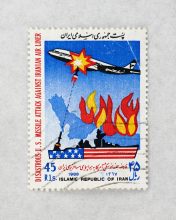
CM: Reading the images themselves is sometimes complicated, occasionally aided by a surprising amount of English in some stamps; number 105 shows an airliner being shot down, perhaps not even needing translation. Certainly, this is a display of the power of visual literacy in furthering political ideology. What does it mean to you to show them today, as an artist, in the current political climate?
AM: Stamp 105. I fully remember this happening. An American warship in the Persian Gulf had shot down an Iranian passenger plane. Audio recordings much later revealed it had been intentional. I was 11 and old enough to understand what had happened.
I’d often wonder how some of these stamps even made it through my letterbox. I’m sure many didn’t. They were all out defining themselves to the outside world. I think it was a genius way of communicating their message to the West, hence the English. It certainly wasn’t because of any kind of fondness for the British or Americans. Before the Revolution the second language on the stamps (and in schools) was actually French, but that was abolished.
As far as showing them today, many of the politicised stamps commenting on the region remain as topical today as they were on their date of issue. For most Iranians the story has remained the same, and the imminence of war is constantly at the country’s doorstep. I recommend the viewer not take these stamps out of context individually but see them as a whole and ask why they shout so loudly at the West and maybe look at Iran’s history and relationship with Britain and America to get an understanding of its current position.
I know much more about the people and the events of these stamps now than I did back then. I try not to let my recently acquired knowledge interfere with what these stamps represent in my work. I try to see myself as the curator of that little boy’s stamp collection. As with my other pieces, I see my projects as collaborations between myself and the person the work depicts. In this case, the politics is something that would not have interfered with my appreciation for the beautiful objects I was accumulating.
Today, I talk of the hereditary repercussions of the Iranian Diaspora on the future generations but to have this conversation I endeavour to remain politically neutral. I do not think it is wise to put one set of values above another. The clash of ideals only breeds extremism. My paternal grandfather was Deputy Prime Minister and Head of National Police under the Shah. My maternal grandfather became Ambassador to Saudi Arabia by appointment of The Islamic Republic. I had politically opposing grandfathers. This perhaps has something do with my neutrality but also the fact that politics drove a wedge between family members and fellow dissident friends of ours here in the West. It made me and the other children of these dissidents (many of them my friends), apolitical. We just wanted to be normal like our English friends and not go on about Iranian politics like our parents. We could not for a minute comprehend what they had been through and didn’t want to. The emotional debris was enough for us.
__________
Ali Mobasser was born in Takoma Park, Maryland, USA in 1976. He graduated from Kingston School of Art with a Bachelors of Fine Art in 1998 and today is a visual artist using photography as his primary medium.
In 2018 he was shortlisted for the prestigious New Discovery Award at Les Rencontres d’Arles for his series The Pieces of my Grandfather’s Broken Heart. Ali Mobasser will be featuring this year at the Photolux Festival in Lucca, Italy as part of Inertia Force and a Second Revolution, a collaborative exhibition of two generations of photography born of and inspired by The Iranian Revolution of 1979.
His work has been included in two educational publications in 2019, Behind The Image, Research in Photography by Anna Fox and Natasha Caruana (AVA Academia) and Context and Narrative in Photography by Sri-Kartini Leet, Elisavet Kalpaxi and Maria Short (Bloomsbury Publishing).
Ali Mobasser is represented by Ag Galerie, Tehran, Iran. He resides in north London with his wife and two children. Mobasser’s exhibition Stamps of a Revolution at Paper Mache Tiger, London continues through November 2019.