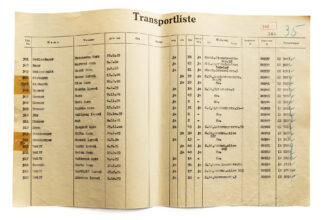
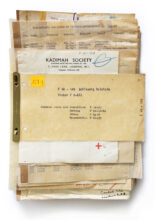
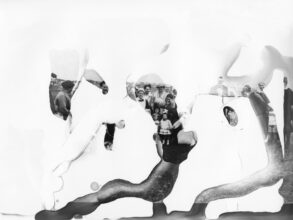
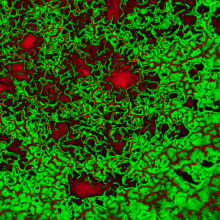
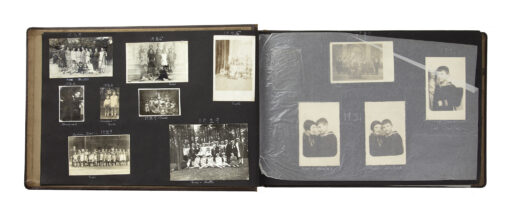
“‘My name is Sara’ began with the discovery of a family album of photographs and some handwritten notes in German that had never been translated. These tell the story of the German-Jewish side of my family – one that my father Manfred was unable to relate.”
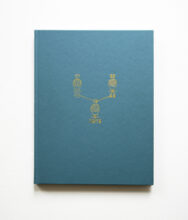
Sara Davidmann’s new online platform for her latest project ‘My name is Sara’ opens with this powerful sentence, a portal into years of research and creativity now woven together in this project which has already included one physical exhibition at Four Corners Gallery, London, and publication Mischling 1 (GOST, 2021). To celebrate Davidmann’s launch of her new online platform, we discussed how her artistic ideas have developed through physical and virtual presentations.
__________
Christiane Monarchi: I am delighted to see that ‘My name is Sara’ now has a new online platform to present this project; it is not often that there is such an extensive online resource available for an artist’s ideas that can be shared worldwide. We are communicating online, and obviously sharing this online; I’d love to know how you feel about this, with this very personal project that has has successful presentations both in exhibition format and in your publication Mischling 1. What does the experience of this project feel like online, and how is it interesting for you?
Sara Davidmann: It’s interesting to be working with an online platform as opposed to physically interacting with the work as photographic prints, objects and installations. When I’m making work the physicality of the work is a vital part of it. Using an online platform involves engaging with an entirely different process. Everything is seen through the screen – images are reduced to a size determined by the screen and surfaces and images merge.
Despite the transformations that are a fundamental characteristic of using an online platform the benefit is that it enables a far larger number of people to access the work. An exhibition is the ideal way to experience art works – to be in the same space as the work – but exhibitions are geographically specific and only exist for a certain period of time, severely limiting the number of people who are able to see the work. When I was working on the book of this project, Mischling 1, I considered it to be an object in its own right – independent of the exhibition. I think of using an online platform as a third possibility.
People regularly contact me through my website. Some of the conversations that have arisen in this way, because of people’s interest in my work, have meant a lot to me. I am delighted that people all around the world will now be able to engage with the ideas that underpin ‘My name is Sara’.
CM: Does putting a project like this online enable expansion of ideas for you ? It is an exciting idea to me to consider how you may choose to grow it in future, beyond what has already been exhibited and put into print.
SD: Online has amazing potential. I’m very excited to see where this might lead.
CM: Are you interested in a 3D virtual experience, possibly for your sculptural pieces?
SD: When I was first thinking of having an online exhibition I thought about a 3D virtual space. But I found that the way one has to negotiate moving around a virtual space interferes with experiencing the work. I decided a simpler method for viewing would be less intrusive.
CM: I’m interested to know more about your process, in terms of how you imagine the audience for your work. I am assuming you worked on the exhibition and publication plans simultaneously for ‘My name is Sara’, perhaps for other series like ‘Ken. To Be Destroyed’ was it more of a sequential process? How does this define what becomes transmitted in each medium?
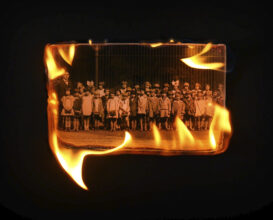
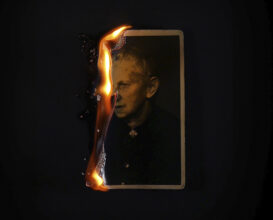
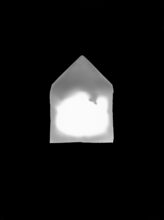
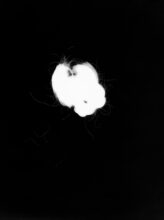
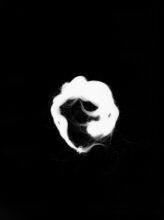
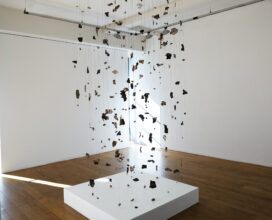
SD: I worked on planning for the book and exhibition at the same time. I intended to show what I consider to be the most important works from the project in both – but decisions had to be made separately for each medium to work in its own right. An example of this was ‘For Leopold’. ‘For Leopold’ is a video installation of 10 videos screened on four walls sequentially in an enclosed dark silent space. In each video a photograph slowly burns. The experience of the work is dependent on the viewer being in the space. All of the elements – the darkness, the silence, the size of the images in relation to the viewer, the ability to move around the space – all contribute to experiencing the work.
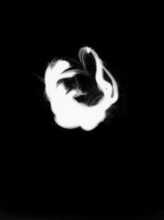
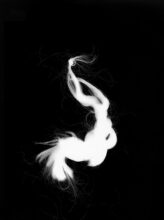
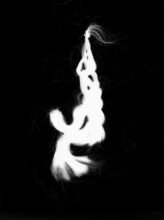
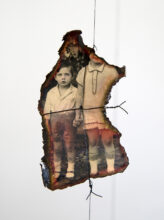
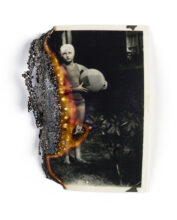
When I was considering including ‘For Leopold’ in the book it didn’t seem to work and so it is not in the book. Instead, I decided to show an earlier series of burnt remains of photographs. There is an illusory three-dimensional quality to these small photographs that works well as the pages are turned. There are also elements of the project in the book that are not in the exhibition. The book gave me an opportunity to bring my artworks together with the history in a new way.
I wanted to know what my father had lived through as a young Jewish boy growing up in Berlin – to get as close as possible to his experiences. What I discovered from my research was that from 1933 (when Hitler came to power and my father, Manfred, was eight years old) to 1939 (when Manfred was fourteen) over 400 anti-Semitic laws were passed that increasingly restricted the private and public lives of Jewish people living in Germany. The slow, insidious changes that took place during the build-up to the Holocaust were shocking. The book includes information on many of the laws that were passed. This section follows a series of photographs showing my family engaging in many of the activities that were to be banned – attending school, seaside holidays, the freedom to interact in public spaces.
The online portal was made after the exhibition and the book. While ‘For Leopold’ is not in the book, one of the videos from the installation can be viewed online and a second video features in a short film about the project – showing for the first time through the online portal.
CM: What advice would you give others who are looking to make a comprehensive online platform such as yours, for presenting a body of work?
SD: I think it’s helpful to think of the online platform as a separate entity to an exhibition or a book. I would think about the way in which you would like viewers to experience your work. Is it important to you that viewers should have a sense of walking through an exhibition? Or would it benefit the work more for it to be viewed through a sequential format? Would a short video of you talking about your work benefit viewers’ understanding of the project? Should there be silence or sound? All of these elements interact to create a whole.
__________
Sara Davidmann is a multi award-winning artist/photographer. For 14 years (1999-2013) Sara took photographs and carried out oral history recordings in collaboration with people from UK transgender and queer communities. Self-representation, trans relationships and families were a focus of this work.
For over a decade (2011- ) Sara’s work has focused on her own family. This work has achieved considerable national and international recognition. Sara’s last project, ‘Ken. To be destroyed’ was exhibited in Berlin, Victoria B.C., Mumbai, London, Liverpool, and Belfast. It was the focus of three events at the Victoria & Albert Museum and was published as a monograph, edited by Val Williams (Schilt 2016). Sara’s artworks are regularly published in books and journal articles. She has received numerous awards for her work including a Philip Leverhulme Prize, a Fulbright Hays Scholarship, four Arts and Humanities Research Council awards, an Association of Commonwealth Universities Fellowship and a Wellcome Trust grant. She is Reader in Photography at University of the Arts London and has a PhD in Photography from London College of Communication.
‘My name is Sara’ was exhibited at Four Corners Gallery, London (27 August – 18 September 2021) and Mischling 1 was published by GOST.
A new platform for this multimedia project is now online here: My name is Sara.
To view Sara Davidmann in conversation with Katy Barron, hosted by Monica Bohm-Duchen about ‘My name is Sara’ (14 September 2021) please follow this link: