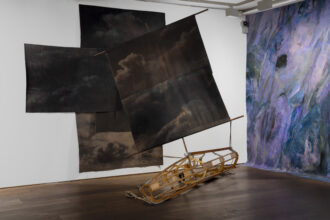
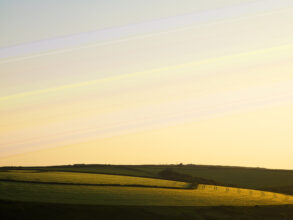
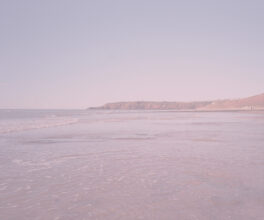
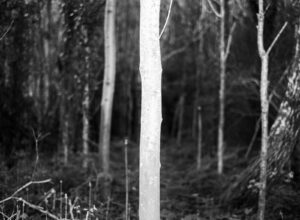
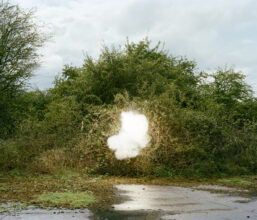
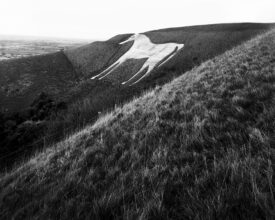
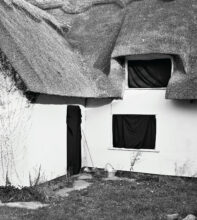
Esther Teichmann, Heavy the Sea, 2018, Installation view © Esther Teichmann. Courtesy of Flowers Gallery
After a pandemic-related pause, the London Art Fair is back later this month, and with it, the much-anticipated guest-curated photography exhibition, Photo50. This year curator Rodrigo Orrantia has brought together fourteen artists in his show No Place is an Island, considering aspects of what it means to be an island, and looking at ‘practices expanding the possibilities of photography’. Christiane Monarchi asked Rodrigo more about these themes, below.
__________
CM: I’m enjoying reading about the ideas in your curation for Photo50, which invites consideration of what it means to ‘be an island’. That the artists in your selection are British and UK-based anchors a starting point to consider the present time and place on this island, and I am drawn to consider the many paths of inquiry you have presented which unfold new parameters in the idea of ‘island’. How did this selection of artists come together for you, was there a starting point with a particular work or artist’s practice?
RO: During the first lockdown in 2020 I wrote a project called ‘On Touch (or the impossibility of touch)’ in response to those unusual first weeks and months of enforced isolation. This was the start of the interest in islands.
I spent most of 2020 reading and writing my thoughts, but also corresponding with many artists over email and zoom. It wasn’t just the idea of individual isolation, it was also waking up to a brexited Britain, and following the harrowing migrant crisis it was also the idea of an island as a mythical place, the providential rescue of the castaway.
By the start of 2021 I felt I was ready to write what to this moment is my most ambitious project, trying to decant the multiple strands of my research. I took the Martin Parr Foundation Open Call as a deadline in spring 2021 to force myself to land the project and wrote a first version entitled ‘The Possibility of an Island’. Although it was a completely crazy idea (and completely against the grain of anything that Martin would show) it was great to have a deadline and a jury to cast their eyes on the project.
A few weeks later I was contacted by the foundation to say although I hadn’t won the open call, the Jury wanted to give me some feedback on the project and that I had received a ‘high commendation’. I had very encouraging conversations with Alona Pardo and Jennie Ricketts about the content and possibilities of the idea.
And then a serendipitous email came in from Sarah Monk at the London Art Fair, to talk about ideas for the next Photo50, at that moment set to open in Jan 2022. It was one of those moments when things just click into place. I showed the ‘Possibilities’ draft to Sarah, and talked about the multiple planetary alignments in place, with the 10th Anniversary of Sue Steward’s ‘The New Alchemists’ [Photo 50 exhibition of 2012] and this show being a tribute to Sue’s legacy. Sarah and the fair organisers invited me to develop a version of the project, tailored to the timeline and scope of the fair, now under the title “No Place is an Island.”
I feel closely connected with a group of artists, both British and UK-based, who have been working very consistently by questioning and expanding the boundaries of photography, many of them originally featured in Sue’s show. I think this generation is key, bridging the search of artists in the 1980s and 90s with new discourses and territories open to contemporary photography. No Place is an Island is an introduction to this group and the type of work that interests me.
CM: I am interested in engaging physically with photographic ideas, after all these months largely looking at the screen.
RO: I couldn’t agree more. My last project before the outbreak of the pandemic was called ‘Material Immaterial’ and had to do with exploring the material possibilities of photography. My journey as a curator has taken me ‘beyond the image’ so to speak, I am now much more interested in the process of photography, specifically its sculptural dimension.
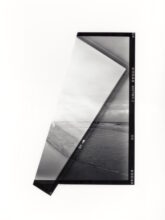
CM: Could you tell me more about the ‘Journey’ section of your show, with Esther Teichmann’s installation ‘Heavy The Sea’ and Alexander Mourant’s project ‘A Vertigo Like Self’ taking the photographic into dimensions of time and space?
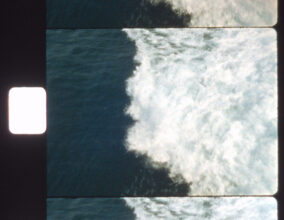
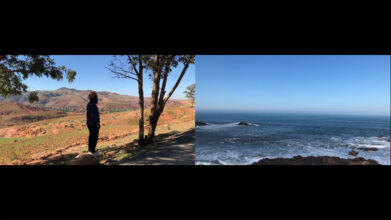
RO: I wanted to create a narrative journey, a kind of cinematic flow for this exhibition. I always think of films when I imagine exhibitions. And I thought, this show needs to start with a voyage at sea, a journey to this strange non-place that is the island. I had seen Esther’s installation and it moved me immensely, especially thinking of the current situation in the English Channel and across the Mediterranean. I think it is remarkable how Esther constructs these mythical worlds without diverting from a very classic photographic language. Alexander’s film also had a mesmerising effect, it brings you in this atemporal voyage, it’s a catalyst for the audience’s memories. I like the idea that you can see the image in the film but also the film itself, by including the film sprockets and the border of the object. You are both in and out of photography’s spell.
CM: Your invitation for the viewer to travel to an island ‘that feels both familiar and real but at the same time ineffable and fantastic’ within this exhibition is a welcome mental escape from the generally oppressive news these last few months where travel has become increasingly fraught again. Could you walk me through some of the ideas in the ‘Borders’ section?
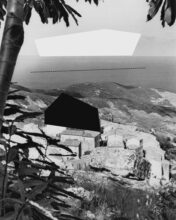
RO: The border is a mark, it brings the journey to a halt, to a destination. It divides, but also it signals an arrival. I wanted the audience to feel they arrived to a place, which is also a non-place, to recognise it as real but also to understand it is essentially a constructed idea, something that exists only in our minds. I was instantly drawn to Eva Stenram ‘New Meridians’ as an example of how we inhabit photographic images with our own ideas of space, altering the images with our own imaginary markings and conventions. She takes a lot of inspiration on maps and mapmaking, and the graphic elements drawn from them.
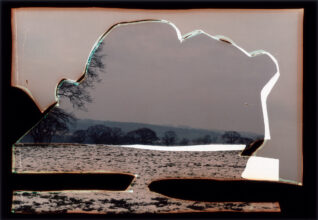
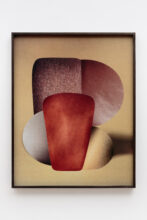
Yes, this invitation is an escape, that’s a really interesting way of seeing it, an escape into an imagined world. Artists like Aliki Braine, Dafna Talmor and Hannah Hughes have been working in this idea of the ‘constructed’ space, and are particularly interested in its borders, and the liminal space between the world of the flat image and the three dimensional object.
I have also been very fortunate to include Martin Seeds’ work, where the idea of the border also has a political interpretation, working around the Stormont Estate in Northern Ireland, and developing the ideas of the invisible but very present borders between his country and Great Britain.
CM: It is a privilege to consider the work of Sue Steward, whose insightful curation brought the exhibition ‘New Alchemists’ to the London Art Fair ten years ago. How have you decided to work with the legacy of this exhibition in your show?
RO: Sue was a great friend and mentor. She opened my eyes to a world of possibilities through her ‘New Alchemists’ show. I have a very clear memory of meeting Sue, it was one especially cold day up at the Format Festival in Derby. She was working with a group of artists, in her words ‘transcending the print’, most of whom I had never heard of before; Aliki and Esther are two examples. She was very generous with her knowledge, we must have spent hours that day talking about what photography is and what it could be.
This is why I think of this show as a tribute to Sue’s legacy, 10 years after the ‘New Alchemists’. We were working on a small project down in St.Leonards when she passed away, and I’m very fond of the very few books I inherited from her after we packed away her collection with her brother and her dear friend, another great mentor of mine, Anne Braybon.
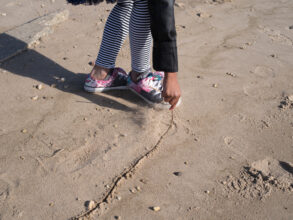
It has been great to work with artists like Dafna and Tom (Lovelace) whose practice was directly influenced by Sue’s show. And to now show how their work expands the vocabulary of photography into new areas, in the case of Tom, with a very rigorous practice of performance and audience participation.
I am looking forward to installing the show. I constantly think ‘what would Sue think of this, or that’ and feel she would have been very proud of this show, and how it connects to her work. We are planning a session dedicated to her ideas and legacy as part of the Photo50 Photography Focus Day, with some of the artists on her show, and also Anne Braybon, who knew her very well. It’ll be a chance to think about what has happened in these last 10 years.
CM: Performance hasn’t often been included in Photo50 and I am intrigued to consider this element in your show – could you tell me a bit about Tom Lovelace and Emily Ryalls’ collaboration during the exhibition?
RO: I have been working with Tom for the last few years, for me it is one of the most exciting art practices in the contemporary British scene. His work is rigorously researched, developed and presented, bringing elements of sculpture – especially minimalism and performance- to the realm of photography.
I was very fortunate that I was able to include a performance piece as part of an art fair exhibition, it really validates what he seeks to do with his work.
During the last few months Tom has been mentoring an emerging artist, Emily Ryalls, and they both sent me a proposal for a performance piece. I feel my role as a curator is also to enable these spaces to exist and to take chances with experimental work performed live in front of the fair’s audience. This would be so powerful after so many months of isolation and only looking at the world through a screen. To come back and share an experience with other people, and stand close to the performers, a connection like no other.
__________
Photo 50 at London Art Fair returns Thursday 21 – Sunday 24 April (Preview Evening Wednesday 20 April) at the Business Design Centre, Islington, London.
This year’s exhibition No Place is An Island curated by Rodrigo Orrantia presents works by: John MacLean | Eva Stenram | Dafna Talmor| Martin Seeds | Tom Hunter | Tom Lovelace | Andy Sewell | Aliki Braine | Esther Teichmann | Bindi Vora | Shepherd Manyika | Alexander Mourant | Sarah Pickering | Hannah Hughes
For details visit: London Art Fair Photo50
To attend the LAF talks, book via this link: London Art Fair Talks Programme
Curator’s website: Rodrigo Orrantia