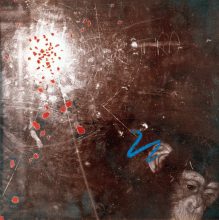
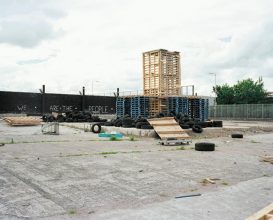

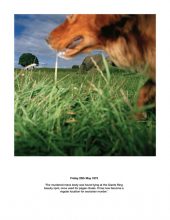

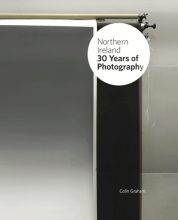
The past three decades have been significant for photography in Northern Ireland. From this era of conflict emerged a distinct approach to the photographic image, the methods and motivations of which have never been fully analysed. Northern Ireland 30 Years of Photography authored by Colin Graham narrows its focus to the specific shift in photographic practices from the press and media context of the 1980s to the gallery and photobook publishing context of 1990s & 2000s. The accompanying exhibition is running until July 7th 2013 at Belfast Exposed and the MAC as part of the Belfast Photo Festival.
Colin Graham is the author of Northern Ireland: 30 Years of Photography (2013), Deconstructing Ireland (2001) and Ideologies of Epic (1998). He is co-editor of The Irish Review, and of three collections of essays. He writes for Source photography journal and The Vacuum and is curator of the Illuminations gallery space at NUI Maynooth, where he lectures in English. Sarah Allen is a Dublin based writer. Among other publications her writing has appeared in The Irish Arts Review, Aesthetica Magazine, The Visual Artists’ News Sheet and Prism Photography Magazine. Below, Sarah Allen recently interviewed Colin Graham for Photomonitor.
———-
Sarah Allen: Could you speak a little about your background and your motivations for writing this book?
Colin Graham: My background is in English literature and I have lectured in the subject for twenty years. Although I am now based in Dublin I am originally from Belfast and in the late 90s I returned to the city to lecture at Queens University. I became interested in the response on the part of Northern Irish writers to the years which immediately followed the Good Friday Agreement. At the time I believed that these writers adopted a mode of writing which was essentially quite liberal and quietistic. In retrospect that may not have been an entirely fair conclusion but it acted as an impetus to research exactly how Northern Irish photography employed a different language – a different way of seeing – that moved beyond weak liberalism.
SA: One of photography’s inherent strengths is its ability to reveal change. Is this a quality which makes it uniquely suitable for documenting conflict?
CG: I believe documentary photography is most interesting when it attempts, in a series of still images, to capture something that is changing as opposed to something that is static. This mode of photography is strongest when it presents a crisis or a question, rather than presenting an outraged portrayal of an injustice. The art-documentary mode which arose in Northern Ireland was rarely in the position of presenting a real sense of absolute injustice so in a way it was forced into a line of questioning around the whole idea of change.
SA: How has photography’s claim to ‘truth’ been interpreted by Northern Irish photographers?
CG: There are several ways of interpreting the idea of ‘truth’ in the Northern Irish context. One observation that could be made is that the vast majority of work that is produced in the art-documentary mode in Northern Ireland is ‘peopleless’. One reason for this is that in Northern Ireland in the 80s and 90s to take a photograph of a person was to take a photograph of a label of identity, be it Protestant / Catholic, nationalist / unionist. Northern Irish photographers began to circumvent this problem by letting the presence of people be traced into the image without the people actually being present. This approach produces a more complex ‘truth’, one which avoids burdening the image with the ‘untruth’ that one person can represent a whole community or identity. So the very notion of truth is problematic; in the Northern Irish context it could even become redundant and could perhaps be replaced with a sense of experience or evidence or an accumulation of events.
SA: How influenced were Northern Irish photographers by the New Topographics and the Düsseldorf school and do you feel the legacy of New Topographics is still felt in any way, perhaps by emerging photographers?
CG: For emerging photographers both the Düsseldorf School and New Topographics have been absorbed to such an extent that they are no longer explicitly present in their work. For photographers such as Willie Doherty, Paul Seawright or John Duncan perhaps the influence is more apparent. It is important to remember that The Troubles were a visual conflict which was photographed in a similar manner to The Vietnam War. So the conflict was visual from the very beginning. Sentimentality and drama are two particular characteristics which could be viewed as damaging to the image and during this period of conflict there was a conscious rowing back from these elements on the part of certain Northern Irish photographers. The political situation in Northern Ireland essentially disempowered people and press imagery which over-dramatised and stereotyped people served to reassert that powerlessness. Conversely the art-documentary aesthetic offered an undramatic mode of photographing which was initially ‘objective’ and so created a space to withdraw to and from which to consider the subject more deeply. It is also worth noting that there is a longer history of European and American photography which leads up to the New Topographics and Düsseldorf which is equally evidenced in the work of Northern Irish photographers.
SA: You mention how particular Northern Irish photographers seem to be directly inspired by the New Topographics. In your opinion, where is the line that divides inspiration and imitation?
CG: Some photographers might adopt varied styles in their practice and others develop a signature style. This signature style could initially arise from a form of imitation but it quickly develops into something distinctively individual. The photography that I am drawn to moves between a very strong signature vision and a photographic form which is allowed to arise from the context of the photograph. A good example here is Patrick McCoy’s images taken in the back seats of black taxis. In a voyeuristic mode the camera angle imitates a personal viewpoint, that is, sitting in the back of the cab as another passenger. There is a simple cleverness in these shots and the approach employed here, which allows the subject-matter to dictate the photographic method, is replicated by many of the photographers included in the book.
SA: Was there a photographer who you believe to have set a stylistic precedent for Northern Irish photography?
CG: Paul Graham’s Troubled Land series is the first example of the kind of approach that reappears in the work of photographers such as Paul Seawright, John Duncan and Victoria Dean. However Victor Sloan is equally important and although Graham and Sloan have different aesthetics their fundamental approach is very similar. By tracing small elements onto the landscape they transform the image from something ordinary or banal into something which is extremely loaded. In the case of Graham this is evident in his image of a Union Jack flag atop a tree. Sloan employs a more artistic form of tracing which scratches details into the surface of the print.
SA: Paul Graham would have been considered an ‘outsider’ documenting the troubles. Do you believe the images created by the ‘insiders’ have more authoritative power or are more ‘real’ than those taken by ‘outsiders’?
CG: No. Claudio Hils and Kai-Olaf Hesse are prime example of ‘outsiders’ who have done fantastic work in Northern Ireland. There are examples of press photographers who came to Northern Ireland during The Troubles with slightly crass assumptions of what an international image of conflict should look like. Thus they took photographs which were imitative of different images of conflict such as riots in the southern states of America or conflict in Korea or Vietnam. Photography is an international phenomenon and a lot of the photographers who would be considered ‘insiders’ have lived and worked outside of Northern Ireland. In the late 1990s and 2000s several Northern Irish photographers made work internationally, and a point I make in the book is that all of this work can equally be understood as ‘Northern Irish photography’.
SA: Was the exhibition made in tandem with the book and could you comment on the curatorial thinking behind the show?
CG: In the early stages of planning the book I approached Karen Downey (Senior Curator at Belfast Exposed) as I felt that the book ought to have an accompanying exhibition. Working from my initial proposal we agreed on certain images which should be featured in the exhibition. Karen had editorial input into the book but as the project progressed Karen’s curatorial practice became independent from the book. While the book can adopt a linear approach to storytelling, an exhibition has to be more visually satisfying. This meant that the book and the exhibition diverged in places and took on separate lives – a process which I believe was ultimately beneficial to the entire project.
SA: Do you feel that a canon has been established and if so what photographic modes have been pushed to the margins?
CG: The project is about paying homage to Northern Irish photography and so to an extent it is also about creating a canon. In terms of what has been pushed to the margins, canons are difficult because they are subjective. Of course the project omits various types of photography; for example it does not discuss the more ubiquitous forms of photography nor does it discuss community photography after the 1980s.
When the project was finished I was almost embarrassed to see the extent to which The Troubles are threaded through most of the featured work. However there is a whole generation of creative practitioners for whom The Troubles are receding into the past. The last chapter of the book points to new pathways for Northern Irish photography. In this way the book is both about establishing a canon and calling for future generations to react against it and carve out a new photography for Northern Ireland.
———-
Colin Graham, Northern Ireland: 30 Years of Photography was published by Belfast Exposed in partnership with the MAC on the occasion of the exhibition Northern Ireland: 30 Years of Photography showing at Belfast Exposed and the MAC from 10 May to 7 July 2013.