September 2020
Interviewed by Daniel Pateman
Oli Kellett (b.1983) is a British photographer based in Hastings, UK. He studied at Central Saint Martins College of Art before working in the advertising industry, drawing layouts and writing scripts for TV. In 2008 he shifted his attention to photography full-time. Welcome to Paradise (2006-2016), his first project, saw him traverse the UK to photograph locations named “paradise” – often revealing a less-than-utopian reality – while in 2016 he began work on Cross Road Blues. Visiting Los Angeles prior to the election of Donald Trump, Kellett found himself enchanted by the symbolic potential of the cross road: his images of solitary individuals standing pensively at urban intersections offering an allegory of America’s uncertain political future. But, as Kellett’s series proceeds to include countries like Japan, Brazil, and Mexico, its more universal relevance has been elucidated. ‘Fellow Humans’, Kellett’s second solo show with HackelBury Fine Art gallery in London, foregrounds the existential and moral quandaries we all face daily, and which are dramatized in the artist’s large-scale prints.
__________
Daniel Pateman: Your Cross Road Blues series, which you began in 2016, initially comprised photos taken in cities across America of people waiting at urban intersections. What inspired you to extend the project’s US-centric scope and create similar images in countries around the world?
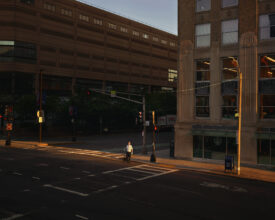
Oli Kellett: Originally I’d intended to make a small body of work while I was staying at a place called Hope Street in downtown LA, in the ten days leading up to the 2016 presidential election. I wanted to focus here because the word ‘Hope’ had so much resonance, particularly in the lead up to Obama’s 2008 presidential campaign and that iconic Shepard Fairey poster. I ended up with about twenty-five photos. It’s quite a slow process on a tripod and everything, it’s not street photography.
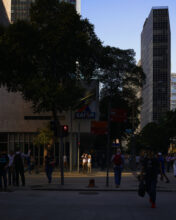
So, after that first trip – which I didn’t feel had been a great success – I was going through the pictures and there was the image of the lady standing at the cross roads looking slightly upwards [Figueroa St, LA, 2016], and it really was one of those moments of, ‘oh, that’s interesting.’ At that point it was definitely about America being at a political cross roads. But also, she just seemed lost and looking for something. I thought, I should continue with this. I’d been wanting to make a big long-term project anyway, in the grand American road trip style. And I liked the framework of cross roads. Working within really tight constraints is a good thing, for me anyway.
Gradually, after another six trips or so, I felt like, this isn’t really about America anymore: it’s about people, it’s about the universal experience. It’s about decision-making and direction, people looking…I want to say looking for answers or guidance. At that point I wanted to travel to another country. Not that I was tired of America, just that I wanted to see if I could find the same situation in different countries. I’ve been to Tokyo, I went to Rio; I’ve been to Madrid, Sao Paulo. I’ve shot a bit in London and Mexico City. And it definitely became this thing of just being human, just being a person, instead of being about America. It grew into something more existential, I guess.
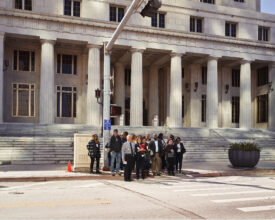
It’s funny, one of the pictures I really wanted to take that first time in America was a picture of a cross roads with a hundred or so people crammed together at a ‘Don’t Walk’ sign. That’s what I was actually looking for, and funnily I’ve got dozens of those pictures from all different countries. But it was the shots of individuals that resonated more. I’m not saying the group images won’t ever see the light of day. Just that they’re at the bottom of the pile at the moment. I think emotions resonate for people much easier when they’re looking at a single person, picking that person out and saying, ‘that’s me. That’s the Everyman.’
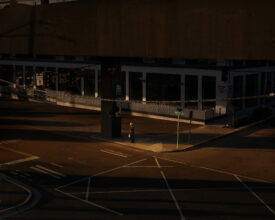
DP: That puts me in mind of one of your more recent images [Av. Almirante Barroso, Rio, Brazil, (2019)]: a busy street scene that’s quite dark except for two people in the centre, illuminated by a beam of light as try to navigate their way around the city.
OK: You’re the first person I’ve talked to about this picture actually. But I just want to say when I took it, I was waiting, and I was there, and I could see this light coming. I was desperate for something to happen, because everything was set up so perfectly for something to happen. But what I love about photography and not staging things is that you can never imagine what’s going to show up, and then these people appeared, and in that one second he pointed up in the same, John the Baptist, Raphael, the School of Athens, Plato sort of way: all of this art history reference in that one second. And her arm is bending over, almost like a Raphael cherub in the sky. And then it was over, and I rushed back to my apartment and immediately backed it up.
DP: On that note, how much have painters influenced the style and themes of your photography? There seem to be contemporary echoes of paintings like Casper David Friedrich’s Wanderer Above the Sea of Fog (1817) in your images, and particularly of Edward Hopper in your figurative use of light and dark [for e.g., Excursion into Philosophy, 1959)].
OK: I mean, enormously. Painting is my first love, it’s what I did as a teenager, it’s what I thought I was going to art college to do and to be. And then I didn’t because…I don’t really know why. I love the process of painting; I love the construction of painting. I love the idea of being sat in the studio all day, painting [laughs]. I love everything about it. These trips I make, I really enjoy doing them, but the risk, the time and finance is so great, I sometimes wish I could just get out of bed and roll into a studio to paint instead. But what photography brings to my practice is that element of chance, of surprise, which I also love.
When I’m taking these pictures in the street, though, it’s not a dissimilar process. I mean, I’m up before dawn, walking for hours and hours. It’s a very meditative process, just like painting in the studio probably is. So yeah, it’s a big influence. I hadn’t actually thought about that Caspar David Friedrich example you mentioned.
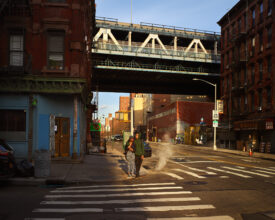
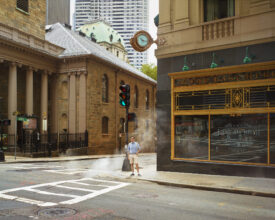
DP: I think it’s most pronounced in your Tremont St, Boston(2017) image, where the young man is waiting alone at the cross roads, sort of wreathed in a cloud of steam from below.
OK: There was a note about being an admirer of Hopper in the press release for the ‘Fellow Humans’ exhibition, and I am an admirer of Hopper, but the pictures aren’t meant to reference him. There’s a wonderful quote from his wife about him [“Sometimes talking to Eddie is just like dropping a stone in a well, except that it doesn’t thump when it hits bottom”], which I just love it. People regularly mention him in relation to my work. It doesn’t annoy me, but I think it’s kind of an easy thing to allude to. That’s why I’m much happier about being referenced to Caspar David Friedrich [laughs].
DP: Why do you think the imagery and symbolism of the cross road continues to resonate with you?
OK: I think making important decisions is so difficult, and I think about it all the time. It’s definitely since having children, you have this ‘decision paralysis’ because you just make so many decisions before breakfast. I sometimes find myself standing there like the people in the pictures, just like, ‘what am I doing, what have I got to do today?’ The whole idea of decision making and looking for something or someone to provide the answer, it’s just so universal. You see it in both really religious cities and more secular ones. Cross Road Blues actually evolved from a few different projects that I did a long time ago, of me taking pictures of people at train stations, of crowds, people waiting for trains. As I’ve said before, I’ve always taken pictures of people where I want to know what they’re thinking, and I guess that’s never really left me.
Going all the way back to that Robert Johnson myth of his deal with the devil [alleging that the blues musician sold his soul for musical ability at the intersection of Highways 49 and 61 in Clarksdale, Mississippi] and the idea of two different voices, the angel and the devil on your shoulder. All these things come together at a cross roads. I feel like it’s just such a loaded place.
DP: Do you think your photographs embody that moral uncertainty then: ‘which path should I take and will I make the right choice?’
OK: Exactly. There are these choices, these many paths to take, and who knows which path is the right one. I just think that’s all quite exciting and interesting. I especially like the idea of these dualistic voices. I mean, it’s within everyone, isn’t it? What’s the right decision and what will the consequences be? And suddenly you’re down a rabbit hole of decisions and directions. This is why I love to photograph people when they’re just on their own and there’s nothing around them, because it definitely foregrounds this idea of the individual and what is it to be a human, and these decisions that you have to make, and the stillness and the silence. I think it’s hard to find silence in the cities. But you know, it’s good to step outside, step away from everything.
DP: In an interview with CNN Style in July 2019, you noted that Cross Road Blues was “growing into something that’s more like an index of people.” Can you elaborate on what you mean by this?
OK: I think I was probably trying to make it more about other countries, and meant indexing as in, everyone’s essentially the same: most people want the same things out of life and ask similar questions. And once the work is complete – if it ever is complete – they’ll be on view and able to demonstrate that someone in Tokyo is almost exactly the same as someone in the City of London.
DP: Did you find on your trans-global travels that there were more similarities than differences in the way people behaved within the urban environment?
OK: Well, I’m after something that’s so specific in terms of people’s posture and attitude, that if there was a difference it’s not really very obvious. There are definitely differences in my approach when I’m working in different cities. I mean I found America really easy to work in. People say how hard it is, but I’ve never found that. I found shooting in London much more difficult. I’d just come back from a trip – each time I’ll shoot for about ten days at a time – and I don’t think I’d been stopped once. But I tried to shoot in London a couple of years ago and got I stopped three times by security personnel in one afternoon!
DP: How detrimental has the Coronavirus pandemic been to the evolution of this series – and your artistic practice generally – given that you need to navigate busy city streets, and regularly travel internationally to countries like Japan, Brazil and Mexico?
OK: I was definitely planning on making a couple of trips this year, but they haven’t happened and it’s not the end of the world. I see this going on for a long time. Incidentally, I don’t want people to think that I’ve taken these during lockdown, given they’re of mostly empty streets; I don’t want people to think it’s been an easy win [laughs]. So yes, this project is on hold for the moment.
I haven’t actually shot much in Europe for this, because I was after those non-descript urban places that you find in North and South America, and parts of Japan. But I think I’ll try and broaden it out a bit. I would love to try and shoot in Rome. That’s probably following on from the Tremont Street, Boston image, and looking for a bit more of that description in the buildings. And I haven’t been to America for quite some time, so I think I’m ready to go back now.
DP: Would you consider making new work in some of America’s small towns?
OK: I think it would still be a city. It’s tricky, it’s a very fine balance between weather, and temperature, and amount of people. The way I decide where to go is actually a lot more practical than romantic. It’s usually a combination of: when can I go away, how much are the flights, how much is Airbnb, and is it going to be sunny? Essentially though I could take the project anywhere. It’s a long-term thing, and hopefully I find the same things everywhere I go and the pictures can translate across different countries.
DP: You mentioned that your intentions when planning your next location aren’t romantic, but the results certainly can be. Like Hopper, would you say you employ light and dark in a symbolic way, to embody an inherent dualism in life?
OK: It’s funny you say that, I was just re-reading some notes I made years ago on this project and I talk about light and dark. I think, in a perfect world, the pictures would have all of those elements together, but you know, there are some times when I’m shooting and I don’t want to discount a strong picture – if the person has the right attitude and posture – just because the light and dark isn’t present. I feel like you can still walk away with the same thoughts and feeling from a picture that doesn’t have it. I think it’s a bonus, and if it’s there it alludes to something more powerful.
There’s a picture that I really love called Carson Avenue and it’s from Las Vegas. It’s got a Black guy in a blue vest and it’s got everything I want in a picture. His expression, he’s looking above to my left…he just seems lost, as if he’s looking for guidance. I like everything about that image, even though it doesn’t have that contrast of light and dark.
Even when I was shooting in Las Vegas, about six trips later, I wasn’t sure the project was going to be about cross roads. I was much more interested at the time in the idea of The Last Judgement, Michelangelo, the Sistine Chapel. The first morning I woke up I looked out of the window, and sunrise was reflected in the curved glass of one of the other hotels. And it was so red that it looked like the hotel was on fire. And it was just like it was burning [laughs]. In my head I was thinking a lot about The Last Judgement and hell, and it was just an amazing moment. Then I went out and carried on taking pictures of cross roads.
DP: Can you tell me a little more about your first photographic series, Welcome to Paradise (2006-2016)?
OK: Well, it goes back to that idea of indexing, that kind of Mark Ruwedel, Thomas Struth way of working. There are these places in the UK that are called “Paradise” – officially – and I found them on the old A-Z Streetview website, before the days of Google Maps. And I just travelled up and down the country. I think I photographed thirty-eight different locations? There are still more, I just haven’t gone that far north, and I don’t think I will now.
I got chatting to one lady and she asked what I was doing, and I said I was photographing paradise. It wasn’t a very nice place. And she said, ‘everybody’s got their bit of paradise, haven’t they?’ And I thought that was a really profound thing to say, as I was photographing this place that’s mainly concrete. It was kind of eye-opening. So that was what the work was about. And I’ve always come back to this idea of guidance, from the very start with the ‘Paradise’ work: looking at this idea of ‘what is paradise?’ and ‘how do you end up there?’
But it’s funny, thinking about indexing – that’s bothering me a bit now – but I think it’s the way of working that I always find appealing: that you know where you’re going, you don’t know what you’re going to find, but you have a destination to get to. I mean, I love everything Mark Ruwedel’s done. And Thomas Struth’s Unconscious Places. I feel like I know their way of working. Mark Power, he did a book called 26 Different Endings, which was about walking around the perimeter of the A to Z. It’s still one of my favourite projects, because I understand how you do that. And I feel like, Welcome to Paradise definitely helped a lot with the cross roads work, which is, when I don’t know what to do, I just walk to the cross roads, and see what’s happening there, and then I walk to the next one. Once you know the destination, it’s somehow easier. It comes back to this idea about decision-making again.
__________
‘Fellow Humans’ will be on display at HackelBury Fine Art in London from 10th September until 31st October 2020.
Oli Kellett was interviewed for Photomonitor by Daniel Pateman, September 2020.