
Melanie Stidolph is a London-based artist working with still and moving images, who trained in British Columbia and in Leeds and has exhibited throughout the UK, New York and Canada. Stidolph has recently been investigating a way of working that introduces an element of detachment over when the picture is taken. Below, Photomonitor editor Christiane Monarchi discussed with Stidolph some of the inspirations behind her current solo exhibition at Campbell Works, London.
————————
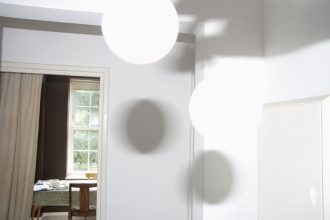
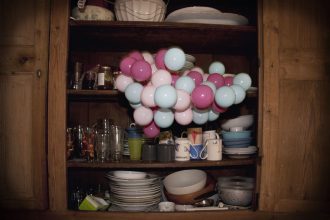
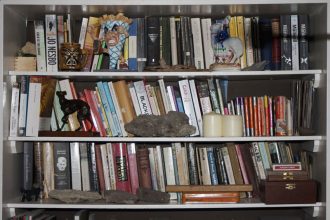
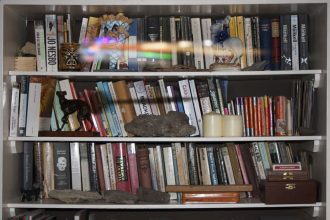
Christiane Monarchi: In considering the works on show at your exhibition ‘The Fall’ I am finding several that inspire readings of playfulness. A shiny ball suspended mid air before its inevitable fall onto a softly rumpled bed, a group of balls on the verge of spilling out of a cupboard, these moments invite associations with childhood and rainy Sunday mornings spent performing ephemeral whimsy. Yet in reading accompanying text for the exhibition I am aware that works in this show have been constructed so that the ball’s motion itself triggers the shutter to create this image. Where did your initial inspiration come from to make photographic images of motion without involving your own hand in capturing the decisive moment?
Melanie Stidolph: In earlier works I was very interested in the tension that came with an image constructed through chance encounters, the sense that the moment was fleeting. Quiet narratives were distilled into single images that relied on an assumption of emotive or intellectual connection between the photographer and the subject; the subject’s movement or a change in light triggering an internal response to the scene. I became interested in disrupting this relationship, using the motion sensors takes me out of the decisive act of pressing the shutter. I’m interested in how this might affect a reading of the image and how it might lead to an emphasis on the moments leading up to the taking of the image as key, rather than the image itself, to imply the photograph represents an end point to be read backwards.
CM: Considering the technology engaged in enacting one of your photographic compositions, travelling from motion sensor to surveillance and burglar alarm, can the viewer shift from pondering the lightness of this seemingly innocuous, frozen moment to considering possible darker meanings – the possibility of mishap, accident, or even violence?
MS: When I was approaching making the work I was aware of consciously disconnecting my reasons for starting it with possible later readings of the work, to work in opposition to how I had previously made images. I researched into as you say ‘darker’ meanings, looking at the notion of ‘The Fall’ as a physical fall, or a moral fall from grace. I was looking at works like Bas Jan Ader’s ‘Fall’ videos, for their literal connection, and then found his crying video. For me these notions of grief and sense of self falling were very much part of the making of the work. I didn’t want to produce an overriding fatalistic view, I was experimenting and wanted also to be lead by the aesthetics of the images being produced. There has been a lot of throwing and falling over the past few months and it was only a month before the show that the stilled images seemed to settle into a particular aesthetic that came together for me in terms of my own approach to the work and what I hoped a visitor might sense when viewing them.
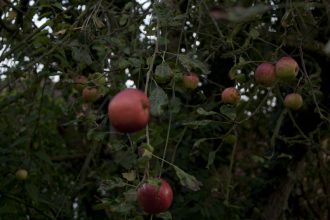
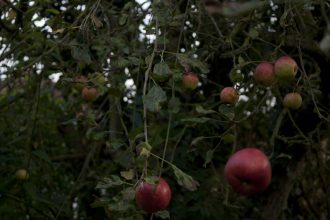
CM: ‘Windfall’, a looped video projection ostensibly shows an apple falling from a tree in a series of still images. What significance does this sequence have for you, that you have chosen to make this projection instead of a single, still work?
MS: I’m working digitally now, in the past its been with a medium format film camera, for a long while it seemed strange to translate the digital images to prints, the method of presentation seemed to need to echo its means of production. Earlier works shot on film were always shown full frame, and I think I carry that same wilfulness to ‘Windfall’, in some part it seemed necessary to show the sequence of images, just in the order they came. More than that though it was to echo how they were captured, to include movement in their presentation to give a visual clue to how the work was made. Showing a single stilled image might have emphasized the image, that even if the explanation of its capture was there in titling or text it might be natural to assume that all had been leading up to that moment, that frame, that press of the shutter, whereas with the changing sequence of images I hope it might imply that this is one slice that has been captured and that others are continuously occuring, with or without our knowledge, and that it is not our choosing that makes the moment significant, but the viewing of it.
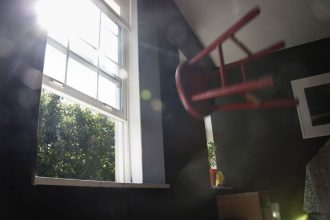
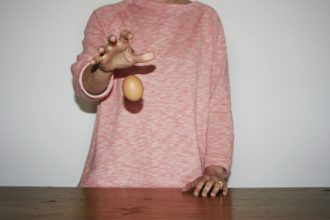
CM: Images of a person dropping something fragile in the instant before it hits, or a piece of furniture suspended in air, these could imply a narrative of wilful destruction, a tiny chaos introduced into an otherwise calm interior, and of a different tenor than a falling plastic ball or apple. What comes next, after the image?
MS: I like the phrase ‘a tiny chaos’, in thinking of a bigger picture, a wider significance to the idea of ‘The Fall’ I kept returning to slight shifts in environment and perception that can be suggestive of a wider significance. In pursuing the works and chasing the idea of the fall I think I knew I didn’t want the images to be spectacular, but more everyday or incidental in how they appeared, perhaps then to allow more space for a consideration of what led up to them, what came before, rather than what came after. In my mind these interior stills are a series of scenes in temporary suspension, subjects held with no immediate release, with only a back story, not a forward one. I recently saw the surrounding images for Yves Klein’s ‘Leap into the Void’ revealing the specifics of the whole shoot and how the image was constructed, there’s no sense that these photographs disrupt the illusion of the iconic image, but instead add to it through the revelation of the intensity of the repeatedly performed gesture.
CM: After this exhibition, what are you investigating next?
MS: I’ve recently bought a sound and light sensor for the camera so I’m interested to experiment with other ways of setting off the image and exploring how evident this original trigger is in the photograph. You can literally shout at the camera to take an image or let environmental conditions take their own pictures. Its a continuation of an interest in how far removed I can make myself as the photographer and how much a series of events leading up to an image can be implied in its final form.
———-
Melanie Stidolph lives and work in London. She studied at University of Leeds and University of British Columbia, under the tutelage of Jeff Wall. Her large scale photographic works have been exhibited internationally including solo exhibitions with Northern Gallery of Contemporary Art Sunderland, Kamloops Art Gallery, Canada and group exhibitions including, ‘Nine Point Perspective’ – Hotshoe Gallery, London, ‘Harbingers’ – Centrum, Berlin, ‘Running and Standing’ two-person show with Emma Hart – The Agency, London, ‘The Russell Herron Collection’ – Sartorial Contemporary Art, London, ‘Curious Nature’ – Newlyn Art Gallery, ‘This Show is Ribbed for Her Pleasure’ – Cynthia Broan Gallery, New York, ‘Lillith’ and ‘Scrambled’ at MOT International, London and ‘Lapsus’, Five Years, London. Selected for the first edition of ‘Pilot’, commissions include the Big Chill Arts Trail, ‘The World in London’ for The Photographers’ Gallery and ‘Still Life in Mid Air’ for Tate Learning.