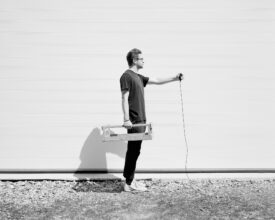
This month, Photomonitor has the pleasure of speaking with Alexander Mourant, around his recent body of work ‘On Living Stones and Reaching’ and its compelling online presentation. After ten years of working on and viewing websites, it takes a lot for a project and its virtual exhibition to make a long-lasting impact, and this one does. We recommend this project highly for viewing, reading and contemplation. Below, Christiane Monarchi spoke with Alexander about the journey involved in its creation.
__________
Christiane Monarchi: It’s not often that I land on an online platform that is so carefully curated in presentation of word and image, and as I have approached your recent project with the (for me) unusual approach of ‘read first, look second’ I have been rewarded with Jonathan P. Watts’ text introducing your latest project ‘On Living Stones and Reaching’. Immersed in the ideas presented in Watts’ text, with echoes of the genesis and subsequent histories of photography and Land Art, I now consider your works presented here which, paraphrasing Watts’ words, explore how the processes of photography could be analogous to the processes of farming. Could you take me back to the beginning of this project, why did you return to the family land in Jersey, to make this multi-layered work?
Alexander Mourant: Thank you Christiane, I’m so pleased to hear you enjoyed visiting the site and reading Watts’ text, I’m delighted to have his words accompanying the work.
I guess the beginning is hard to pinpoint exactly, but my interest in Land Art really cemented itself during the final year of my BA, when I was writing about the relationship between Land Art, Photography and Time. There was something I uncovered about an apparent resistance from the mainly American artists producing earthworks that started eating away at me: it was Michael Heizer’s reductive comments on photography as merely a ‘souvenir’ of the site or event. As an artist intimately engaged in the theory of photography, enamoured with its potential, I felt a sense of injustice. I’ve always believed photography is also a site of sorts, and therefore not the end, but an extension of the earthwork itself: photography has its own terrain; we traverse, dig and reshape images, much like artists working in and shifting the landscape. I’ve carried this thinking with me for a long while. And my ongoing research into 1960s-70s Conceptualism—focused on often overlooked Land Art practices—only serves to strengthen my fascination in rebalancing the scales, so to speak, between Land Art and Photography.
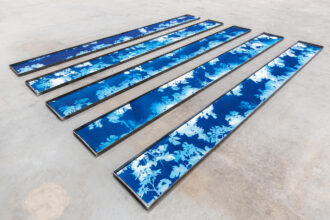
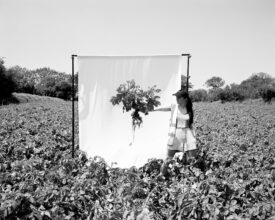
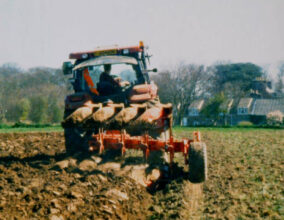
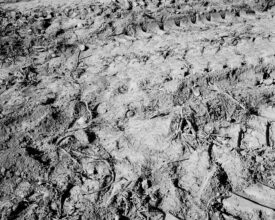
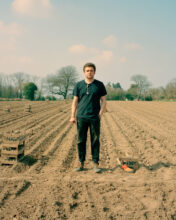
With this in mind, I began the painstaking process of responding to my own autobiography and family history of working the land. As my family have been farmers in Jersey for hundreds of years, I had an innate attraction to agriculture and began drawing parallels between plants, growth, cultivation and photography—like plants, analog photography needs light, time, water and minerals too. The overall aim was to create an earthwork for the sake of an image alone; but I also wanted to stretch that image-making process out, to question its emergence, and, in doing so, I rigorously overturned my own ideas and feelings towards the nature of images more broadly.
CM: It’s fascinating to meet people with such longstanding family roots in a place and in a way of life, and I can see how it permeates your creativity and specific resonances from art history. At present I believe you may have a more urban existence in London, how did it happen that you went to Jersey and were able to start this multilayered project?
AM: I’ve lived in London for the past 4 years, and it’s definitely a different rhythm and one that I’m not entirely sure suits me, but it has its moments. As it happened, in March 2020, just as I was preparing to return to Jersey and begin planting the field, the dreaded COVID-19 began. I was forced to escape London a little sooner than expected, and ended up spending the remainder of the year based in Jersey. Initially, I had planned to travel back and forth a couple of times, maintaining my London life and commitments with the cultivation of the field and my ongoing journal entries. With hindsight, I couldn’t have made this work while living a normal life; it was simply too demanding. The project required continuous dedication, reflection, persistence and a shutting down of any distractions. The gift of a truly cleared calendar, I believe, genuinely made this work achievable. Although, that being said, I’m very hesitant to call this a “lockdown” project; its origins and reasoning stretches beyond situational restrictions.
CM: I’m intrigued by ‘The Wilderness of Words’, a compilation of your daily journal entries over this time period. Reading through these there seem to be multiple intents, some factual, historic, poetic, observational, literary, a real multivitamin of journal entries to sustain and inform the ideas in this multilayered project. It may take one longer to read all the journal entries than to view or experience even in durational terms your photographic works. Have you worked like this in the past or is this a new part of your artistic process?
AM: When I was studying for my MA, I used to always slip away and turn up to the lectures hosted by the MA Writing course. At the time, it was led by Brian Dillon, and the symposia he curated really struck a chord with me: most notably, the sessions on Autofiction. I believe we had Lavinia Greenlaw and Claire-Louise Bennett speaking, to name a few. Writing further and deeper than ever before, my dissertation, On Being Someone Other, studied the formation of the self through writing. The process led me to consider the theory of writing, which, as with everything, inevitably percolated through my practice and became yet another device to pick at, or better understand, photography.
Ironically, The Wilderness of Words was arguably much tougher on my body than hand planting the field. The comparison between practical work (manual labour), and artistic work (metaphysical or theoretical enquiry), shares a parallel with Seamus Heaney’s Digging (1964). It was the first time I positioned writing as a “work” within my practice. The ongoing journal entries, made religiously, over a period of 83 days—from planting the field, watching it grow, and eventually, harvesting the thing—became a universe, and sometimes, a twisted fantasy, which bore this intermingled cacophonous vessel of many writerly voices. To riff off Violet Paget (aka Vernon Lee), it was a boiling pot of impressions: the field, family, history, the body, and, above all, the nature of ‘image’ itself; all swirling around, crystallising and then becoming liquid once again. Its roots are in my aforementioned text and was a way of seeing how far I could push myself.
I recently went to Whitechapel Gallery’s A Century of the Artist’s Studio: 1920–2020, and among a couple of things, it was great to see Tehching Hsieh’s One Year Performance (1980-81). Although much more extreme, this concept of ‘endurance performance’ definitely informed my approach to The Wilderness of Words. The act of writing was an attempt to entomb ‘the self’. When I reread it now, sometimes I cringe, and sometimes, on rare occasions, I feel I’m encountering a well-crafted passage that may or may not stand the test of time. Between you and me, I was trying to see whether the ‘image’ of the field was actually, out there, in the landscape, or in fact, forming back inside, on my desk, sitting on the page. Writing is reaching.
CM: I think it’s an impressive and engaging part of the work, and will enjoy re-reading in the decades to come. On 23 June entry you end the text with “We have reached the end. This shape of us, and this iteration, has at last, been laid to rest.” Is this project now finished, as the growing cycle was completed, or would you look to add to it in other seasons?
AM: I wouldn’t repeat this work in other seasons, that’s down to practicalities more than anything else; you can only grow this produce during a particular time of year. Having said that, I had considered growing a portion of larger, seed potatoes, which would have joined the communal seed store in the barn for the following season’s planting. Meaning, in the future, the ‘image’ I’d grown would become a parent of multiple images, and each and every year after that, it’s lineage would multiply, creating further generations grown throughout the island. I had considered tracking their whereabouts, returning each year to photograph the fields, but it slipped my mind, and I focused on other projects.
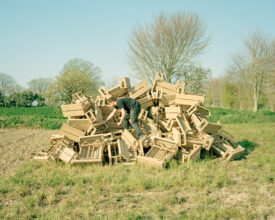
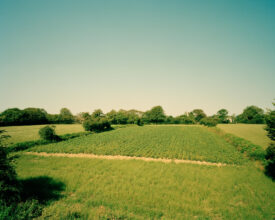
That final entry was made the day before we harvested the field. After weeks of rain, the weather cleared and the following morning, I positioned myself on the bottom right hand side of the field, and on a tall platform I made a photograph of the entire view; therefore, at last, ‘reaching’ the image that I’d searched so hard to find (The Image Reveals Itself, 9:57 am, 24th June, 2020). You might define that as the ‘finishing line’ of the work, and in many respects, I would tend to agree. However, the events that followed are the true continuation of the work.
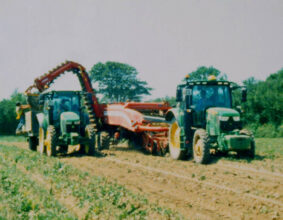
After being excavated from the earth, the potatoes or the ‘seeds of the image’, began a journey like any other harvested crop: carried by trailer from the field to the farm, sorted, sized, washed, packaged, and then, loaded onto a ferry, destined for the UK, headed for local supermarkets that you or I would usually visit. I enjoy thinking of the people who unknowingly picked up pieces of the ‘image’—artefacts from the ‘artwork’—and placed them into their baskets. Later, they’d cook and then consume parts of the image, inviting it to enter and, in turn, fuel their body. They participated in the performance of the work; they are unsuspecting collaborators, and perhaps co-authors, as the image surely conjured future images.
__________
Alexander Mourant is an artist, writer and educator based in London. He has been commissioned by FT Weekend Magazine, Hapax Magazine and The Greatest Magazine, and included in publications such as British Journal of Photography, The Guardian, Photograph, Unseen Magazine and Photomonitor. Solo shows include ‘Aomori’ at The Old Truman Brewery and Unseen Amsterdam, alongside group shows at Edel Assanti, Saatchi Gallery, Seen Fifteen Gallery, Peckham 24, and Photo50, London Art Fair. Mourant is a recipient of grants from ArtHouse Jersey, Jersey Bursary and Arts Council England. He has won the Free Range Award and was nominated for the Foam Paul Huf Award. Mourant is a member of Revolv Collective, an arts organisation established in 2017 which champions art pedagogy; he is also a Contributor at C4 Journal, a platform dedicated to writing about photography and the various incarnations of the photobook. He achieved BA Photography at Falmouth University, and MA Photography at Royal College of Art, London.
Mourant’s project and online platform referenced above can be found here: On Living Stones and Reaching, and his new, as yet unseen project will soon be published in issue 3 of Hapax Magazine (Autumn 2022).