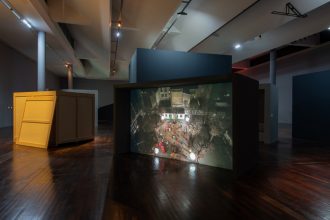
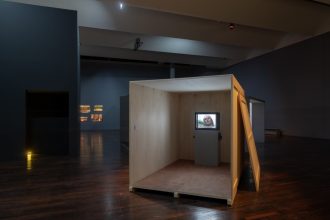
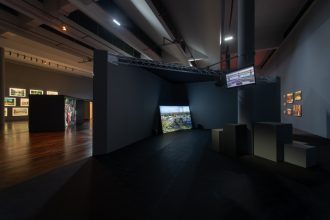
Melanie Manchot’s practice stems from a deep interest in people and space and how they in turn shape each other. For the exhibition Open Ended Now currently on at the MAC VAL museum of contemporary art in Paris, the curator, Frank Lamy, has brought together works from between 2001 – 2018 that are the artist’s most overtly collaborative and performative. This is an intelligent grouping of Manchot’s works that focuses on bringing people together to examine social behaviour in public spaces, both urban and rural. The built framework for the installation, comprising 2 photographic series and 10 video pieces, is a flawlessly constructed scenography encouraging the viewer to trace their own path through an architecture that facilitates immersion into each of the individual works and unites the whole that is greater than the sum of its parts.
My viewing experience started with some of Manchot’s earlier works: from Groups + Locations (Moscow), 2004 to Dance (All Night, Paris), 2011 to For A Moment Between Strangers, 2001 to Celebration (Cyprus Street), 2010 and then on to Security, 2005. This sequence evoked in me a great compassion for people and our shared spaces. Underscored was a desire to be a better urban citizen: to slow down, take notice and be kinder. Particularly For A Moment Between Strangers where the artist’s practiced voice—held between neutral and persuasive—requests a kiss from strangers on the streets in various cities. The use of a hidden camera on the artist’s body shows only the subjects and their reactions to the request. As expected, the answers range from brusque to very willing, with many awkward and touching moments in between. What is not expected is how uncynical the piece is as a result of the absence of commentary or judgement from the artist. She is a collector of kisses and the choice of how to respond is left to the viewer, much like the individuals approached in the film. The exhibition poses the overarching question: “How do we treat strangers?”
__________
Persilia Caton: This query is linked to Lars Von Trier’s film Dogville, which the exhibition references. Can you expand on what you were aiming to achieve with this cinematic reference and how the exhibition is constructed and staged?
Melanie Manchot: The staging of the exhibition is highly important as a conceptual framework. Both the exhibition title Open Ended Now (a reference to Mikhail Bakhtin) and Dogville inform a scenography that combines defined individual viewing spaces with openness. The shifts of light (from cold to warm), half walls, open viewing spaces, changes in elevation and delineated navigational areas allude to the framework of a city at night. The non-chronological staging of the works forms a dialogic space where each piece can potentially be read in relation to another across space and time. Through creating this permeability, the desire is to allow the viewers to come to their own conclusions about overarching methodologies in my practice. For example, Security is an early work from 2005 and 11/18 was made 10 years later, yet they are both very much about how someone confronts a camera. Across many of the works arises a triangulation between the people that are being represented, the mode of representation (the apparatus) and myself (part of the apparatus but also key to setting up these relations).
Dogville connects formally to the scenography of the exhibition and to strategies that encourage the viewer to become a conscious critical observer. The film utilises a liminal space between different modes of being—the theatrical and the cinematic—and different classifications of performance. It builds its own original framework, yet manages to connect across genres. This Brechtian, anti-realist style points to the suggestion of a thing (a wall, a road, etc.) for the audience to conjure, much like in theatre. In Dogville, the narrator is used to highlight the presence of the viewer and to constantly remind them that they are encountering something. This is echoed in the exhibition through the position of an active viewer who is responsible for constructing what they are seeing and how they conceptualise it.
PC: In your use of group portraiture you bring people together yet also keep them apart. For example in Groups + Locations (Moscow) the subjects are assembled in a public space where it is prohibited to form groups larger than 4 people and to take photographs. You unite them through the photographic frame, yet you maintain a distance between the subjects. This is also apparent in Dance (All Night, Paris) where the groups of dancers are separated by genre. The area they share is cramped and communal but remains segregated. Can you explain your thinking regarding this structure?
MM: Bringing people together and maintaining their individuality is an ongoing point of interest in my practice. In Groups + Locations (Moscow) I stopped people in their path on the street and asked them if they would be willing to stay there over the course of 5-10 minutes. The people are strangers passing by but in the resulting photograph they form an incongruous group. The people in the two projects you mention represent a temporary coming together. How participants choose to move within the set framework ultimately depends on the choices of the participants. For example, in Dance (All Night, Paris) the participants were told to stay within the camera’s frame (the civic square) but how they moved within that space was entirely up to the dancers. They completely choreographed their own routines and decided themselves to maintain the separation between the groups. Ultimately, the works ask questions about how people coexist within large cities and how can we live together better.
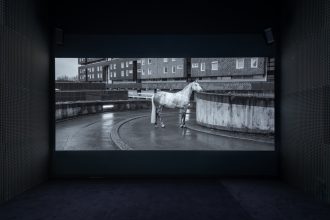
PC: Moving away from the early works, I went on to view Tracer, 2013 and Cornered Star, 2018. Positioning this pairing together could mark a shift in your practice. A previous sense of communal idealism evaporates to make room for a realist desire for direct change. A subversive, agonistic pushing back of authority arises through these two films by way of a group of parkour runners that scatter and merge across a route through urban and rural terrain and a stunning powerful horse who appears to be the last living being, set against a sculptural urban backdrop. Compared to the previous earlier works, these have heightened aesthetics and sound, both pulling the viewer into foreboding moments of harsh winter weather and brutalist architecture where the human body moves quickly and the animal stands sculpturally still. Can you speak about this possible shift in your practice?
MM: Until very recently Tracer was my most architectural work and this focus certainly bridges it to Cornered Star. It picks up on many ideas that Tracer tries to address, specifically the notion of speaking architecture and articulating a particular sense of architectural aesthetics that expresses an element of society’s desire and intention. In Tracer, this yearning is articulated by the parkour runner’s physical language spoken upon the architecture. In Cornered Star, it is the highly bred and cultivated horse that also speaks of this desire. Historically, the horse is emblematic of success, grandeur and masculine power. It is a multiplier of whomever is atop the horse, but is rarely considered the hero themselves. Both of the works address public space and the complications of this arena, such as the economics and male coding of public space. When one empties out a large urban space it becomes a stage. Modernist architecture has often been considered as a form of a stage, framing whatever is accommodated within it, whether it is a group of parkour runners or a horse, it heightens it and renders it more aesthetic. In both works I use sound to fictionalize the observational quality of the films and by extension the spaces depicted.
PC: In more general terms, but in reference to these two sections of your practice that I have sketched out, can you speak about your own control over the outcome of the work and how you think about collaboration in respect to this?
MM: Throughout my practice there are times when the work is participatory and other times collaborative or even co-authored, these are very different forms of inviting others into the creative process and each has a distinct outcome. I consistently seek out a way of working that sits between choreography and a loss of control. An example of the latter instance is when you give people what you think are a clear set of directions and they hear them differently and act in unexpected ways, that, quite often, is beautiful. Forms of exchange and collaboration are so important to me because it is about bringing ideas together.
Ultimately, I take responsibility for making the artwork. I have a duty to the collaborators and participants to make the work to the best of my abilities. Yet, instead of imposing a predetermined aesthetic on the piece I always try to interrogate the work and understand what kind of aesthetics it needs. The aesthetic choices are a response to how the content presents itself; it often changes in the process of making.
PC: What is your intention for working with animals? It is quite a different objective and outcome from working with people in the mode of a social practice.
MM: This is a departure for me and extends into my research about our relationship to the natural world: between the human, the environment and forms of nature. What drives everything that I do is a deep curiosity about other human beings and the knowledge that this curiosity will never be satisfied. Knowing animals is even less possible, yet I have a strong connection to animals and I am exploring what this means.
__________
Open Ended Now closes 24 February 2019 and the companion exhibition at Kunsthaus Centre d’art Pasquart, Switzerland runs from 13 April – 16 June 2019.
For more information on Manchot’s practice, please visit www.melaniemanchot.net
__________
With thanks to Melanie Manchot and Persilia Caton for this feature.