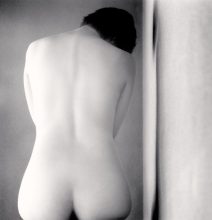
Michael Kenna, internationally celebrated for landscape photography, has this year produced Rafu, a collection of nude photographs. In his treatment of one of the great themes for artists through the ages we see that, though the subject has changed, Kenna’s vision persists.
Below, Patricia Baker-Cassidy shared an emailed discussion with Kenna of this new body of work, which has been published by Nazraeli Press.
__________
Patricia Baker-Cassidy: Looking at your nudes, I feel I am also looking at your landscapes. In the opening image, the woman lying on her side is seen from a distance –so initially this feels like a landscape – the viewer becomes like a traveller approaching an unknown island. Your landscape vision is unique, and I feel it translates into these nudes – the same composed gaze and otherness. Could you say something about nudes as landscapes?
Michael Kenna: I approach photographing the female nude, very much as I approach the landscape, with absolute respect and admiration. In landscapes I search for subject matter that resonates with me. I am interested in the relationships, juxtapositions, even confrontations between natural elements and structures that we humans have formed. It is not so different when I photograph the nude. I look for the individual characteristics in bodies, their shapes and uniqueness. I explore their relationships to the environments where we are photographing. I allow the models to express themselves, to find interesting poses and angles. Some required direction, others were content to move as they wished and I would stop them when I saw photographic possibilities. Sometimes I had a great rapport with the model, other times it was more distant and reserved. I never began a photo session with fixed ideas of what I would photograph, and I could never predict or pre-visualize the results. It was more of an impromptu event, something of a wordless dialogue between model and photographer. Essentially, I was open to possibilities. I used whatever available ambient light and props I found in the locations. All this I do when I photograph the landscape.
PBC: I sense a dialogue between your work and nudes by other artists…
MK: I believe it is impossible not to be influenced by those who have gone before us, and I have never thought my photographic mission is to recreate the wheel. So, yes, there are references to Ruth Bernhard, Bill Brandt, Mario Giacomelli, Eikoh Hosoe, Man Ray, Edward Weston, and many others. My work with the nude has given me an even greater appreciation of what has been created well before my time.
PBC: Looking at the final version of the essay – are you surprised?
MK: I am always surprised and delighted by the miracle of life interpreted by photography. The silver gelatin process which I still use, essentially slows everything down and enables us to more fully appreciate what otherwise passes us by, often without us even noticing or acknowledging.
All the photographs were made with my old Hasselblad film cameras, so exposures were usually long, close to a second, with the camera on a tripod or on the ground. The process was often slow and arduous for the models maintaining their poses. There were many sore muscles after the sessions! I cannot adequately express my appreciation for their kind forbearance and patience.
PBC: What was the starting point for your edit – were there some images that you thought essential to the architecture of the book?
MK: I have never fully understood the editing process and for me it is not completely methodical. I have the negatives processed and two sets of contact sheets made. One set I file with the negatives, The other I go through and cut out images which I find interesting. These I keep, to consider again later. Why are they interesting? Honestly, I really don’t know. Perhaps because of the graphics, or some sort of connection, a resonance. Occasionally, there is a connection to an influence.
I think that when we look at images there is a gut reaction, we know inside whether they work or not. However, through experience, I have learnt to be somewhat ambivalent about this method of evaluation as I often made suspect decisions. When I look through my negative archives I find overlooked images. The famous theologian Paul Tillich wrote that, for him, doubt was central to his faith. This could equally apply to choosing images! Having made an initial selection for Rafu, Chris Pichler greatly helped with the final book pagination and lay-out. I had taken about 9000 photographs between 2008-2017, but Chris and I decided early on to have a small, somewhat precious book. We work well together, so it was easy to agree. Of course, later, I wanted to make changes. A few images came out, some new ones went in. I also contacted all the models; I regarded our sessions as collaborations and it was important to me that they were happy with the images that we made, to be exhibited and published. One model had married and no longer wanted photographs of her published. I respected her wishes and two of my favourite images were taken out of the book.
PBC: In your interview with Zoe Balthus, you speak movingly of Ruth Bernhard’s influence – did you have inspirational tutors earlier, when you were at the London College of Printing?
MK: Over the three years I spent at the London College of Printing I was fortunate to work with many inspirational tutors. One in particular, Peter Espe, remains a friend and guide to this day. In the early seventies, Peter taught a fascinating course: The Science of Photography – a subject completely new to me. It gave meaning to the magical alchemy of the silver process. He supported us through, and ultimately judged, our senior thesis. Mine was about optical illusions – another subject that still interests me and continues to inform my photography. Peter came to photography from a different angle than most. He was something of a bohemian scientist who seemed to think “out of the box”. Most of the other teachers were from the professional side of photography, also necessary, of course.
During first year at LCP I lived in the Stockwell YMCA. It was dire, with tiny rooms and bed bugs. I remember mentioning this to Peter towards the end of my first year and he offered me a room in his house in Richmond. I lived there for the following three or four years, which immensely enhanced my LCP experience. We had innumerable informal chats about photography and life; he let me use his Richmond darkroom and even shared his allotment along the River Thames! Peter later introduced me to many people, including the Magnum representative Robert Hillelson and the photographer Anthony Blake, both of whom I subsequently worked for. Later, he organized exhibitions of my work at The Theatre Gallery, Chipping Norton and The Bampton Arts Centre. Over the years we have stayed in touch with each other and he remains a supportive and encouraging presence in my life for which I am hugely appreciative. I will always consider myself extremely fortunate to have met Peter when I did.
PBC: Reading that interview, I sense a duality: obsessive love of photographic processes (darkroom magic, that smell of the fix bath!) combined with calm acceptance of the unpredictable. So, I wonder – does your photography not only express the beauty of the perceived world (trees, nudes, skies) but also something inward, a philosophy?
MK: I suppose photographs reflect the photographer in the same way that paintings reflect the painter and writings the writer. If I was a writer, I would write about these things, but they are not easy to put into words, so I photograph. And every viewer interprets the images in their individual ways.
__________
Notes:
Rafu by Michael Kenna was published by, and is available from, Nazraeli Press (1 Jan. 2019)
With thanks to Patricia Baker Cassidy and Michael Kenna for this interview.