Born in Bethlehem, Pennsylvania in 1954, Mark Ruwedel has lived and worked across the USA and Canada. His oeuvre illustrates a fascination with the intertwined relation between man and earth, particularly exploring the colonial history etched into the landscape of the American West. Exhibited internationally, with over fifty galleries and museums worldwide holding his work, he has also received the prestigious 2014 Scotiabank Photography Award. His most recent exhibition Artist and Society: Mark Ruwedel – curated by Sarah Allen and Simon Baker at the Tate Modern last year – now sees him nominated for the Deutsche Börse Photography Foundation Prize, alongside photographers Laia Abril, Susan Meiselas and Arwed Messmer.
__________
Daniel Pateman: Given a career spanning forty years and your extensive photographic output, how did you decide what to include for the Tate exhibition, Artist and Society: Mark Ruwedel? What decisions led to Dusk, Bomb Craters, Pictures of Hell and We All Loved Ruscha being selected in particular?
Mark Ruwedel: Not to pass the ball but a lot of that was the Tate’s doing, because that exhibition was largely from their permanent collection. The work they don’t own that was in the show was borrowed from people who have committed their collection to the Tate…so it was really a Tate show. Of the two things that aren’t owned by them as yet, the We All Loved Ruscha piece that’s owned by a private collector in London…I really pushed for that to be included in the show, because it points to other things I’ve done recently that weren’t represented, as well as to other works in their collection. I also wanted to cast a wider net in terms of understanding my relationship to my work and who I’m inspired by and admire.
The work in the show that’s not necessarily property of the Tate would be the hand-made books in the vitrines. Again, that was something I was really interested in doing for similar reasons, because over the last ten years that’s become a larger part of my practice, so I wanted that note in the show. Also, the subjects in that selection of individual books are related to works on the wall that the Tate own. So when we move to the The Photographers’ Gallery for the Spring, the idea is that that show is representative of the work that was nominated. The Tate had, I think, three pictures from the series Pictures of Hell but they owned more, so we’ve included six for The Photographers’ Gallery show. We sort of played with it a bit while still representing the bodies of work.
DP: It sounds as if you wanted to provide a broader overview of your practice as a whole rather than a single facet of it.
MR: Right. Hopefully all those projects as represented in the two shows engage in some sort of dialogue, they don’t look like four different people’s work [laughs].
I also just completed work on the catalogue collection for the Deutsche Börse exhibition. That was yet another selection process and I tried to do something that had its own integrity, so that if someone never saw the show but saw the catalogue it would make sense. I left some stuff out of the catalogue for that reason, because on the wall it seemed to work, but in the book it seemed like an odd note.
DP: How do you see your work as intersecting with the concerns of your fellow nominees for the Deutsche Börse Photography Foundation Prize?
MR: Well, I was only familiar with one of the other three when the announcement was made. And when I looked at the two that I wasn’t familiar with I thought, ‘how on earth is someone going to be able to make a decision?’ because these are four completely different things. It’s not like they’re not all a high level of accomplishment; it’s like comparing apples, oranges, bananas and pomegranates, you know.
DP: Would you agree that at first glance your work seems less overtly socio-political by comparison?
MR: I would underline the word overt. Maybe it’s not as quick a read in that regard, and that I would agree with, but I would certainly argue that there is a political dimension to my work. Over the years there’s been all these debates about those kinds of questions, and they’re really big questions, and I think where I started and Susan Meiselas started [also nominated here for her retrospective Mediations] are really really different…but somehow we both ended up on the same museum walls over the years.
DP: Your work seems to express a dual movement, responding both to a specific context (for example, American expansion in Westward the Course of Empire) as well as universal cycles of growth, decay and rebirth.
MR: I tend to put more emphasis on the decay part than the renewal part [laughs]. I don’t know…a wall label I saw recently said that the work was all about how nature finally triumphs, and I was like no, no, it’s not.
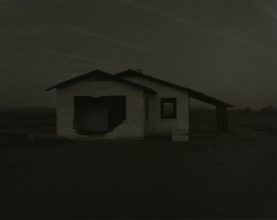
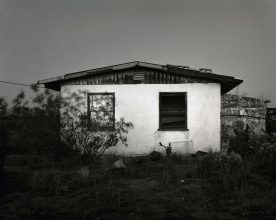
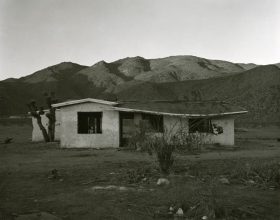
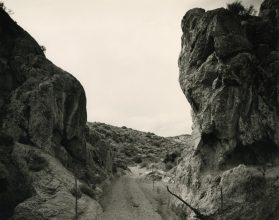
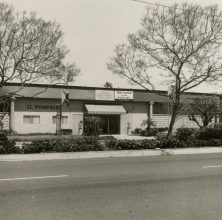
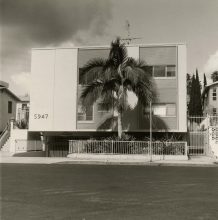
DP: Westward the Course of Empire, Desert Homes and Dusk suggest the end of the American idealism that saw the West colonised and the natural environment radically transformed. These series reveal, in an attractively melancholy way, the inevitability of decline in even the grandest of human endeavours. Was this your intention?
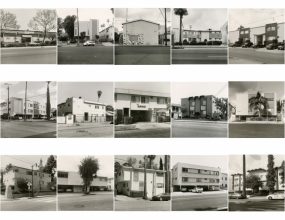
MR: I would say that that’s the stuff that I come to understand as the work develops. I don’t think I set out to suggest that. When I started photographing the houses, it was a really simple attraction to a kind of anonymous ruin. It was only as I thought about ‘why am I interested in this?’ that I started thinking, well they’re here, and Los Angeles is here, and about the West, and very much related it to the railroad pictures in terms of this residue of the idea of the frontier. But I still just start out kind of dumb. With the Westward…project I photographed some of the railroad cuts, thinking they were going to contribute to a completely different project I was doing at the beginning at the nineties, and it was only after seeing the pictures that I started to think about their potential as something a little more specific. The engine that drives the work is really a kind of curiosity being out there; the research aspect is parallel with production rather than proceeding it.
DP: So you’re really responding to your environment and being inspired by what you see, and then developing ideas and seeing connections as you go?
MR: Exactly. The Dusk pictures for example, the first Dusk picture was made in frustration that I fumbled the picture and the sun went away, I thought I’d missed it and I just pushed the shutter anyway. Then a month later I’m looking at this print and thinking, ‘oh, well, that’s kind of interesting’. But I didn’t sit in the studio and think ‘oh, sunset, I’ll go out there and do that’, you know.
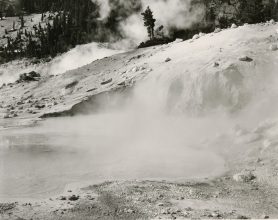
DP: In your series Pictures of Hell, your photographic approach is more like a conventional landscape survey, but unified by locations with devilish names. What was it you were trying to explore here?
MR: I think it’s that kind of dissonance between the name of the place and the look of the place. A lot of them are volcanically formed landscapes, so I can understand the thinking in the naming of the place. But, if we step back a minute, my reason for doing the nuclear landscapes [The Italian Navigator] was that I was really interested in the difference between what something looks like and what it might mean. That’s where the title became part of the work, writing the names on the mounts of the prints, that came from that idea, suggesting that there could be another way of thinking about these places.
There’s also a kind of conceptual project in there. In this case I did set out looking for these places, and the rules of the game were that I had to make the picture with whatever was there. Maybe there’s something a hundred feet away in the other direction that’s more interesting to me, but this is the Devil’s Hole so this is where I’ve got to make the picture. Some of the locations really taxed my picture making abilities [laughs] because there was nothing there. But the fact that there are so many named “Devil” or “Hell” – and I did not exhaust the subject – says an awful lot about the people that named them. And that leads back to the frontier and the so-called taming of the West, as most of those places had other indigenous names first. I think that in the name there’s an echo of European disappointment, you know: ‘this was supposed to be the Garden of Eden but it looks more like the Devil’s Hole’. And if you think about the European incursion onto the continent, the further you get from Europe going towards the West coast of the United States, the less the land looks like Europe. There are “Devil’s” places in the North-East, but not nearly as many as in the West, so it sort of suggests the collision between reality and promise.
DP: Westward the Course of Empire is due to be shown at the California Historical Society in March to September of this year, to commemorate the 150th anniversary of the Transcontinental Railroad. What sort of a comment do you think your series Westward…makes on this legacy?
MR: I’m hesitant to make a pronouncement about what my works mean, but I do think there’s something about this kind of relic that’s not that old, these monuments to a past ideal. It’s not as if the railroads failed, but ultimately they did of course, they’ve been replaced. And maybe a contemporary equivalent would be a huge pile of iMacs out in the desert, you know. I’m hoping that there’s no sentimentality in the work, because I’m not like this railroad buff. When I started that project, I only photographed the railroad cut – the other stuff came a little later as I got more involved in the history of that subject. And I thought of the cuts originally as a kind of earthwork, a kind of anonymous sculpture that says an awful lot about the relationship between machine and terrain: if the machine won’t go over the mountain you cut a hole in the mountain, basically. So I’m giving the Historical Society a lot of credit for showing this work rather than a glorious, celebratory collection of nineteenth-century pictures which, you know, they’ll probably have in their other rooms.
DP: What’s interesting about your work is that, while it may not be celebratory, it isn’t necessarily cynical either. It’s not simply an indictment of human endeavour.
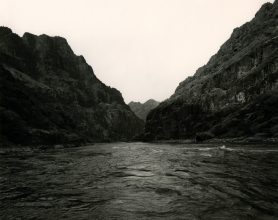
MR: No, of course not. Most of those things are much too simple. I think a lot of my work comes from the frustration I had in the eighties with so-called environmental art, it was just so black and white. One of the reasons I was interested in the nuclear landscapes was that they just seemed to be dripping with paradox. So, I did work on the Columbia River in the early nineties where the Hanford Nuclear Reservation is, and, I didn’t know this until I made the work, but one of the things that was really interesting was that in the pictures the river looks really natural. And it sort of is, but its because that part of the river was closed off from development because of the plutonium production, so it’s the only part of the Columbia River that’s not dammed. So it looks like the same river that Lewis and Clark floated down. But the reason it looks like that is because of this really horrifying technology. So that kind of paradox, and thinking about the complexity of how we both use the land and think about the land, I think is at the root of all these projects that have come since. It’s part of the engine that drives the work.
DP: Your work constantly explores this tension between the natural and the man-made.
MR: Yeah. People speak now of a kind-of third ecology, because things are so intertwined that it’s something new. I’ve recently been photographing the Los Angeles River and met somebody who was writing about this third ecology, and it’s really interesting because it’s no longer possible to sort this out, at least in some specific landscapes. I don’t know. I don’t want to make a big “Anthropocene-like” announcement [laughs].
__________
Notes:
Mark Ruwedel was interviewed by Daniel Pateman for Photomonitor, March 2019
The Deutsche Börse Photography Foundation Prize, including works by Mark Ruwedel, will show at The Photographers’ Gallery from the 8th March to the 2nd June 2019, with the winner announced at the awards ceremony on the 16th May.
Mark will also have an exhibition of new work showing at Large Glass gallery in London in Spring 2019.