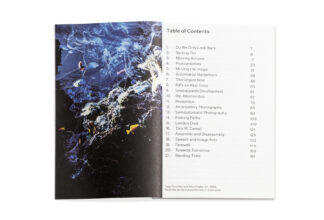
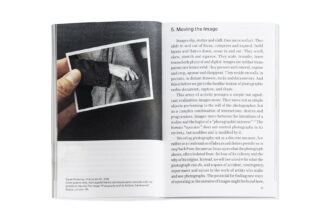
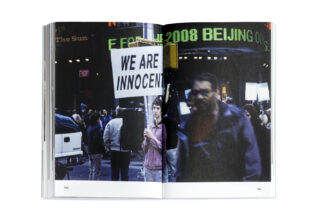
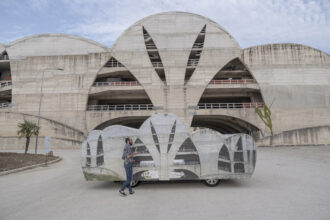
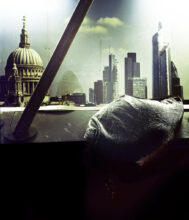
Duncan Wooldridge’s To Be Determined: Photography and the Future was commissioned and published by Self-Publish Be Happy Editions as part of SPBH Essays series which “aims to inject provocative new ideas into the contemporary cultural debate…. Writers, academic and artists offer their ideas on how to use and think about art and photography today”. Below, an interview by Sarah Dobai shines light on ideas developed by Wooldridge in his recent publication.
__________
Sarah Dobai: The book starts with a short essay challenging the orthodoxy that photography is primarily concerned with the ‘what has been’ and proposed the medium’s potential to point to “what could be”. The idea that the photograph might reveal to us something of the future as much as it informs us of the past, is refreshing and has all sorts of implications. Was this proposal an outcome of the commission from SPBH or did it come about through your practice as an artist and as a curator & teacher working with photography?
Duncan Wooldridge: I suppose there are two places that it comes from and one of them is from the conversation with Bruno Ceschel and Self Publish Be Happy. We were working on a different book, that I’ll go back to soon, a book about the photograph as an experiment. This had started with a question about what it would mean to think about the photograph ontologically as an experiment, in a way that encompasses thinking around both production and reception, that are often treated separately. When we were talking about the experiment book, I became aware that there were a cluster of essays and some other ideas that I wanted to write about that didn’t fit into the experiment book. This writing was all directed towards some kind of future tense or some kind of anticipatory quality of photography, which also connected to the hypothesis or proposition in the idea of the experiment. So, in one of our meetings about the experiment book, I said to Bruno, I think there’s another book and he said, we’re working on a series of publications of essays and maybe this idea of the anticipatory aspect of photography could be explored for that format.
And the second place that To Be Determined came from was my realisation that in many different pieces of writing, I have been talking about how, in an image, something is often about to take place or something is becoming animated or has a future consequence. This is in essays I wrote about Laura Letinsky for a commission from Daniel Blight at The Photographers’ Gallery, in essays about Edouard Taufenbach and Dafna Talmor for 1000 Words Magazine, and another I wrote for Foam about Thomas Hauser. So, I recognised that this subject reoccurred in a variety of places and that I was constantly pushing up against it. I realised this is a quality that’s happening in the work so part of the idea of the book was to put those ideas together.
SD: Would you characterise the motivation in writing the essays which feature in To Be Determined as partly a reaction against the propensity towards the aesthetics of melancholy that one could say dominates in some photographic debates and practices – emphasising the deathly aspect of the medium that stems from some key foundational texts?
DW: Absolutely yes. I think I’ve long been a bit frustrated with the way that a lot of photographic criticism seems to revolve around death, and I’ve alluded to this in a few places. I think that melancholy seems to me mainly to reflect the obsessions of image viewers not image makers. There’s a massive disconnect there and I think what this recognition revealed to me was that the history of recent photographic criticism is a history of looking at images, not a history of thinking about how images are made.
SD: Oh, that’s interesting. Yes, when I was thinking about this, I was thinking about students and maybe myself when I was starting out and how those texts did really have an influence but then as you carry on working with the medium, that influence fades.
DW: I think so. I mean, those are powerful arguments and I think an image does a lot of those things. But the idea that that’s the totality of what the image does, I think is incredibly myopic and risky ultimately. Because this is where the idea of photographs as documentation of truth takes hold, and there’s an idea that all a photograph can do is to see, and to temporarily fix something in the past. We don’t talk about what impact an image might have, or the way that an image conditions the way we will go on to see in the future. What’s interesting about that is I think that artists who work with photography often explore and test what the what the camera can do and how photography functions, and any conversation with them would make us aware that they are making something for an encounter that hasn’t taken place yet. So, the artist photographer thinks about the image in an entirely different register to the way that this criticism tends to describe the photograph. We want images to have an impact on the world, and yet somehow, we failed to see that they do. We somehow think the medium should generate revolutions, rather than subtly transform our behaviours.
SD: Yes, when I was thinking about photography’s relationship to time, I realised some of the artists working with photography who’ve been important to me like Claude Cahun, Hans Bellmer, Jeff Wall or Gillian Wearing can neither be characterised in relation to a past nor a future time. Their works seem to elude historical time and to exist within an adjacent non-linear temporality.
DW: I think in some ways what we’re talking about is a very expanded definition of temporality and a recognition of a temporality beyond the clock time, for example, beyond the time of the individual. There is a coming into contact with a variety of times: planetary, non-human, non-linear. Take for example the revelation that time moves at different speeds at different altitudes, which takes time away from the body; but add to this the intensely singular perceptual experience of time which expands and compresses, which phenomenology reveals as a triad of protention, impression and retention – anticipation, direct encounter and memory, all functioning at once, all of the time. Many of those models show a cyclical force of time; others, especially those influenced by physics, retain some linearity, but combine a far more complex mix of forces and constituents. So, time is up for discussion. And that’s part of the reason why the book is titled as it is, with this open-endedness.
SD: When looking at early twentieth century photographic practices, we can see how it anticipated and contributed to the future directions of art, science, design and architecture. In the current context of photographic image overload and the levelling of specialists’ uses of the medium with the general public’s, it is perhaps harder to imagine the potential for the medium to be transformational going forward. Can you say something about this?
DW: It’s an interesting question because I think, as David Campany said recently (in relation to an exhibition he curated at ICP) that you can trace back complaints about being inundated to at least 100 years ago. So, it’s an interesting problem, the condition of the present as it relates to the future and past. I think I’d be tempted to separate it into a couple of different parts. One is about the current role that technology plays and where it positions us, which I think is important because the level of automation, especially in smart devices, is so great that we are oblivious as to how they are operating and why (and we are discouraged from thinking about the why of their functioning very strongly – technology is just progress, isn’t it?). As a result our ability to intervene in them is undone. I think this has a direct bearing on our sense of agency.
Second, something the book does is to talk about recent critical theory where there has been a study of the present or 24/7 culture, where the future is set in relation to the ‘now’. I think of it as ‘the now’ because it has got this sense of urgency inscribed into it, an interpellation that we might recognise from Althusser. ‘Bifo’ Berardi, for example, points out that in everyday society when there are discussions about the future, we’re simply asked “Do you want to be part of it?” We are not asked “what is your vision of the future”? The question does not really involve us, and agency is missing. Bifo also reveals that the future facing visions we are presented with are often apocalyptic. He writes about ‘The Hunger Games’ as a deterrent of sorts: if this is what it is going to look like, why do we want to think about the future? We are coercively detached from it.
It seems to me that the role of technology and this perception of what the future might hold, are disempowering, and yet I don’t think this changes what photography is actually capable of doing. We see in the work of contemporary artists and photographers a whole host of potentialities.
SD: Do you have certain work in mind when you’re thinking about this subject?
DW: There’s one work that I don’t talk about in the book (which I encountered only as the book was being edited), which I’ve talked about in another essay for the journal Over. Sethembile Msezane is a South African photographer who made work in Cape Town at the time of the “Rhodes Must Fall” campaign. She was looking at pre-colonial history in South Africa and the history of colonial monuments, to talk about what might come after, who and what we might value in their place. She works performatively: she would dress in pre-colonial matriarchal clothing, and construct a pedestal to stand on and perform near colonial monuments. She would make a photographic work, document or record at that time. Now, in some ways we could think about the photograph as just a record of the performance, but they really aren’t that alone, and one of the reasons why is because of how she photographs her relationship to these monuments, as the perspectival vision of the camera becomes part of that. In one work she is seen standing in the foreground with a statue of Louis Botha on horseback in the background. Botha historically is positioned as a Boer War hero, and as the first leader of the Union of South Africa, but he is also widely understood to have conceded readily to British dominion, and was therefore a foundational part of the culture facilitating colonialism and subsequently Apartheid. Perspectivally, Msezane in the foreground suddenly becomes larger than the monument, and there’s this reversal that the camera makes possible that is incredibly potent. I think it’s created an incredibly powerful conversation, especially in relation to right now.
SD: Vilém Flusser features quite largely in these essays. His theoretical writing is very helpful in allowing us to look at and think about the conditions under which photographs are made and how they circulate in the world. Can you say something how Flusser’s writing played into your thinking around this book ?
DW: Flusser is in and around all of this. I think I find myself recalling, recounting, replaying and modifying his thinking in most of the things that I write, so much so that I feel self-conscious about it! Flusser goes back to looking at all of the components that make an image and is prepared to ask questions about each of them. And I think that means that photography becomes momentarily but radically defamiliarized for us. That’s incredibly helpful because we are so familiar with photographs, we see so many of them, that it’s a medium of convention. This goes back to Moholy-Nagy and his essay ‘Production and Reproduction’. Most images are reproductive, they reproduce versions of the world already and they encourage the production of more images of the same. A photograph can also be productive, by bringing into view a way of seeing that directs itself towards something that is not yet commonplace or widely recognised. By taking the photograph apart, Flusser allows us to see a variety of forces and one of the things that happens in Towards the Philosophy of Photography and especially in Into The Universe of Technical Images, is that the question becomes less ‘what is the camera’ or ‘what is the image’ and becomes more ‘what are we doing with photography, what are we asking it to do and how is it shaping us?’
In Into The Universe… he starts to say that the image envisions, it becomes a model. And he’s thinking about what this image is going to be, not because it shows how the world has been, but because it is going to be received, encountered, distributed and in turn reproduced. It’s a more complicated book than the first, but I think there were lots of ideas there that I realized were already surfacing for me and they confirmed this kind of sense that I was getting from looking at a variety of different artists’ works that they concerned was something that is about to happen as well as something that has been seen. And it made me aware that images are as much about the impact that they have on us and the way that they affect how we go on to see, as they are ways of accessing a time that has been.
SD: When I first encountered Flusser’s writing it was through getting to know the work of Christopher Williams whose shows at Whitechapel Gallery and David Zwirner (2016) made a big impression on me. Reading his influence through his work and other artists in the Pictures Generation group, his work attended to photography’s status as an industrial medium whose parameters are informed by the capitalist system whose interests it often serves. In your writing there seems to be a tension between this acknowledgement of this industrial character of the medium working within the design of cameras and of photographic post-production software and the notion of photography as a potentially transformational and avant-garde medium. Was this tension something that you were thinking about when writing the essays?
DW: Maybe we can talk a bit about photographic pre-capture, which there is a short essay about in the book, as I think it sums some of this up. Pre-capture is a mode that some digital cameras had and many still have in some form – my iPhone has it if I tap on the image a couple of times. What pre-capture promises is to catch the moment that you missed. The person has already jumped the puddle and has already landed by the time you press the shutter. But pre-capture has caught the image of the figure over puddle for you – so you can scroll back through your images and find the moment before you pressed the shutter. What’s actually happening is that the programme of the camera is now set with a different set of parameters, so it is recording before you believe it is doing so. There is a distinction between what you believe the camera is doing and what it is actually doing.
This is an instance that the philosopher Yuk Hui would say is a moment when the smart device looks forwards because it is anticipating your behaviour, anticipating what you want. It has been programmed to do this. Now there are lots of ways in which it’s not actually seeing the future, but it’s programmed to anticipate in basic terms, and its appearance as an intelligent or smart device rests upon anticipatory behaviour. If you have a smart toaster that makes your toast at nine o’clock in the morning when you’re just getting out of the shower, or if your coffee maker realizes that if you open the fridge that’s the moment to start your coffee – those devices are using different cues and they’re constructing a process to anticipate what you want. There are fixed parameters they can operate within, but we rarely think of those limits.
The big question that suddenly arises is: do we understand how, in a process such as pre-capture, we allow our devices to decide for us? And do we understand such decisions in their full complexity? The new Google phone adverts introduces a Magic Eraser to remove unwanted figures from your images. This is not exactly a new process, as it combines a sequence of postproduction actions into one automated effect. The consequence of this tool however is multiple: our understanding of the tracing, masking, and algorithmic doubling of sections of the image, which is to say, the computational process made thinkable or comprehensible to the human operator; the disappearance of accident from the encounter with the image, which Lee Friedlander described as photography’s excess and generosity; and most significantly, the erasure of strangers from images, and the depopulation in our visual memory of a world in which others live. Technologies like pre-capture or Magic Eraser appear like a great convenience, but we’re either oblivious to how it’s functioning or we understand that essentially there’s now a giant disconnect between what the camera is telling me its doing and what it is actually doing, and we’re very resistant to thinking their consequences, even though we know many of them. This creates a really interesting kind of friction, as it extrapolates out to our relationship to technology at large.
SD: As you touched on earlier, a significant part of the book concerns our understanding of ‘the now’. In particular you cite books by Franco ‘Bifo’ Berardi After the Future and Futurability and Shoshana Zuboff ‘s The Age of Surveillance Capitalism in which the contemporary individuals experience of everyday time and the possibility for agency within this, become overwhelmed. Through these texts we understand today’s subject as inundated by demands to produce, consume, present, and engage. The image of the future that figures in these works often looks highly dystopic – where under the regime of ever-increasing automation and technological applications corporate power seems unstoppable. Is there a coalescence or resonance between the mourning for lost futures and the melancholy for the past in photographic practices and conversations?
DW: Sure, I think it’s important that we recognize where the obstructions, obstacles and problematics function, because it’s about the friction between the constraints and the limitation of the possible. The dystopian look of some recent photographic work and the melancholy of a photography forever obsessed by what is lost are very close to each other. For me, this is where a writer like Tina Campt comes in. Her Listening to Images gave me the confidence to talk about something like the photograph and the future, to go beyond noticing its occurrence, and to give it gravity, but also a productive force. In Listening to Images and Image Matters she studies the Birmingham City archives and photographs of recently arrived immigrants in the UK. She spends time with these images and she asks what are the constraining forces upon us, what are the fixing forces? One of the things that photography does is to fix things, it’s a type of power, it plays out through saying this is what you look like, this is who you are. She recognizes that there’s a force that acts through political power and there’s a force that acts upon us photographically as well. But by giving those images a lot of time and a close reading, she also starts to find that something productive is taking place. In a series of images of families shot in photo studios in their best dress, there’s a quality where they are formalizing themselves, presenting themselves as an image. But there is subtle difference in this and the passport photograph, as there is a becoming which takes place through their decision to show themselves, to present themselves towards a version that they aspire to be. It’s not simple, there’s a variety of social forces happening, but at the same time there is a projection, and an aspiration, an agency that takes place which is historically denied and negated, which always figures in the photographs we choose to make. A properly complex reading has to combine the recognition of the social forces that take place and also an individual’s performing of their own identity; from that, she starts to realize that these images are constructing a type of future, they are made for a moment that is yet to come there, and for a moment that must take place. Campt’s context for writing is in relation to race and the representation of black bodies, however I think what she writes has something important whenever we are subject to power. I think it’s about a type of empowerment and agency that images can have, if we can recognise it.
SD: What I’m struck by is the very positive quality of this vision and that fact that it feels like it’s talking to people making work. But when you think about that kind of dystopic future landscape that we’ve been talking about, I wonder how photography can be used to manifest resistance or critique?
DW: I think the direction of the book recognizes the forces and complexities and the problematics of photographic representation and the fact that it’s inscribed into power. But at the same time, I think it’s also then about seeing the different ways in which artists, by asking questions about what photography can do, what its possibilities and horizons might be, open a constructive, productive space. Critique as I understand it, is not by itself a statement of what is wrong, or at least it is not if it is to be effective. (Sara Ahmed has recently written about how complaint begins to reveal structures within our institutions). Critique and resistance are space-making, and what is at stake is the belief that there is something beyond the world as it currently is. This finds its parallel for me in the idea that images construct the world as much as they show it, which is to say that they cleave open spaces. This is something I think that artists are quick to recognize. This is something possible in any photograph that might be made. It becomes a question that I think has a lot of power, if we see it as potential rather than obligation.
SD: I know you mentioned that people always talk to you about the size of the book (10.5 X 14.8cm). It seems designed to be something that you can carry around and read on the bus and which I certainly did with my copy! Did you see TBD as a kind of provocation, speaking to a general current generation of artists, photographers?
DW: A colleague of mine has described the book to me as TFL (Transport for London) friendly, with the idea that you could carry it wherever you were going, whether that journey is long or short, and I like that very much. The format is a decision that Bruno Ceschel from SPBH and Brian Paul Lamotte, the series designer, chose, but it is really in keeping with the way that the texts were written. Each is somewhere between 600 and 2500 words, as short essays which are threaded together, which can be read out of sequence as little studies or vignettes, or as an accumulating proposition to rethink the photographic. It is about slowly opening up a space that I think we were not paying attention to. Because it places the knowledge and gestures of image makers as equal to those of image receivers, it probably does come across as a provocation.
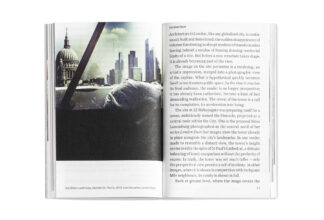
SD: In these essays you focus on a number of artists photographers who have found purposeful ways to use the medium in ways that point toward forward thinking modes of production and viewing. Sarah Pickering’s ‘Pickpocket’ commission in which she reversed the actions of the petty thief to covertly place images in spectators’ pockets. David Horvitz’s ‘Mood Disorder’, in which he released online a photograph of himself, head in hands against a background of crashing waves and then tracked the multiple and various online contexts in which it was used. Also, Rut Blees Luxemburg’s ‘London Dust’ series which rephotographs building site hoardings with photographic renders of future real estate developments. All these artists attend to the status of the photographic medium itself. The works share an interest in the conditions of the production, dissemination, and consumption of photography. When you were writing these essays did an idea of the of possible new directions for practitioners, critics and curators emerge?
DW: The latter part of the book is really dedicated to looking at how artists stretch and bend our relationship to time. In that regard, I think some new directions are always already taking place. I’m influenced by Paolo Virno when he says that artists rupture our relationship to forms of measure, and directions begin to emerge by giving attention to art around us.
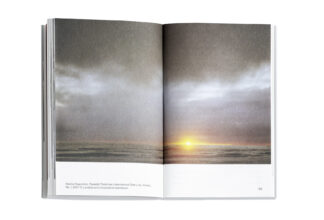
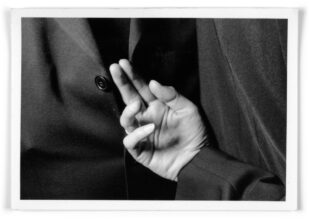
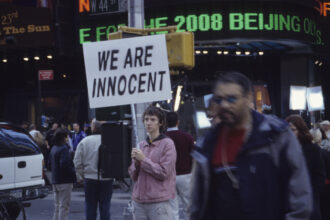
Some works, I think, do propose new possibilities. I looked for example at some of the photographic works of Marine Hugonnier who goes to the International Dateline to photograph tomorrow from the West to the East, in a neat unpicking of the rules of time, set against raw nature – in front of us here is already a necessary multiplicity of time that I think we could explore further. Sharon Hayes shows the repetition of gestures affecting our perception of time, and this has a lot to tell us about politics, pressure and insistence. Nico Krebs and Taiyo Onorato propose that an object’s own agency might speak to a time beyond our own anthropocentric sense, and this too seems like it speaks a future direction of thinking beyond the human.
SD: When chatting about doing this interview, you mentioned reading Tom McCarthy’s new book The Making of Incarnation and his reference to Lillian Gilbreth’s work on time and motion studies as having a bearing on some of the subjects you touch on in To Be Determined. Could you expand on this a bit?
DW: One of the things that McCarthy describes in his novel is how Lillian Gilbreth’s method is somehow observational and propositional, and the novel centres on a tension that seems to suggest what might have been discovered in Gilbreth’s work and dialogue with a scientist, as observations begin to take on a speculative force. Gilbreth recorded workers carrying out assembly line tasks through photography, especially a form of light-drawing, mapping repeated working gestures to analyse and improve efficiency in the factory. There’s a tracing of what happens in the world, but from these records, Gilbreth constructed three-dimensional models which were to choreograph and shape a series of behaviours that become learned, almost intuitive, almost automatic, streamlined, more efficient, subtly modified. There’s a reprogramming that’s happening there, and McCarthy sets this practice of Gilbreth in and amongst contemporary technology: motion sensor tracking, the digital construction of worlds. There seems a strong correspondence to what my book has been aiming to do in showing technological method and the construction of a subtly altered relationship to the world. I read The Making of Incarnation after a colleague had read both my book and his, and it certainly had echoes, in the sense that if we begin to observe something and begin to look at it clearly enough, we recognize that there is not only a recording taking place, but an intervention or a modification at work, some kind of transformation, some proposition, a movement from the past into a kind of future.
A parallel with this, which we didn’t include in the book, was Spike Jonze’s and Charlie Kaufman’s film ‘Adaptation’ which is about a writer who is recounting something that happened in the past, where the moments of the past get closer and closer to the filmic present, until they overtake the present and start to move into a kind of future tense. There’s something about McCarthy’s novel that is prompting a thought about that realisation, that we have to project ourselves into. And I think that’s part of what my book is aiming at in some ways, and part of the reason why it’s called To Be Determined. I think it’s ultimately about us taking our place, projecting into that space, because that’s the question for image making. Does an image continue and perpetuate a way of seeing the world, or does it construct something different?
SD: That’s interesting what you are saying about the film? Why did you take that section on this film out?
DW: The need for a brutal edit, and the temptation to keep on going, writing ever more to keep up the realisations that were emerging. I realised as the book was in progress, that it was the beginning of something. The risk in talking about ‘Adaptation’ was if that if you hadn’t seen the film or quickly understood its dreamlike movement from past into future, it might not help, and might hinder your realisation that the book attempts a similar transition. I hope To Be Determined helps people to think about and recognize all of the assumptions we make about the photograph. I hope it starts to plant seeds about what an image might be. And that’s plenty for now.
__________
To Be Determined: Photography and the Future by Duncan Wooldridge was published by SPBH Editions in 2021.
Sarah Dobai interviewed Duncan Wooldridge for Photomonitor in Spring 2022.