
__________
When it comes to photography, Aaron Schuman wears many hats. He regularly writes for magazines such as Aperture, Foam, Frieze and the British Journal of Photography and has worked on major curatorial projects, including the 2018 edition of JaipurPhoto. Schuman is also a successful artist in his own right, with his latest project SLANT recently published by MACK. Here, he discusses the genesis of SLANT, its dark undertones and its relevance to the poetry of Emily Dickinson.
__________
Ng Hui Hsien: I’m intrigued by the deadpan humour in SLANT. Could you tell us more about that and how the project began?
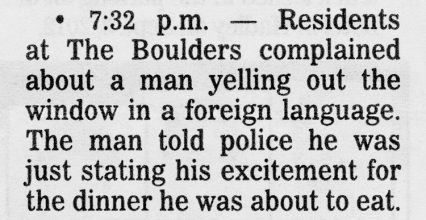
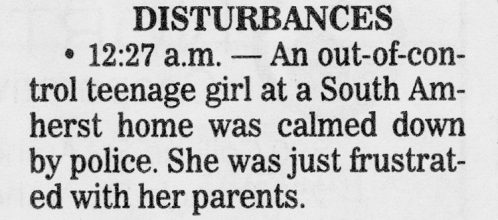
Aaron Schuman: This project began when I discovered some short texts in a small-town newspaper that genuinely made me laugh out loud. Published in a section entitled “Police Reports”, they catalogued the various reasons why the local police had been called during the course of a particular week, and I found some of them hilarious – not only because of their often strange or surreal content, but also because of the matter-of-fact tone in which they were reported. They reminded me of one-liners told by a great straight-man – someone like the stand-up comedian Steven Wright. One of the first reports I found reads: “CITIZEN ASSISTANCE • 4:14 a.m. – A man shovelling snow on State Street told police he saw a strange orange glow coming from the eastern sky that might have been something on fire. Police determined the glow was probably the sun coming up for the day.” Of course, the story itself is funny, but the journalistic tone in which it’s delivered makes it even better.
That was 2014, and I was visiting my parents. The newspaper was the Amherst Bulletin, which is published weekly and distributed throughout the New England town of Amherst, Massachusetts, where they currently live. I started reading some of the better police reports out loud to my dad, and he cracked up as well; we spent about an hour laughing hysterically in the living room. A few days later, when I was leaving to return to England, where I’ve been living for the last fifteen years, I asked him if he would cut out the “Police Reports” section from the paper each week, and send them to me from time to time.
For some reason, I had this inkling that there was a potential project here – something distinctly photographic. Maybe it was the “straight” tone of the reports, which is something I’ve always been drawn to in photography, particularly in American documentary photographic traditions. Take the “straight photography” of Paul Strand, Walker Evans, Robert Adams, Lee Friedlander, and so on. The information in their photographs is presented in a seemingly direct manner, but also consciously leaves plenty of room for further meaning and interpretation on the part of the viewer, as well as a space for subtlety and wryness on the part of the photographer. Think Friedlander’s dry-witted self-portraits or Adams’s blank-stare approach to the development of Rocky Mountain suburbia.
For the next two years, a package from my dad would arrive at my house every few months stuffed full with these police reports, and I’d spend days combing through them trying to find the best ones.
NHH: There is an unsettling undertone in SLANT as well, which is in part generated by the way you respond photographically to the police reports and how you combine the two elements. How did you arrive at this method of working with the texts and images?
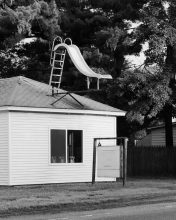
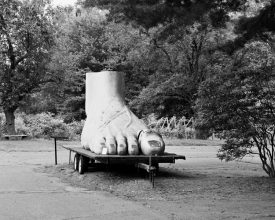
AS: It took me a while to figure out how I might approach the reports photographically, and I really struggled with this – the texts were often so strange and compelling that I didn’t know how to match them visually. Finally, I decided to go back to Amherst with my camera and see what happened. I intentionally left the reports in England, so that I wouldn’t end up simply trying to illustrate each individual one, but they were at the back of my mind throughout this initial trip. So in the summer of 2016, I drove around Amherst and the surrounding area looking for things that caught my eye while in this mind-set – little scenes of normality that on further reflection, seemed unexpectedly strange, quietly off-kilter, or subtly out of the ordinary. When I returned to England, I printed out my favourites, and started trying to pair them with various reports I’d highlighted within the collection, and I discovered these really interesting, indirect relationships between the photographs and the texts, whereby they created new meanings within each other.
During my trip, I visited the Emily Dickinson Museum – which is also in Amherst, as it’s where Dickinson was born, lived reclusively, and wrote her poetry throughout her life. The tour guide that day spent quite a bit of time elaborating on Dickinson’s fondness for the literary device “slant rhyme”, whereby the words at the end of two lines of poetry are seemingly similar, and feel like they should rhyme, but they don’t. For example:
“The heart asks pleasure first,
And then, excuse from pain;
And then, those little anodynes
That deaden suffering;
And then, to go to sleep;
And then, if it should be
The will of its Inquisitor
The liberty to die.”
When reading this poem, the mind wants to synch up the words “pain” and “suffering” – as well as “be” and “die” – so that they rhyme and feel resolved, but they don’t; it creates this amazing sense of dissonance and uneasiness in the reader, like a minor chord or note intentionally played slightly out of tune in a piece of music, and the relationship between the two words, although “slanted”, becomes even more fascinating. As I was trying to pair up the photographs I’d made with the police reports I’d collected, I realized that the relationships between them could also be made and considered from a “slant” perspective – they spoke to one another but didn’t quite match up – and that this disharmony could push both the texts and the images beyond the light-hearted humour of their surface, and hint at or infuse them with something more curious and unsettling at their core.
NHH: SLANT is now published by MACK too. Could you share some thoughts that went through your mind as you put this book together?
AS: When I first emailed the work to Michael Mack, it took the form of a PDF that was entirely made up of image-text pairings, as I wanted to make sure the relationship and relevance of both the photographs and the police reports was absolutely clear. Several weeks later, he invited me into his office for a meeting, and his first question was, “So how tied are you to this diptych format?” Immediately, I was like, “Not at all – I really want to break up that back-and-forth rhythm, and shuffle them all around a bit”. He nodded his head, paused for a moment, and simply said, “Good.”
We then had a long conversation about various strategies that might work in terms of adding complexity and more layers to the work. He suggested that the police reports be printed on a different paper stock so as to differentiate them from the photographs and insinuate their newspaper origins. This also introduced some very helpful rules and limitations, in terms of the practicalities of page numbers, sequencing, layout and binding. To my surprise, he agreed in principle to publish the book the following spring, as long as I could come back to him with another more dynamic draft of the book in a few months’ time.
Previously, in my research for the project, I came across the book Time In New England, which was the result of a collaboration between the photographer Paul Strand and the curator and writer Nancy Newhall in the late 1940s. It interspersed short sequences of Strand’s photographs with short sequences of historical and literary texts compiled by Newhall, and was divided into loose chapters – “Wilderness”, “Savages”, ‘Witchcraft”, “Revolution”, “Protest”, “Abolition”, “Affirmation” and so on – which collectively invoked the history and “spirit” of New England as defined by them at that time. When approaching this new design for the book, I thought I’d take inspiration from them, and see if I could loosely group my photographs and police reports into various themes. All of a sudden, certain remarkably pertinent themes began to surface. When looking at all my materials – which had been gathered from 2014 to 2018 – I started to realise the subtle impact of certain socio-political changes that had occurred in America during that timeframe, even in what is regarded as a safe, progressive, left-leaning, academically-minded and quiet, small New England town. Sifting through the work thematically, I discovered material that hinted at rising levels of paranoia, xenophobia, misogyny, religious fervour, superstition, bullying, intimidation, sex misconstrued as violence and vice-versa, and more. It’s hard not to associate many of these themes with the rise of Trump and the shifts in American culture that have happened since he came onto the scene, so I used these themes as a starting point for grouping together texts and images, creating sequences and mini-chapters in my mind, and building an overall structure for the book itself. In doing so, I also realized how one photograph could take on multiple meanings when presented alongside a collection of different police reports, or how one police report could resonate on multiple levels when considered in relation to different photographs. The potential of each element – whether text or image – expanded tenfold when grouped and sequenced in this looser, chapter-like manner.
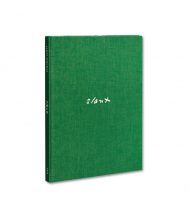
Finally, I wanted the design of the book cover to allude to Emily Dickinson, and MACK agreed, so the colour scheme draws some of its inspiration from the first edition of her collected works, and the font used for the title draws inspiration from her handwriting. I felt it was important to visually acknowledge her influence on the project, both in terms of her poetry and poetic strategies, as well as her lasting presence in the town of Amherst – and ultimately, the literary and cultural heritage of America – itself.
NHH: Speaking of how you put together the book and the realities of America, I am reminded of film-maker John Grierson, who notably defined documentary as “the creative treatment of actuality.” How do you relate to that?
AS: In 1932, six years after first coining the term “documentary”, Grierson also wrote, “Documentary is a clumsy description, but let it stand.” If “documentary” involves treating, engaging with and interpreting actuality/reality creatively, and via creativity, then I’m all for it – I’m happy to fly the “documentary” flag. But as we know, this term has often been misunderstood as something that pertains to notions of “objectivity” and “truth”, which have proven problematic throughout this genre’s history. Again, I’ll defer to Emily Dickinson. The following poem appears at the beginning of SLANT, and explains better than I ever could the project’s approach, relationship and intentions in regard to “documentary” and “truth”-telling:
“Tell all the truth
but tell it slant —
Success in Circuit
lies
Too bright for our
infirm Delight
The Truth’s superb
surprise
As Lightning to
the Children eased
With explanation kind
The Truth must
dazzle gradually
Or every man
be blind —”
Like many photographers associated with the word “documentary”, my work’s relationship to “truth” is a slanted and circuitous one, which aims to “dazzle gradually” but does not claim blinding authority or certainty. Within contemporary photographic circles, there’s a lot of talk these days about “speculative documentary”, “expanded documentary”, “crooked documentary”, and so on – a curious development given the recent inception and encroachment of terms such as “alternative facts”, “fake news” and “post truth” in popular culture and political debate. But I think that when it comes to photography, since the term was coined in 1926, “documentary” has always been a genre that has been clumsily defined, and unapologetically speculative, expansive, “crooked” and creative. In a sense, that’s what makes it so captivating, personal and powerful. To quote Walker Evans, “Documentary? That’s a very sophisticated and misleading word. And not really clear. You have to have a sophisticated ear to receive that word. The term should be documentary style… I’m sometimes called a ‘documentary photographer’ but that supposes quite a subtle knowledge of the distinction I’ve just made, which is rather new. A man operating under that definition could take a certain sly pleasure in this disguise.”
So yes, I’ll call myself a “documentary” photographer, as long as it’s understood that, really, I’m just telling the story of reality as I see it, and wearing a sly and pleasurable disguise while doing so.
NHH: And who is the one person that you would really like to see SLANT?
AS: If I think about it in purely photographic terms, it would have to be one of my many heroes – Lee Friedlander, Robert Adams… Probably – and very predictably – Walker Evans, if I had to pick only one; I know he had an affinity for newspaper clippings as well, so I think he’d get it. More generally, Emily Dickinson – I’d love to see what she’d make of it all, given that it’s about her hometown and the area that surrounds it. On a more personal level, my dad – in retrospect, I can see how much it draws from his sense of humour and general perspective of the world, as well as mine… And from the start, he was laughing alongside me; I couldn’t have done it without him.
__________
For further reading:
SLANT by Aaron Schuman was published by and is available from MACK.