

— An interview with curator Ashley Lumb —
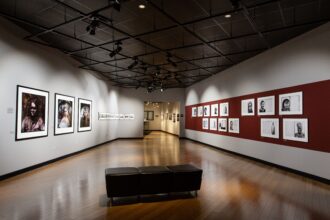
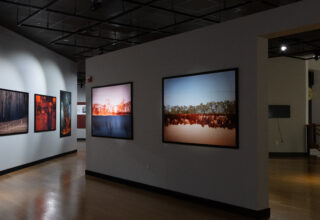
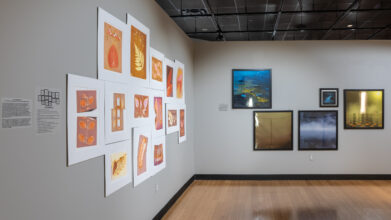
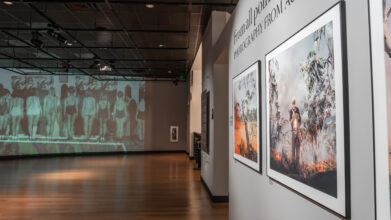
Thirteen artists in From all Points of the Southern Sky: Photography from Australia and Oceania explore the Australian continent – its dark colonial history, indigenous cultures and violent repressions – as well as turning their gaze on the neighbouring countries of Oceania. Jane Brown, Peta Clancy, Leah King Smith, and Kurt Sorensen drag Australia’s contentious past into the light of the present, visualizing the ghostly legacy of colonialism – its haunted landscapes and criminal beginnings – while Anne Zahalka, Stephen Dupont, Katrin Koenning, and Sonia Payes bear witness to the devastating impact of human-induced climate change. Below, Christiane Monarchi asked the show’s curator, Ashley Lumb, about the themes resonating in this show of photographic and moving image works, currently exhibited at the Southeast Museum of Photography, in Daytona Beach, Florida.
__________
CM: I am very interested in this exhibition you’ve curated in Florida, an exhibition I’m only engaging with remotely through the internet and computer screen, but one which has led me to many stopping off points into further exploration of artists, themes and recent history. Maybe this is a benefit of seeing an exhibition online in this current lockdown world, but it also spurs me on to consider how we can share the thoughts and experiences in this exhibition virtually. Hopefully this is a start. So, the first question I have would be why you have wanted to focus on artists engaging with Australia and countries of Oceania now?
AL: Well, there wasn’t initially an overarching rationale to the show. I’d spent a few years living in Australia, in Sydney first and then Melbourne, and had devoured as many exhibitions as I possibly could. I did a huge amount of research, became familiar with a wide range of visual artists, and produced a number of exhibitions: Planetary Gardening in Canberra, for example, which, like the current show in Florida, also explored humanity’s influence on the environment.
So by the time I returned to the states in 2018, I not only had a sturdy knowledge of the Australian photography scene, but a deep admiration for the work being produced, which often struggles to find an audience elsewhere. I must say that the three main non-profit photography institutions in Australia: the Australian Center for Photography in Sydney, the Center for Contemporary Photography in Melbourne, and PhotoAccess in Canberra were invaluable in introducing me to so many fascinating Australian artists. They do an amazing job at cultivating a wider appreciation for the art of photography, and I have such respect for them.
It’s important to me to connect urgent and exciting artists to a wider audience. Artists in Australia just don’t get many opportunities to take part in exhibitions internationally, largely due to prohibitive shipping fees, so I was eager to include artists whose work had never been shown in America before. I also wanted to include a diverse range of voices and not limit myself to Australia: Angela Tiatia is from New Zealand, Torika Bolatagici is from Fiji, and Sonia Payes and Kate Robertson’s work engages with the landscapes and culture of neighboring Papua New Guinea.
Of course, as I began selecting artists for From all Points of the Southern Sky I was drawn to work touching on thoroughly contemporary anxieties, such as the ongoing impact of colonialism and climate change. And I felt that exhibiting their work in America lent it a certain magnifying power, helping to draw a productive parallel to the United States and its own unresolved colonial history.
CM: You have addressed two distinct and interwoven strands of curatorial ideas in this exhibition, exploring colonial timelines and also environmental concerns. These are both areas which are very much constant, emerging, changing – a thoughtful foil to the use of photography which might take the present and turn it into the past, into history. Could you tell us more about the scale of time we can appreciate in this exhibition, how do works take us back into history or confront a possible future?
AL: From a practical point of view, I didn’t think local visitors to the exhibition would be as familiar with Australia as other parts of the country might, having lived in Florida myself, so I felt a didactic approach speaking to Australia’s past, present and future would be the most informative.
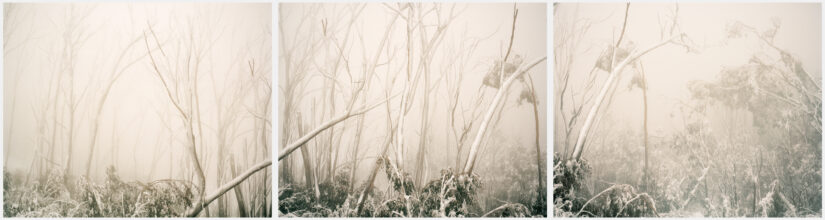
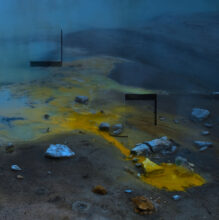
There are certainly various overlapping timescales and contexts here, and different ways of understanding the work. What’s interesting about Sonia Payes images, although being taken in Papua New Guinea only very recently, is that because her style is semi-abstract, they evoke both Earth’s primordial beginnings, and a potential future dystopia that climate change could return us to if it’s progress goes unchecked. There’s ambiguous movement there between prehistory and apocalyptic future.
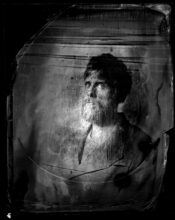
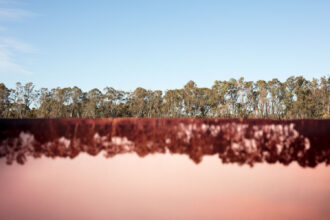
You could argue that works by Zahalka and Robertson refer back as much as 60,000 years ago, with the establishment of indigenous culture in Australia. Zahalka’s triptych of fiery images suggests that the harmonious balance Indigenous Australians achieved with the land, evidence of which you can see on the scarred tree in The Mallee, has been utterly upended by human exploitation and overpopulation in the last few hundred years. And this more recent history, the arrival of British and Irish convicts on the First Fleet in 1788 and the colonisation of Australia – which we see brought to life in Kurt Sorensen’s wet collodion prints – is very much interconnected with our current environmental crisis.
But, as well as having an apocalyptic strand of works that indicate what sort of a future we might inhabit if we don’t mend our ways, I think it’s equally hopeful. Bringing these issues to light is half the battle.
CM: Perhaps along with the question of ‘why now’ would be a question of ‘why here’ ? Seeing this exhibition in Florida is surely a welcome experience and also a challenge of audience engagement and education. So many current sociopolitical and ecological events in surrounding Florida must be presenting resonances to the themes in this show, is this something that interested you in curating this show in Florida?
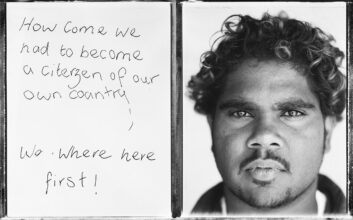
AL: I say this partly in jest, but my family in Florida are climate change deniers, so I wanted to curate an exhibition about climate change and have them see it! Florida faces some of the greatest risks from global warming, particularly from flooding in the south, with sea levels predicted to rise over 30 inches in the next forty years (it’s currently only 6 feet above sea level!). But the parallels are more national than local, and I felt that, as well as providing an entry point into Australian photographic culture and history, the exhibition would provide an enlightening parallel with the United States: it’s founding and Westward expansion, the genocide of Native Americans, increasing incidence of wildfires and hurricanes, institutionalized racism and the Black Lives Matter movement. Of colonialism, indigenous artists Leah King Smith, Angela Tiatia, Peta Clancy, and Torika Bolatigici speak powerfully to its traumatic legacy on the lives of Australian and Fijian natives, who occupied the land thousands of years before the Europeans.
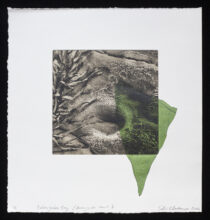
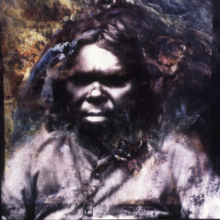
However, my initial impetus was only to produce a show ‘about’ Australia in some way. It all started with Leah King Smith and her seminal body of work, Patterns of Connection, which I found looking through the Southeast Museum of Photography’s permanent collection. I was already aware that Peta Clancy and Tobias Titz had produced really interesting projects on Aboriginal Australians past and present, so I gradually included work that built up key themes, fostered connections, and slowly crafted the exhibition into a meaningful whole.
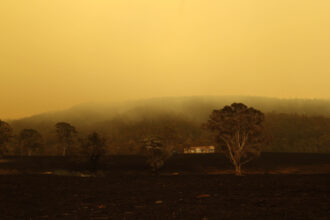
The evolution of the show was definitely more of a dialectic process. I’d worked at Anne Zahalka’s gallery Arc One in Melbourne, so I knew her photographic output focused on Australia, and then I discovered her digitally-altered archive images about the fires. I originally had Stephen Dupont in mind for his images of Papua New Guinea, but stumbled across his harrowing images on the Black Summer fires, of the land in flames and the resulting devastation. So from there climate change and the Anthropocene became a concrete thread, underscored by Sonia Payes and Katrin Koenning’s enigmatic images.
I’m glad, however, that the exhibition is in a region of the states where the majority of people might hold opposing views. My main intention, in particular during the past five years, has been to facilitate new dialogues while bringing international artists to countries where they haven’t exhibited before. It can be logistically challenging, but it’s worth it because creating exchanges is more rewarding than just placing works with a gallery. For Photo50 at London Art Fair in 2018, which I produced with my curatorial collective Hemera, I hauled four framed works by James Tylor and Laura Wills all the way from Australia: a very long journey for a few works! But I feel it’s my job as a curator to amplify and empower diverse voices. Inversely, I’ve brought many American and British artists over to Australia, and my next show in the Middle East will focus on America: the first exhibition to do so at the Jordan National Gallery of Fine Arts.
CM: How can viewers engage remotely with this exhibition, particularly those who are not in Florida or physically unable to see it in person?
AL: There will be a video walk through of the exhibition which will be narrated by Australian voice artist and actor Ming-Zhu Hii. It will be a really immersive way to see the show. We’re in the editing stages now and it should be online soon here: www.smponline.org/from-all-points
__________
From all Points of the Southern Sky: Photography from Australia and Oceania continues at the Southeast Museum of Photography, Daytona Beach, FL until 16th December 2020.
With thanks to Ashley Lumb for this interview.