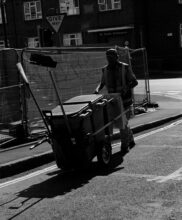
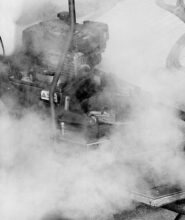
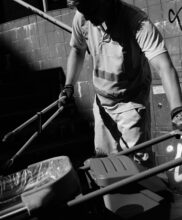
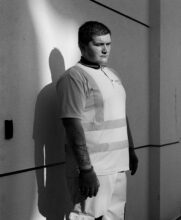
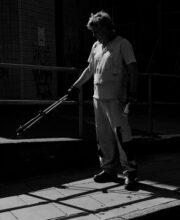
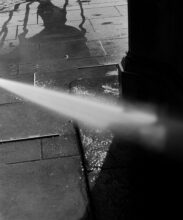
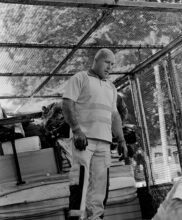
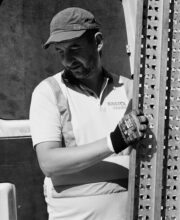
Created during the first COVID lockdown with the support of GRAIN, this photographic series from Chris Hoare will continue its relevance for many years to come. We are pleased to share this project along with a new interview, below, to delve further into Chris’s working practice then and now.
__________
Christiane Monarchi: Your series ‘Street Cleaners’ that you made with the support of GRAIN last summer moved me in its respectful power, focussing on the overlooked and underappreciated workforce on the streets during lockdown. Could you tell me about the genesis for the ideas in this project?
Chris Hoare: Thank you, I’m glad that they resonated in that way. The project began during the beginning of the first lockdown, whereby I was working throughout for Deliveroo on my push bike. It was of course a strange time, but also a very interesting time, particularly for a photographer – as I’m sure many would agree. Whilst working I would talk every now and then to street cleaners, who were of course working throughout this time. For a little while I’d been interested in the fact they provide such a vital job, yet they don’t get the credit they deserve and they are often invisible – despite wearing high-visibility clothing. With this in mind I decided to start approaching them for portraits and getting to know some of them. With the help of GRAIN, I was able to pursue this with more vigour than I perhaps would have done on my own accord.
CM: There is a compelling mix of observations in this portfolio; I like that some of the subjects share the space with you more readily than others. We are allowed to look as long as we like, certainly longer than we may do on the street. Working in street photography in lockdown must be a difficult proposition, could you share a bit about how you went about choosing and photographic the subjects?
CH: It took a bit of time for them to understand what I was doing, I wanted to get past doing ‘straight’ portraits and make images which in some way playing with the idea of visible/invisible – hopefully being more dynamic and interesting. But at the beginning I would make quite straight on portraits, so that I could evidence what I was doing in order to get others to agree for make to photograph them – giving them print each time. It isn’t easy to make portraits during lockdown, much of it is done on a trust basis and being respectful in the distance you photograph at, many would see me working for Deliveroo and I think that helped in terms of trust.
CM: In planning for this feature I had hoped to ask you what life is like for you post-Covid, but well, here we are, in this current winter lockdown, and I guess my question has become: how are you? How has your photographic practice evolved over the past year?
CH: Yeah right, it definitely feels like the worst of the lockdowns, like everyone else I can’t wait for it to be over. I’ve certainly been affected by it, but I’m fortunate enough to still be able to work and have work alongside being a photographer. During the duration of the pandemic I’ve been working on a long term commission for Bristol Photo Festival looking at allotments, so this has been a blessing, as it something that is safe given that it is all outdoors and on a personal level it has allowed me to enjoy the outdoors – allotments are beautiful places. The work is due to be released in the spring as a book to coincide with the festival.
This aside though, I have just coming out of having COVID myself, whereby my energy levels have been effected. Luckily though I am young enough to not have been effected too bad by it and I am starting to feel a sense of normality. My heart goes out to anyone effected by the disease, it feels very real when it is on your own doorstep.
CM: Could I ask about your working practice, do you work alone or involve others in your process? How did the award from GRAIN help you realise this series ?
CH: I almost always work alone really, but whenever I’m working with people it always feels like a collaboration and I’m always grateful for those who give themselves to being photographed. The award from GRAIN gave me the confidence to pursue the idea, it also helps when you have a deadline. This opportunity alongside my work with Bristol Photo Festival – which is a commission but as much so it’s a bursary in the way it’s shaped – has reminded me how useful it is to get funding for projects, as it can really help fuel ideas and help them develop. Most of my projects beforehand have been personal projects, self funded, which is fine to a degree, but obviously not sustainable – mostly.
CM: I’m very interested in allotments and can’t wait to see your new project come together with Bristol Photo Festival.
CH: Allotments are amazing, I’m blown away by how good they can be on so many levels, well being and just general quality of life. I’m waiting for spring to start growing some stuff, I can’t wait to get started. Thank you, I’ll be sure to share it with you!
___________
Chris Hoare is a photographer born in Bristol, 1989. It is is in his hometown where he continues to work, both as an image maker and in the gallery at the Martin Parr Foundation. In 2019 he completed an MA in Photography at University West of England.
His work has been recognised in recent years through a number of prestigious awards, most notably the Taylor Wessing Portrait Prize, whereby two of his portraits were exhibited at The National Portrait Gallery and in the same year he was selected by Paris Photo as part of their annual Carte Blanche award, being one of four students selected across Europe by the festival.
Within his personal work he is interested in areas of society that he feels are overlooked, interested in exploring themes of identity and place. He is increasingly drawn to ‘speculative documentary’, excited by the possibilities that come with telling visual stories in a loose metaphorical way.
For further viewing: chrishoare.org