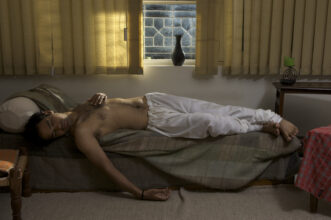
Sunil Gupta is a London based artist, writer and activist, whose work is instrumental in raising the visibility of the marginalised voice. For over forty years, he has dealt with the politics and representation working with themes of family, gender, migration, race and sexuality. He is a professorial research fellow at the University for the Creative Arts and is a founding member of Autograph-ABP. His work, Christopher Street (1976) was published by Stanley / Barker in 2018, was shown in Masculinities: Liberation Through Photography at the Barbican (July – August 2020) and is now showing in Berlin. This interview by Caroline Molloy coincides with the current exhibition at The Photographers’ Gallery, London, From Here to Eternity, a major retrospective bringing together Gupta’s divergent bodies of work.
__________
CM: To begin this interview, I wonder whether you can tell me about why and how you chose that title for this exhibition?
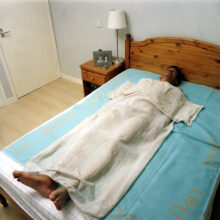
SG: The title draws from one of my bodies of work included in the exhibition, made in the late 90s in response to my HIV status – it was a kind of phototherapy. In fact, it also refers to a post-apocalyptic book and movie of the same name.
CM: The work at TPG spans 16 interconnected bodies of work, including black and white reportage style images, images and text, vernacular visual culture, moving image and performative images. What interests me about this work en-masse is how you have documented your life – your experience and how different visual strategies have been used to do this. It would be interesting for our readers to hear more about some of these strategies and the thinking behind them. Could you tell us a little bit about your early body of work, Christopher Street?
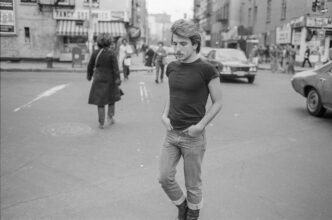
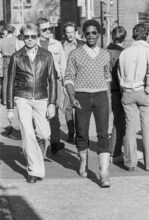
SG: I found myself in New York, which is where I first encountered the photography world. I spent all my free time going to the photo galleries in particular and catching up with the history of photography which was always on display in the New York museums. I met people in the business, and for the first time I realised that photography was more than just usage – it was actually about the work. I took some photography workshops with Lisette Model, Philippe Halsman and George Tice and found myself on the street taking photographs. Manhattan is famously different from street corner to street corner. My main focus became Christopher Street, I found myself frequently coming back because it was my tribe. I felt like the people on the street – I was young-ish and gay.
At the time I only made a few prints in my small apartment in New York. It is only now in the last few years that I’ve had time to think and reflect about this work and put it on my website, as well have a show at SepiaEye gallery, New York, 2014. Gregory Barker saw the work on my website and invited me to collate the work as a book. This was extraordinary to me, because no one ever asked me to make a book, usually it’s me asking to make a book. So, we made the book which got shortlisted for The Paris Photo–Aperture Foundation PhotoBook Awards in 2018 and completely sold out. The work was also picked up by the Hales Gallery in London – that’s how Christopher Street happened… Amidst all of this suddenly the fashion world became interested in the work. I didn’t expect that because it had never occurred to me what the people were wearing in those pictures. The designer for Helmut Lang, Thomas Cawson, liked the work, themed his autumn/winter 2020 collection around it, and invited me to come back to Christopher Street and shoot their collection.
CM: I’m interested in the strategies used in the image and text body of work, Exiles (1986), could you speak about why and how you made this body of work?
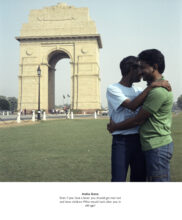
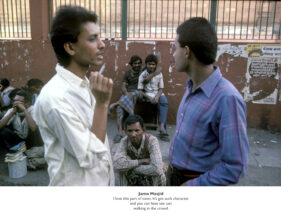
SG: It was a solution to a problem I was having on several levels. In 1986 the opportunity arose with The Photographers Gallery to go back to India to make work about gay Indian men in India. There were no pictures of them that I’d come across, I felt that we needed pictures of them. I went to the city of Delhi to try and find out what life was like for Indian gay men, and I discovered that it was so bad, they were completely invisible. Nobody spoke about it, nobody wanted to be photographed; the whole thing was a non-starter. It wasn’t like they weren’t there, they were very publicly there, meeting and cruising in places, so I could have done the reportage thing by hiding in a bush and leaping out at the right moment but then I thought that wouldn’t be very ethical – it’s my tribe.
In deciding the locations for the photographs, I looked at the history of photography. Delhi is full of ancient medieval monuments which are in fact the subject of 19th century British photography, there’s just no people in them. I got to populate it, with Exiles. I needed the cast to be gay men, I think there’s a certain truth in that and I made constructed pictures, so we didn’t see the faces of the participants – and I agreed to not to show the work in India. Having the text presents a wider range to the complexity of their lives, more than the pictures alone would have done. I think people in other cultures maybe forget, certainly from here [England], that people in other countries are under severe familial law and economic pressures, don’t have access to the kind of individual liberties that we have over here. That’s something that it’s a little hard to get across in a single still image sometimes, so then the text can be useful.
CM: I know that Exiles was then followed up and revisited more recently under a very different political climate. Returning to this work your method of documenting the gay community in India changed. Could you say a little bit about why you changed your visual strategy?
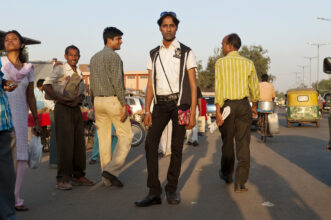
SG: There has been a great shift between the 80s and the 2000s, now everybody’s queer. I returned in mid 2000s and a bunch of activists came and did a series of film screenings as part of my exhibition project, and so I got to meet this new generation of LGBTQ. They felt less economically stressed and although being gay was still illegal in India they were very keen for change. They didn’t want to wait for it – they wanted it now and so they would have regular meetings about how to change this law in all major Indian cities. And so, I thought I’m going to start photographing these people, and they were very keen. They were just the opposite to Exiles, they wanted to be seen. I chose to make the portraits very vernacular. They were taken on a normal city street either near the home or work of the participant, basically I took a formal portrait of somebody in a public place – I enjoyed doing that. The other thing was in 2005, having missed gay liberation, India went straight to queer, so by the late 2000s, queer came out of academia – travelled from Yale to India and came out and hit the media and suddenly everyone was queer. I have men, also women, bi-sexual people, and what’s now becoming trans over here… all kinds of people not just gay men. I feel like I’ve lost my outsider status.
CM: In Trespass (1992 – 1995), you use image, text and vernacular visual culture. Can you tell me about why you adopted a very different visual strategy?
SG: I embarked on Trespass as a series of chapters, rather than fully formed little stories. It was 1991/1992 and it coincided with the advent of Apple computers and the first Apple scanner. I was an early adopter of computers – I thought wow, this is really liberating in a way because it does away with the negative/positive in the camera. I began to think of all kinds of potential source material working towards a final image. This included newspapers and stuff, it was just like our culture at the time, everybody was doing it to some extent. The first Trespass was a response to the 500th anniversary of Columbus. At the same time Thatcher was taking us into Europe, it was the opposite of Brexit – we did join, and for black people, for migrants it seemed like a threat. We were all here under a special dispensation, called the Commonwealth. I was either Indian, or Canadian and although I have certain extra privileges, I was anxious that once Europe became one, the Commonwealth would become nothing, and we would lose all our privileges. It was a worry.
I went to Germany, I took a little snap camera and I took all kinds of pictures of anything, all kinds of different things that interested me. It wasn’t just street photography; it was also little details in nooks and crannies. For example, I saw an exhibition, it featured an image of ‘The Eldorado’, one of the gay bars that the Nazis closed, I took notice of that. When I came back, I had this mass of pictures, book covers and newspaper articles to work with. I don’t think anyone had seen anything like this work, they were these low-res digital collages about snippets of all kinds of things. It was so different, it just kind of happened naturally. I then went on to make Trespass 2, which was about domestic life, so I brought the story in to the home; and then Trespass 3, a commission from Focal Point gallery and Essex County Council. I went back out to look again at points of entry into Britain, treating Essex as a kind of gateway into the country.
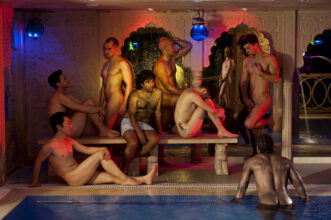
CM: The last piece of work I’d like to ask you about is The New Pre-Raphaelites. You use a very performative method in this work, could you talk to me a little bit about how this work came about and why this strategy was used to make this work?
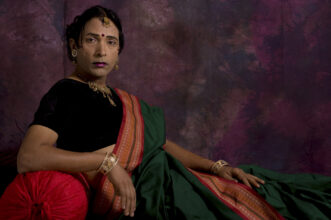
SG: Well, I’d wandered into a Pre-Raphaelite exhibition at the Tate Britain on one of my trips back to London and was struck by how surrounded by all these images in one room conjured up a kind of emotional feeling that reminded me very much of my young friends in Delhi. They were trying to break away from the social hypocrisies that surrounded them, so I made a kind of equivalence in my mind. I bought the catalogue and I worked from the pictures and I began to recreate some of the paintings using backdrops. I then cast it with the very same people I’d been shooting the portraits of. Sometimes the image was an exact replica of a painting and sometimes I referenced the style of painting. I was trying to capture that moment in Delhi, around 2009, when we had the first court judgement that was legalising homosexuality. It was a very charged time.
CM: We’ve discussed the construction and motivation of a number of your works. When I look at your divergent bodies of work across the galleries at The Photographers’ Gallery, I’m reminded of Jo Spence’s comment that, “the personal is political”. With that as a starting point, I wonder what it feels like to look back at your practice and see how your life plays out through your work?
SG: It was always about my personal life. I do think that over the years although I wanted to go out and make big social justice projects and have made a couple of attempts to do that, I always seemed to end up making work about my life. This was because of the lack of availability to situations or ethical considerations – like when I wanted to make something about gay men of colour or men with HIV in London in 1990, nobody would be in the project, because no one was comfortable to be exposed in that way. So inevitably it had to be me, I was the last one standing in front of a camera. I now work with whatever is around me now.
CM: As a closing comment I’d like to thank you for your time and for the candidness with which you’ve discussed your work and ask what advice would you offer to emerging artists who find themselves marginalised from hegemonic forms of representation?
SG: The worst thing is to do something because you think somebody out there is more interested in that thing than what you really want to do – never do that! My strategy has always been to keep going and keep making the work. Sometimes there were no exhibition outlets or very few, but then the work could suddenly become relevant. So just don’t stop doing it!
_______
- Jones, J. (1951) From Here to Eternity. United States: Charles Scribners Sons
- Spence, J. (1986) Putting myself in the picture: A political personal and photographic autobiography. London: Camden Press
From Here to Eternity is being shown at The Photographers’ Gallery October 9, 2020 – February 21, 2021. Please check the website for opening times.
With thanks to Caroline Molloy and Sunil Gupta for this interview