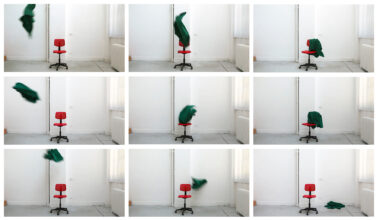
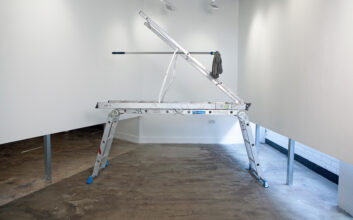

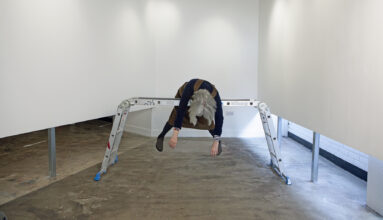


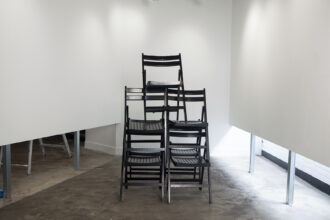
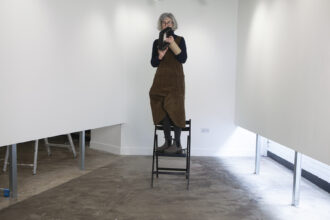

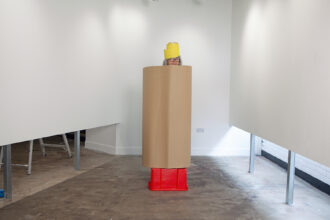
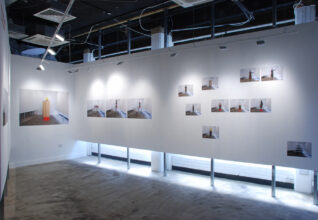
Sian Bonnell’s artistic practice aims to challenge our ideas around the nature of art and its subject-matter. Earlier this year, Photofusion presented Ten Seconds, a solo exhibition by Bonnell including work created during a short residency at the gallery a few weeks before. Working with available objects and spaces, Bonnell sees her camera as a “partner in crime – my provocateur; it dares me to do things. In this way it becomes a magical agent. Point a camera at any child, they will play up, show off, pull faces and adults will pose. All of this is performance, the camera demands it – and we are complicit.” We are grateful to the artist for sharing some images and ideas from these encounters here, and also to Katy Barron for taking us along on their conversation, below.
__________
Katy Barron: When we first began to think about the shape of an exhibition at Photofusion it became apparent that your three residencies at The British School in Rome (2011, 2014 and 2017) had a significant effect upon your work. It seems to me that being in Rome unlocked a part of yourself and enabled you to make work that was focussed on your interior space. What was it about being in that space, both the urban space and the studio space, more than once, that enabled your practise to move forwards?
Sian Bonnell: I think part of that was the distance, both physical and psychological and also because there was no expectation from the fellowship awards bodies on me to produce anything. It was literally time away from work and home, in for me, a completely new environment. I found it intoxicating being in a city, having lived in rural locations for the previous twenty years and suddenly being surrounded by such a richness, beauty and diversity of culture. I found the studio space to be the most amazing thing, it held a real latency of promise. That first year being there for three months, was a real gift – not only was I living in my studio but I had all that time to just engage with my work, a luxury I had not had for thirty years since art school. The environment of the BSR took me back to those art school days and I found myself conceptualising the studio as a transitional space, D.W. Winnicott’s potential space.
KB: I wanted to ask you to share a few thoughts about your preparatory process before you begin making a new work? I was delighted that you agreed to make a new body of work for Photofusion, in the knowledge that you only had two working days to do so. Many artists would never commit to such a challenge, and I would like to understand a little about how you prepared for the mini residency in terms of your thinking and how you managed to allow yourself to be creative under extreme pressure?
SB: That was so odd! I suddenly found myself saying that I would make something in the space in two days and then after realised just what I had committed to. I was a bit scared!
It has though, always been quite natural for me to make first and think after – if I think and plan too much beforehand, the work loses freshness and vitality. I did prepare in very practical ways. I made photographs of the space and walked around it a number of times to gauge a feel for it. I studied how it looked as it was. So, for instance the wedge shape led me to consider the costume – I deliberated a long time about what I might wear in that space. In the end, I chose my A line pinafore dress made of elephant corduroy, that resembled the A line shape of the space and the brown ridged texture of the floor. And that was the only preparation or thought I gave to it. I knew I would find objects lying around in the corridors and I just had to trust that they would help me make interesting pictures. It’s the extreme pressure that gives the work some kind of an edge, which is what I want to experience and explore; it was a real test of chance but then that follows the concepts of chance and adhocism that underpin much of what I have always done. I think, the space is always the most important thing here, if I know where I will be working and how I will negotiate it, then everything else follows. My work tends to result from asking this same question – what can one do in a space?
KB: I felt that the exhibition gallery at Photofusion was an unusually awkward space for curating exhibitions, and so it is well-suited to some of the themes that run through your work. Did you respond directly to the difficulties of the space, or did you choose to ignore it whilst making the work?
SB: I think I responded specifically to those very difficulties. And then found a way to highlight them by specifically making the lighting very theatrical – this is something I have never done before, having always worked in daylight where possible or available light.
KB: None of your previous bodies of work have been shown in the space in which they were made. I was very interested to present your work within the context of its creation as this would allow the audience to consider your working process more immediately. Do you feel that showing the work in this way has added a further layer to its meaning or perhaps I am being too ‘meta’?
SB: No, I don’t think you are. I was very excited to see how that would work! So I found it a wonderful opportunity to engage fully with the space both conceptually at the time of making and then contextually at the time of showing. Interestingly, the restrictions for the project fed into the work in the best possible way. The lack of budget meant that we had to work with the cheapest of materials – vinyl – but the vinyl suddenly became so intrinsic to the work and the space, it picked up perfectly, the anomalies of the actual walls and for me it became terribly exciting!
KB: You use yourself in so many ways within your work – as body, as jester, as prop, as woman etc. Please can you explain how you see your role as the subject of your photographs, and have you considered working with human subjects other than yourself?
SB: I don’t see myself as the subject in the photographs. My body is the performing object so it is not about me or my self. My body is available to me to work with and again, I use it to test out how it works within a space and also with the other objects that are performing with me. There’s no hierarchy in the images, the human element is equal to the vegetable or mineral one. I am reminded of a radio quiz that I heard as a child, where the participants had to guess if an object was animal, vegetable or mineral, I have never forgotten it! And yes, I have worked a number of times with human subjects that are not me – I made a body of work with art history and medical students, who all re-performed a series illustrations of medical procedures from a medieval surgical manual. The series was called ‘Imagining Medicine’. I suppose my role there was as director. Another time, I transformed my husband George into Karl Lagerfeld! Both of these projects are on my website.
KB: I am struck by the tension in your work, between the absurd and the serious and the questions that it raises about performance, sculpture and photography. Much of it seems to sit in a liminal space that falls in between, and I wonder if this tension and challenge is something that you are consciously seeking in your practice?
SB: Yes, I am pleased that you can see that in the work. This is something that has been central since making the series Groundings in the late nineties. It was around that time that when the work was shown, that I had been surprised by the audience response, which had been to laugh at the images. I had been deadly serious in making that work and had been thinking of land use and ecological issues, among other things related to motherhood and feminism. When people found the work funny, I was initially taken aback but decided that perhaps the humour was a way to better engage with the viewer and somehow draw them in. As long as the initial humour was subverted in some way so that the viewer was led to the edge, then for me that was when the images worked, exactly as you have described, in that liminal space between. I do seek that tension in the work.
KB: Ten Seconds is the first solo exhibition that you’ve had in London for a while, and I wonder if you feel that the photographic landscape has altered during the years that you were focussed on your academic teaching career?
SB: I’m not sure if I was so very focused on my academic life. I never stopped making my work, there were just fewer opportunities for showing it. Having said that, I think the photographic landscape has altered a fair bit over the last fifteen years. When I remember back to my beginnings over forty years ago, photography and other art disciplines were ghettoised. The things that I was trying to do making objects and sculpture specifically for the camera were not considered so acceptable. I find it very exciting to see how photography transgresses culture and all art forms today. And then I am so pleased to see that women have much more traction now, although it pains me a little that we have to be so often labelled as ‘women’ in the field – I do hope that will change before too long. Photography is certainly much more commonly acknowledged as an art form now and concepts that have always been accepted within the industry are now being examined and questioned for example, decolonisation and ethical implications – all of which I think is very welcome.
__________
Sian Bonnell is a UK based artist, living and working in West Yorkshire. Her work is concerned with concepts surrounding photography and its relations with objects, environment and performance. Her work has been exhibited and published widely and is held in many public and corporate collections notably, the Victoria and Albert Museum, the Museum of Fine Arts, Houston, Texas, the Ransom Center, Texas and the Bibliotheque Nationale, Paris. www.sianbonnell.com
Bonnell’s solo exhibition Ten Seconds was presented from 6th May – 10th June 2022 at Photofusion Gallery, London:
Katy Barron is a photography curator, mentor and advisor based in London. Katy has undertaken a myriad of roles within the field – from Senior Director at Michael Hoppen Gallery to Chair of the Board of Photofusion. She is currently employed by the Maud Sulter Estate in Glasgow and is helping other artists with issues around their estates and legacies. Katy has curated numerous photography exhibitions in the UK and abroad, mostly recently at Four Corners in Bethnal Green, St John’s College, Oxford as a part of the Photo Oxford festival.