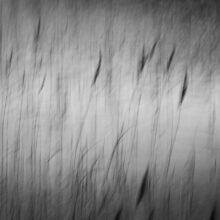
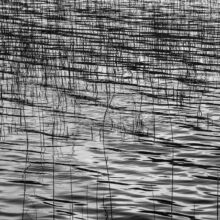
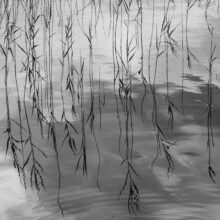
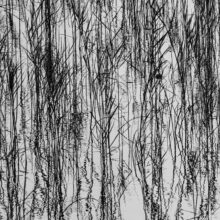
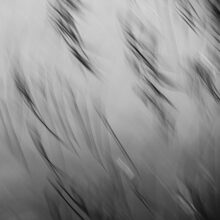
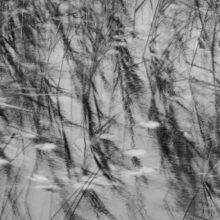
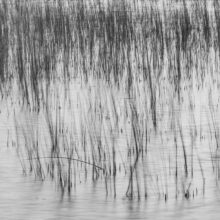
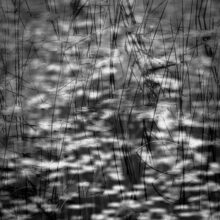
Alison Price is a photographer based on the Isle of Skye. We have not met in person, in this strange world we are in, but we have spoken onscreen and on email. Through sharing images, words and thoughts in this way, Price has been able to share with me some of the ideas she generates in her photographic practice, which can be loosely described as ‘landscape’, although not the kind I have previously been familiar with. Price is now working towards a practice-based PhD at Duncan of Jordanstone College of Art and Design, University of Dundee, and we recently exchanged thoughts on email below, about the generation of her recent works. I can’t wait to see these works in their physical form; for now we continue our conversation online and I enjoy carrying this essence of a landscape I have never visited, along in my thoughts.
__________
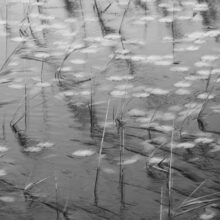
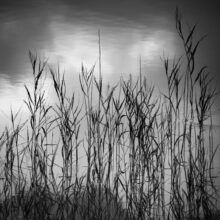
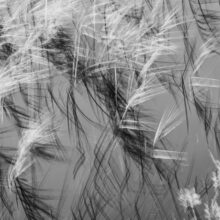
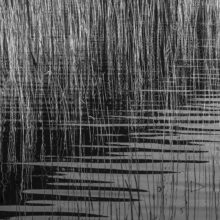
Christiane Monarchi: I am approaching your work on Skye as someone who has never visited this place, and I am delighted to immediately have my senses awakened. That these images in your series ‘The Ephemeral Hiddenness of Skye’ are created in B&W is an interesting place to start, as it allows an abstraction in form while also taking these images to an older possible time. Could you tell me a bit more about your decisions to photograph these watery reeds in monochrome palette?
Alison Price: Using a monochrome palette is a reductive strategy that I use a great deal in my work. In my view, presenting my images in black and white allows the viewer to be transported beyond sensory perception (and the super-saturated sweeping landscape images of Skye) to a sense of the essence, and to glimpse the ephemeral hiddenness of an Island that most people never see.
CM: If I were to conjure the feeling of Skye, I imagine blustery vistas, vast horizons and a feeling of the sublime. I am now looking for these emotions and reading the movement of the foreground, it’s all there in the concept with which I am now approaching these images. In this strange year, however, I am seeing all of these as small .jpegs on my screen. Could you describe for me your ideal image size and presentation, and what a physical encounter with your works would feel like?
AP: In terms of ‘The Ephemeral Hiddenness of Skye’ images, I produce these in square format. The reason for this is that I believe the square allows the viewer to dwell in the space and move around the image in a circular motion. This allows them the time and space to reflect on a different perspective of Skye.
The reeds are a metaphor for the Isle of Skye – they are fragile, slender, exposed and vulnerable and in winter they briefly succumb to the harsh climate– the gales and the rain and the intense cold that descends over Loch Cill Chriosd. But every spring they re-emerge, strong and resilient.
In terms of size, I produce my images at 40 x 40cm with a black frame 60 x 60cm. I also provide options at smaller framed sizes of 40 x40cm for commercial reasons. However, moving forward, I believe that the best viewing experience for my images is to produce them with floating frames of at least 60 x 60 cm. This will allow my audience to be immersed in my work and my world, not punctuated by a traditional frame, and to experience the reality of Skye.
CM: You are interested in working photographically throughout the year, could you tell me a bit more about your approach to the landscape and its seasonality, and what type of visual perception you wish to convey?
AP: I like to go out with my camera in all weathers and see my favoured locations and subjects at all times of the day, week, month and year. Like the Scottish writer Nan Shepherd, (The Living Mountain 1977) who spent her life learning to know and understand the Cairngorms, I like to spend time writing, watching, listening, smelling, tasting and reflecting on what I see. I believe that I become part of the landscape in a world of real objects. In terms of my photography, I think that a sensitivity and connection with the landscape is borne out of intense observation and engagement, developing a deep knowledge over time. Many visitors to Skye are overwhelmed by the beauty of the Island, and that is fine, but for me it is about a much deeper relationship.
CM: In this type of immersive process, living and breathing the landscape and its subjects within, has there been a time when something doesn’t quite work?
AP: Yes, I think this is inevitable in any creative pursuit. My practice involves many failures.
Mihaly Csikszentmihalyi speaks of the concept of losing oneself in creativity as ‘flow’. For me, it is when a number of things come together in terms of what nature has to offer on a particular day, how I am feeling, whether I feel at one with my camera and whether I am able to glimpse the ephemeral hiddenness. This combination allows me to drift into a state where conscious awareness is lost to one akin to a form of day-dreaming. I can often lose track of time and the sense of connection with the external world! On other occasions, I know almost immediately that today is not my day, and my images reflect this lack of complete engagement with nature.
CM: How does language best accompany your visual explorations, in order to convey to a viewer an experience?
AP: In terms of presenting my images, I have considered accompanying them with my own words or that of, for example, a poet. However, I have always decided to allow the images to speak for themselves and for the viewer to interpret in any way they see fit. Having said that, I regularly combine the production of images and my words on my blog. I normally write three or four blogs a week about my practice, the images I have taken and also about the academic research I undertake as part of a PhD at the University of Dundee.
CM: In your research, you will have learned about artists and photographers who have gone before, and of those, some whose practice you value and others who inspire you less. Are there artists and photographers specific to your chosen location of Skye whom you look at, either contemporary or historical?
AP: The inspirations and influences of my work are broad and range from photographers and artists to writers, poets and sculptors. I spoke earlier in our conversation about the influence of Nan Shepherd, a twentieth-century Scottish writer and I have also been inspired by Robert Macfarlane’s Wild Places (2007) and Roger Deakin’s Wildwood (2008) for their compelling and meticulous observations of nature.
In terms of photographers, I find inspiration in a number of ways, and not necessarily for a similarity in their subject matter or location. I am a great admirer of Awoiska van der Molen whose search for wild places and isolation is similar to my own and her recent book shares the name and search for being of Nan Shepherd’s The Living Mountain. Sandra Bartocha, the contemporary German photographer, also influences my work, not just in terms of the similarity of techniques, but also for her careful attention to small elements of the natural world and her ability to capture perfect natural lighting conditions in her images.
In terms of aesthetics and the search for an impression rather than representation, it will come as no surprise that my inspiration lies in the artwork of J M W Turner, Monet and other impressionist painters. Monet spent many years painting the gardens and countryside around Giverny preferring to stay in the same place rather than choosing different locations for his artistic inspiration and Turner famously strapped himself to the top of the mast of a boat to experience a storm at sea!
CM: Is it important to you to consider the ecosystem and environmental balance within your subjects? By this I mean, is there a hidden message of imbalance or damage as well as sublime beauty?
AP: I do not have an explicit message to convey about the environment although in practice my work represents the often-overlooked beauties of nature – the lone tree or the reeds on a tiny loch. I am drawn to the metaphorical stories that these elements tell about the vulnerability, fragility and sustainability of an island community. However, it is difficult to ignore (living on the Isle of Skye) and as I work in the field, the increasing number of visitors, compared to the Island’s capacity to provide the infrastructure and services to support them during their stay. It leads to the conclusion that as tourists seek more wild and isolated places to visit, how much longer will any of these locations survive as such?
__________
About the artist:
Alison Price is a photographer based on the Isle of Skye, part of the Inner Hebrides, off the north-west coast of Scotland. With a first degree in History and an MA in Photography with Distinction (2020) from Falmouth University she is now working towards a practice-based PhD at Duncan of Jordanstone College of Art and Design, University of Dundee.
She was awarded a Fellowship of the Royal Society of Arts in 2005. Her wildlife photography was recognised with a Licentiate of the Royal Photographic Society in 2011 and an Associate (Professional & Applied) in 2012. She was short-listed for the Outdoor Photographer of the Year and Wildlife Photographer of the Year in 2011. More recently, Alison has turned her attentions to nature searching for the Ephemeral Hiddenness of Skye.
Links:
The Ephemeral Hiddenness of Skye