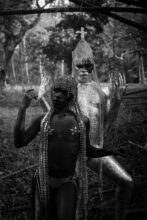
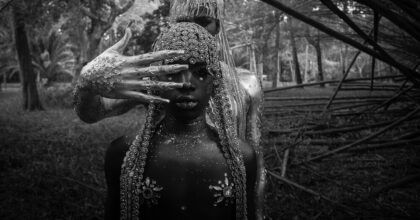
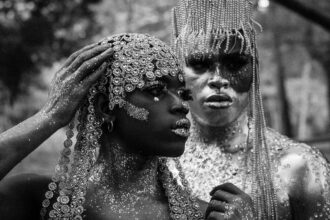
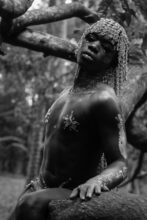
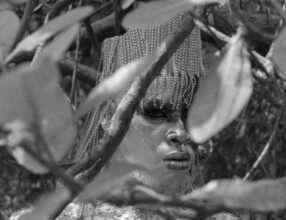
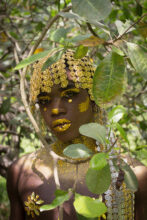
Ngadi Smart is an artist who focuses on documenting cultures, subcultures and intimacy; her work is motivated by the representation of minorities, highlighting cultural identity and racial discrimination, as well as feminism and gender roles. With her recent photographic project “The Queens of Babi”, Smart explores self-identify and expression among members of the drag community in Abidjan, Côte d’Ivoire in this ethereal portraiture series.
__________
Christiane Monarchi: I am really enjoying looking at your recent series, The Queens of Babi, and it has so many different layers I’d like to explore with you. Could you tell me a little bit more about how you came to start this project in Abidjan, and what first sparked your interest?
Ngadi Smart: In early 2020, I shot Kesse Ane Assande Elvis Presley, or simply coined as “Britney Spears” by her friends, along with “Venus King Kong, aka “Baba” for a new personal series entitled “The Queens of Babi”. The series was created after meeting and talking with the members of Abidjan’s drag community, and discussing how to highlight their talent and creative passions. For a duration of two years, until 2018, members of the drag community in Abidjan would meet discreetly in an undisclosed bar to attend drag themed events, where they would parade and show off their finest creations to each other and members of a jury. A winner would be picked at the end of each event. The group has now disbanded due to adversities, but their desires to create and self-express remains.
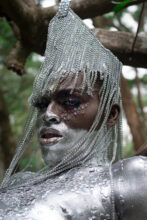
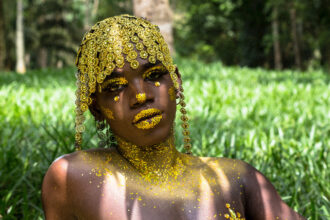
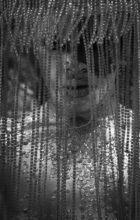
I chose to highlight the only two winners of these competitions, as after talking to them, their personalities just stood out to me. What came out of this were outfits that were made, fittingly, under the theme of royalty. All creations were imagined by themselves and crafted from scratch, which was amazing to watch as I received their photo and video updates. Both have ambitions that reach beyond drag. Britney wants to be a model and an actress, be an international drag queen, have her own life and freedom to do what she wants, and most importantly, be proud of the life she leads. Baba would like to own a fashion company, start a family and work in the entertainment industry. Regular desires, that would normally be attainable to any person whose gender and identity would be deemed “acceptable” to carry these out within society’s confines. Both are also aware of the difficulties of work such as this in Côte d’Ivoire – from the costs, to finding a tailor who would agree to work on their outfits, and premises that would host them without fear of backlash. All these remarks sadly point to the elephant in the room: The culture of drag and LGBTQ identity is still not as readily accepted within the confines of modern African society. Baba quotes, in addition: “People need to understand that drag is art and they need to start giving us the respect and credit we deserve.”
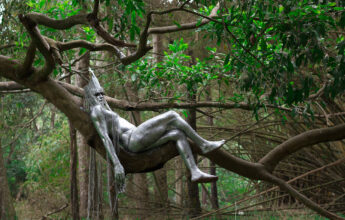
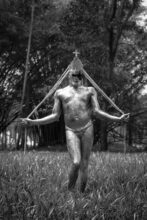
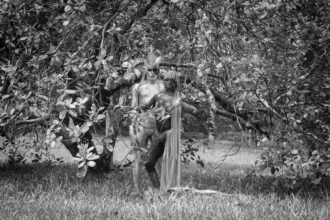
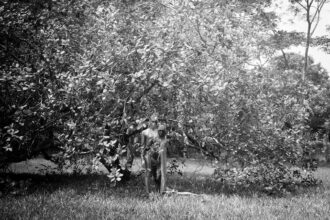
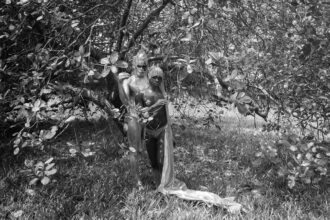
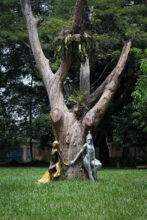
CM: I’m responding to your subjects’ very performative poses and physical transformations set in what looks like private woodland. It offers a possible reading of these subjects being some kind of sprites or spirits, glinting in the hidden sunshine, part of the natural world or even supernatural. How did the collaboration progress with the subjects in your photos, in terms of location and composition?
NS: I chose to shoot both Baba and Britney in the botanical garden of Bingerville (which is a suburb of Abidjan), as I thought using the backdrop of unrestricted nature would compliment their wild outfit choices. I directed both a little but there was not much need as they were they are both very confident and sure of themselves enough to suggest certain poses or shots they wanted to try out. It’s funny you mention them looking similar to sprites or spirits, as Baba has mentioned previously designing costumes inspired by the goddess Oshu, who is the goddess of fertility and an African “fairy”, and Britney has also mentioned a previous creation inspired by African mysticism. It could be that their subconscious from previous designs had an influence on this shoot. We chose to design with the theme of royalty, so the goal of the shoot was also to go with a huge majestic feel.
CM: Coming out of lockdown, these images are a real awakening to spend time with. Your way of photographing has let the viewer in, welcoming a lingering gaze. It is something I notice among your other series, across photography and illustration, the idea of slowing the eye down to look ‘all over’ and really engage in all corners of an image. Could you tell me how you know when an image feels finished, feels right to you?
NS: Thank you! That is really lovely to hear. It’s a very subjective choice, so it’s unlikely my own experience will be similar or relatable to another person’s, but what I can say is the more you shoot, the more you will be aware of your limits and capabilities, the more you figure out what you like or don’t like. The more I do it, I find ideas can form faster and more effectively, so that the end goals for the shoot will be clearer.
CM: Considering the pandemic and everyone’s locked down, private lives at the moment, with the world ready to open up again soon and venture out, I am thinking about the idea of drag performance being very much a public-facing idea, which relishes an audience. What would be your ultimate goal for the visibility of your images, and their message, and the audiences they reach?
NS: I would say the ultimate goal for me would be to get anyone to question everything they never have before, change their perception, change views on LGBTQ in West Africa. I plan to do this with new photos following up this first series, which will hopefully delve into the community’s lives.
I would like to add that of the 76 countries that still criminalise same-sex relationships and behaviour, 38 are African. Recent surveys also show that the overwhelming majority of people who live in Africa strongly disapprove of homosexuality. The reporting of LGBTQ communities in Franco-African societies is not readily and commonly published. One of the particularities in West Africa is that LGBTQ mobilizing at the community level is relatively new. In Abidjan, there are no real LGBTQ organisations and the members I photographed told me they were often unable to go into certain neighbourhoods for fear of being assaulted, or losing their life.
Through my photography, I want to change Africans’ perception of the community by sharing their stories, as they reflect true human rights issues. I self-funded the photo shoot myself, as this is a cause that is important. I just believe that their stories have to be shared, and I want to be able to share their story well, keep shooting more of the community, in different environments, including their daily life in order to have a more well-rounded representation of an African LGBTQ community. Also, I’d like to support them in their endeavours to better their life, including future possibilities such as setting up an LGBTQ association for them.
__________
Ngadi Smart is a Sierra Leonean Visual Artist and Designer based between London, U.K and Abidjan, Côte d’Ivoire. Her practice comprises of Illustration, Photography and Design. She also works as a Mixed Media artist, primarily in the form of collage art.
In her Illustration work, she is motivated by the representation of minorities, highlighting cultural identity and racial discrimination, as well as themes on Feminism and gender roles. She likes to deconstruct mainstream society’s preconceived views of what the definitions of “normal”, “beautiful”, and “right” are. She has illustrated for The Atlantic, Time Out London, Eastpak, The Guardian, as well as for publishing houses such as Penguin’s Riverhead Books in NYC and London’s Faber’s Children.
In her Photography, her focus is documenting cultures, subcultures and intimacy. Her work often speaks on how people self-identify and choose to present themselves in front of the lens. Recently, she has also been interested in documenting Black sensuality and culture from an African point of view. She aims to show as many representations of African people, and what it means to be African as she can. Her photography has been published on CNN, British Journal of Photography, Vogue Italia, Atmos Magazine, and I.D Magazine.
For further viewing: ngadismart.com