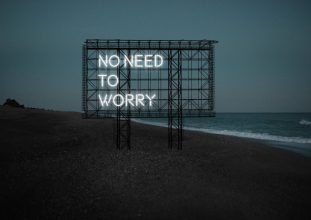
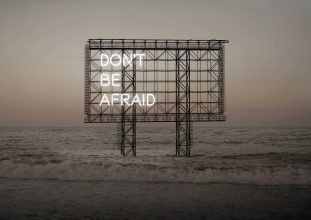
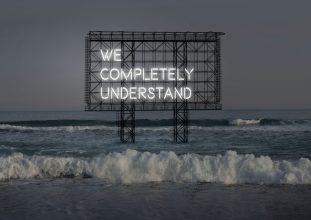
Giorgiana Pallamara is a photographic artist based in London whose recent compositions engage with current events in her hometown in Italy, which continues to witness significant immigration and its legacy. Her recent series ‘Traces’ was awarded a Photomonitor commendation at her graduation from UCA Rochester last year; below Christiane Monarchi asked Pallamara for some of the background to these tableaux connecting facets of reality across different media.
__________
CM: I’m looking at your series of images ‘Traces’ that you made last year, and would like to know a bit more about your thoughts behind these. I was instantly drawn into the idyllic beach view, but blocked by the menacing placement of a sign. If I didn’t know English, the image of this neon phrase in the water would seem to be a warning or ‘do not go’ type of message. Instead, we have these quite banal, soothing phrases that one may say without much drama, especially to children. Could you tell me more about your thoughts behind the words on your signs?
GP: The visual project I created embodies a very current thematic, explained through very subtle elements. My intention was to show the immigration phenomenon, seen from my point of view, in my little town in the south of Italy and the story of these people coming from the sea. The story I am telling here has to be seen from a different point of view, which is the specific one of language.
The idea of wanting to explore this side of the project came up because language can be a powerful tool. It is seen as a “pharmakon”, which in Greek can mean remedy or poison. Language then becomes the two faces of the same coin, having a dual effect: although “nicely” put, it can conceal and deceive at the same time. The aesthetic of the images represents this dual effect through means of technique and visuals as well.
As you stated, there is this idyllic landscape and suddenly the shock of a billboard and a neon sign. Both of these objects are there to attract one’s attention to these subtle messages, which are quite straightforward. The first reaction I wanted from these images was to make people stop, because they would be seen as a kind of warning. Once moving the attention to the actual meaning of the phrases, someone would say they are harmless and quite normal to hear; the point is the context in which they are said and what consequences they can lead to, especially in the case of these people searching for a new start, who leave their land to pursue their idea of happiness, safety and wellbeing. They are unaware of what dangers the journey will take them to; they are scared, but reassured by people who may just be seeing a benefit behind this action. Not everyone who helps has good intentions.
The title “Traces” in fact, refers to the ones left by someone, somehow: by saying a word with indifference or referring to a mistake about a decision taken based on other people’s reassurances. Therefore, the banal/warning duality expressed through visual elements such as the billboard and the neon phrases are meant to raise awareness in the viewers.
CM: Are we allowed to consider the continual arrival of migrants who may be landing on European coastlines? I am also thinking of the recent tragedies involving migrants who didn’t make it, or those who were detained on their arrival after their harrowing voyages. Have you had experienced these places yourself?
GP: I created this project in a moment during which the arrival of immigrants was starting to be kept in “control”. The new political measures have seen lots of immigrants waiting in foreign waters for an “Ok” from politicians of our State, just to be granted the opportunity to land on the coasts and start living their lives. These people coming from lands such as Libya, Algeria, Tunisia, Morocco, Ethiopia, Jerusalem, Afghanistan and so on, started arriving to our Mediterranean coasts at the beginning of 1990. The first disembarkment that took place on our coasts, in Calabria, was in 1989 and the people came from Kurdistan. In the South of Italy we had the opportunity to create small villages where they were given medical help, safety, accommodation and food. Even though the majority of immigrants were just passing through our small towns, as some of them were waiting to go to Germany or to the North of Italy for example, most of them stopped in the South in the end, as they saw the hospitality of the inhabitants. Not only that, but they probably felt at home because of the resemblance with their homeland. We have vast lowlands, mountains, the sea but the climate and the food are the most favorable ones. They were given a job where they could earn money, working in farms, carpentries, looking after the cattle, working in small crafts shops, bringing their tradition in our land and integrating in our community. Both children and adults were offered education by going to schools and and learning the language as well.
It’s been like this for years and years and it is quite sad seeing that they are trying to put a stop to it. I had the chance to meet quite a few people coming from these countries, with different stories to tell and moments to share. I remember that I assisted at a disembarkment in 2014 where I wanted to take pictures for the local newspaper; I was 18 years old then and I couldn’t do it. Just seeing with which kind of ship they managed to get to our coasts, which was all shattered at that point, seeing the shock and the tiredness on their faces: all this stopped me from taking pictures. In that moment there was just space for humanity. Some of them do not make it during the journey by sea, some children are born in foreign waters and some other acts of violence happen throughout the journey. Before starting this trip, they are not aware of all these things that might happen.
This is the reason why, through my experience, I wanted to “document” what happens at a more intimate and hidden level, in a very different way from the traditional documentary. It is true that there is more to this than meets the eye.
CM: Could you tell me more about the construction of the image, after some visual interrogation it appears an incongruous scene to have this sign on a calm, wavy beach. How did you decide on this composition?
GP: The aesthetic of the body of work wants to represent the current century, as I introduced elements such as neon signs, which have been used as an element of artistic practice to convey various meanings. Digital manipulation has been the basis of this project, as the pictures are representing something that hasn’t been there before. I photographed the sea of my hometown, which is the Ionian Sea, and then added these new elements. The use of the billboard and neon sign was a mix, due to the fact that both of them are built to attract someone’s attention; the billboard is made for advertisements and the neon sign is made to say something. I started playing with them and liked the result.
The composition showing a calm scenario with an unexpected object placed within it underlines the idea that simple and straightforward things might hold a deeper meaning, such as the weight we should give to spoken words.
This project can be read as a whole, but also as individual pieces, which anyone of us can relate to. The choice of digitally manipulating through Photoshop was made because I think that intervening physically on the pictures they may be transformed to deliver a question for the viewers, who may ask themselves: “Why is the image being corrupted?” Therefore, the composition of this series of images was made in order to shape a reality in which viewers could be immersed in the moment created by all these elements, giving the impression of experiencing these landscapes just by looking at the pictures.
CM: Since making these works, have you felt the shift of immigration in your town grow or subside?
GP: After the orders given by politicians, the immigration phenomenon started subsiding as disembarkments were denied on our coasts. That meant that ships carrying people could not enter our borders or come to land, having to navigate in deep waters for more days, waiting for other nearby countries to grant them access. By giving this type of orders, Italy is putting a mark onto 21st century history, where instead of progress there is a strong regression of culture and more importantly, of humanity. The “Traces” project had been created before all of this happened, assuming more weight and importance with all these events taking place. Nonetheless, I still feel that this phenomenon will never totally subside, as it is a natural “movement” that has always existed since the times of Neanderthalism, where the concept of immigration didn’t exist as an explanation, but just as an action. Movement is in fact the most natural instinct for survival and growth, as all the pages of history have shown us throughout the ages. Moreover, just like the waves break and follow one another endlessly, the immigration phenomenon will continue in the same way, as we will always want to pursue our own idea of a better life.
CM: Are there new phrases that come to mind in these days or new borders you would think of exploring? Is the series complete in your mind?
With the phenomenon of immigration being at the centre of daily news, I have grown to the idea of giving to the “Traces” project a more developed narrative. The first three images of the series mark the first section of this bigger project, which we could see as a book with chapters. As a matter of fact, I would like to explore the concept of immigration in the big cities, as a second part of the project. Trying to create this narrative is important in order to be able to see the contrast between remote places such as the sea – where everything takes origin – and places we live in everyday – where this phenomenon unfolds, as part of the 21st century.
Even though some events appear to be distant, we realize that we are part of them in the end, today more than ever. I am based in London at the moment and it is here that I intend to continue this project, due to its multicultural society and integration, a phenomenon that happens everyday and that has made this city what it is today. Through analyzing things, we realize that the “outside”, the distant and uncanny is part of the “inside”, which is what we constantly experience and it is familiar to us.
With regards to the phrases I am going to use, I am not sure yet; they will still have a dual connotation though, in order to represent the modern society which is based on appearances, by holding diverse meanings.
CM: What are you working on now?
GP: There are different ideas on hold at the moment, as I am still interested in exploring the important thematic I have already explained with the “Traces” project. I would like to develop the next chapter according to the first one, as they are strictly linked. The project, once finished, will need to be read as a whole, where the meaning will unfold through each and individual image. As this project is still on its way, I think I will concentrate on this, trying to see if there will be space to develop other ones in the meanwhile. The problem is that I think projects are a never-ending circle; there is always something more to add.
__________
For further viewing please visit Giorgiana Pallamara’s website