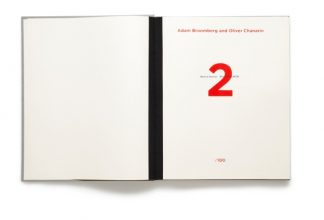
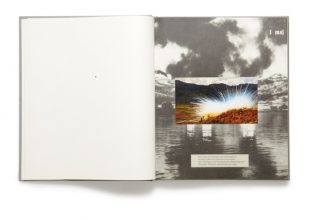
Adam Broomberg and Oliver Chanarin are artists living and working in London. Together they have published nine monographs and have had numerous international exhibitions including The Gwangju Biennale, the Stedelijk Museum, the International Center of Photography, KW Institute for Contemporary Art, The Photographers’ Gallery and Mathaf Arab Museum of Modern Art. Broomberg and Chanarin teach at the Zurich University of the Arts and are Visiting Fellows at the University of the Arts London. Their work is represented in major public and private collections including Tate Modern, the Stedelijk Museum, Victoria and Albert Museum, Musee de l’Elysee and the International Center of Photography. Most recently they have been shortlisted for the 2013 Deutsche Börse Photography Prize for their collaborative publication War Primer 2, (2012 MACK) and their work will be on view at The Photographers’ Gallery 19 April – 30 June 2013.
Emilia Terracciano recently interviewed Adam Broomberg about war, Bertold Brecht, and the inspiration behind creating War Primer 2.
———-
Emilia Terracciano: A number of years ago you were part of the jury of the World Press Photo awards. What was that like and how does it feel to be on the other side?
Adam Broomberg: That experience really led me to understand the world of photojournalism as an industry. You could see how photo-editors work with photographers and how ultimately their commissions answer advertisers’ needs. You just see the whole machine at work and the World Press Photo awards as a business model.
ET: Yet the art world could be considered another type of industry in itself. How does being an artist-photographer differ from being a photojournalist?
AB: Photographs function as commodities in both worlds. But I think that the realm of photojournalism works very much in a public space, it’s almost like public art, if you think of a public sculpture commissioned by the state or by big capital, like banks, it has to meet certain criteria and not be too critical, not be too offensive. Photojournalism functions in that same sphere compromised by the landscape in which it operates. It can’t be too critical or too confrontational. It became very clear to us that when operating in a traditional photojournalistic mode, you could not be radical in your gestures. The art world by contrast, operates outside of this public space. It offers a context in which it is easier to be more critical.
ET: Could you tell me a little bit about your project War Primer 2?
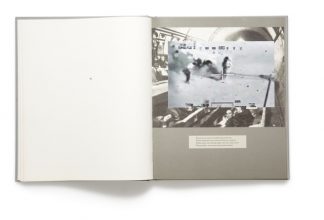
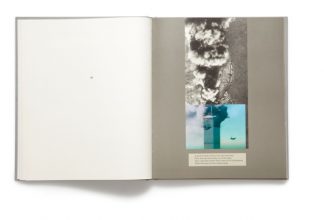
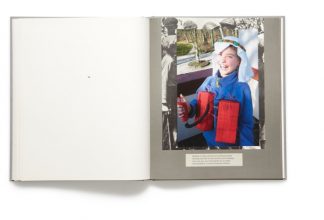
AB: We were very curious and intrigued by Bertolt Brecht’s War Primer. The book was sitting around our studio for years and years. Essentially Brecht began the War Primer in the twenties and thirties. Brecht was famously very cynical and sceptical of press images. While in exile, from Scandinavia through to the US, he started cutting out images that he found in the newspapers. Then he would write a quatrain, a four-line poem that would, he hoped, help either decode or complicate the image. In the German version of War Primer, which was published in 1955, Brecht inserted a quote where he states that he thought of these images almost as hieroglyphics in need of decoding. Our project hijacks Brecht’s original. We pasted and silk-screened directly into the original book.
ET: Brecht sought to complicate the relationship between image and caption?
AB: Yes. I think he was not trying to provide a simple solution to the image. Often the relationship needed to be complicated because it was offering a simple solution in the press. He was complicating it when it was over-simplified and simplifying it when it was over-complicated. At the same time, he was also very direct when an image opposed his politics.
ET: How does your War Primer 2 echo this Brechtian desire to demystify press images?
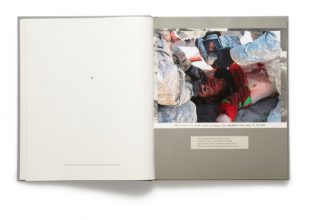
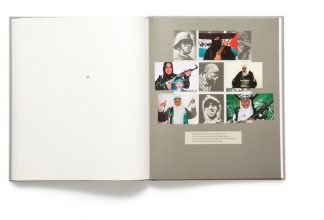
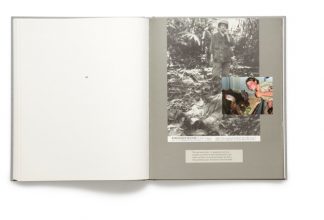
AB: Brecht had analysed primarily WWII and was working mainly from the mainstream media because that was all he had to work from. And we were thinking what an interesting comparison it would make to focus on the so-called War on Terror. First of all, how images are disseminated now as opposed to then, so the book is partly an analysis of that. Brecht had access to newspapers. We have access to all these different media, including the Internet. Secondly, the War Primer 2 is an analysis of how the War on Terror was imaged as opposed to WWII, which was primarily represented by professional photographers who were not necessarily embedded but who had access to the war…like Capa’s famous D-Day images. The meta-narrative of the War Primer 2 is an examination of these new ways of imaging war. For example, there is an image of an American soldier using a biometric camera, taking a reading of a dead man’s iris. In another, there is a picture of a bunch of photojournalists taking a picture of a dead body in Haiti, which has become almost a genre in itself. We used Brecht’s poems as a kind of Google filter. We would try and figure what he was trying to get at, summarise it, and then almost punch that in to see what images came up.
ET: You focused on images from the web.
AB: Well, a few years ago, we began with one researcher only who spent about three months in the Sunday Times archives going through the Broadsheets. So we started very much like Brecht, taking pictures from newspaper cuttings and pasting them, but then we took Brecht’s own advice. There is a famous Brecht quote “Don’t start with the good old things but start with the bad new ones.” We thought this process was ludicrous. If Brecht were alive today he would be scouring the Internet, he would not be sitting in a library. So that’s what we did and we assembled a team and went through the main themes and then started pooling literally thousands of images.
ET: So you kept all Brecht’s quatrains but changed the images.
AB: Yes, we did keep his quatrains but often also his images too. And what we’ve done at the back is to silkscreen the source and the website address from where the image comes from. Often what is intriguing is to see how the same image is used for different purposes on different websites.
ET: The images you select are often pixelated and cheap in appearance. There is an equation being made here between poor image quality and truth?
AB: Absolutely, we celebrate that. I think that’s also about the notion that the so-called poor image, the low-res image somehow represents the truth. In the sixties if an image was in black-and-white it suggested the truth. But nowadays it’s more like the lower the resolution, the more it implies a speed of transfer…a compromise of quality over accessibility and immediacy.
ET: How far would you describe these images as collages?
AB: Each of them is different. Some of them are quite formal. See how for example that face of a woman joins that of another. So some of them are very formal insofar as we’ve used strategies of collage where they’ll fit into the space prescribed by Brecht’s image. In other cases, it totally obscures it.
ET: So you’re betraying Brecht to estrange him…
AB: We saw this as much as a kind of betrayal of Brecht as well as homage. There is this famous quote by Heiner Müller if you don’t change or mess with Brecht then you are doing him a dishonour. Brecht thought very much in terms of “laying bare the device” and showing the mechanisms at work. He never tried to seduce someone. The poetic equivalent would be how he would avoid any use of lyricism yet still be able to sneak some in. And I think this project still does something like this.
ET: It pushes and pulls you.
AB: Yes, there is never a kind of formal fit. It’s never that pretty or ugly enough to totally…There are too many layers and so you can’t really read it in one simple, quick way. It demands too much of your time to have an instant emotional response. So in this case, it’s less a formal comparison but also it’s a way of saying it was new then and it is new now. And then both images, Brecht’s original and our superimposed ones are actually responding to the text in a very important way. Both are very relevant in those terms. It’s amazing to see how the quatrains still feel so contemporary. It is incredible how he can draw an entire century and compact it into four lines. Or sometimes he uses all four lines to describe one tiny little moment of history.
ET: Unlike the photographs?
AB: Perhaps, because images date much faster…You get the feeling that in another fifty years time you could use the same quatrains and they would still be relevant. And that in a way is a sad testimony to the state of the world we are in really. Brecht was all about change. There’s that beautiful line of his….“What is the good of a poem that cannot stop a tank.”
ET: So are you following Brecht’s pedagogical attempt to re-train the human eye?
AB: Yes, but Brecht was also a troublemaker.
ET: With a hopeless vision of humanity?
AB: No. There is definitely hope. If you look at the last picture where it says: “Never forget that men like you got hurt . That you might sit here, not the other lot. And now don’t shut your eyes, and don’t desert. But learn to learn, and try to learn for what.”
ET: It is a plea. Yet, a strong sense of retrospection seems to animate your project.
AB: Yes, but isn’t every gesture? The plea is for the future. There is hope through learning. ‘Fitting in’ is part of the syllabus at school as well as learning how to be a good citizen. But to belong to what society? That’s never taught. We are told that war is necessary but for whom? That was Brecht’s constant struggle and all those questions are for us still totally relevant.
———-
For more reading:
Adam Broomberg and Oliver Chanarin’s website www.choppedliver.info